Category Archives: Uncategorized

Cecil Report

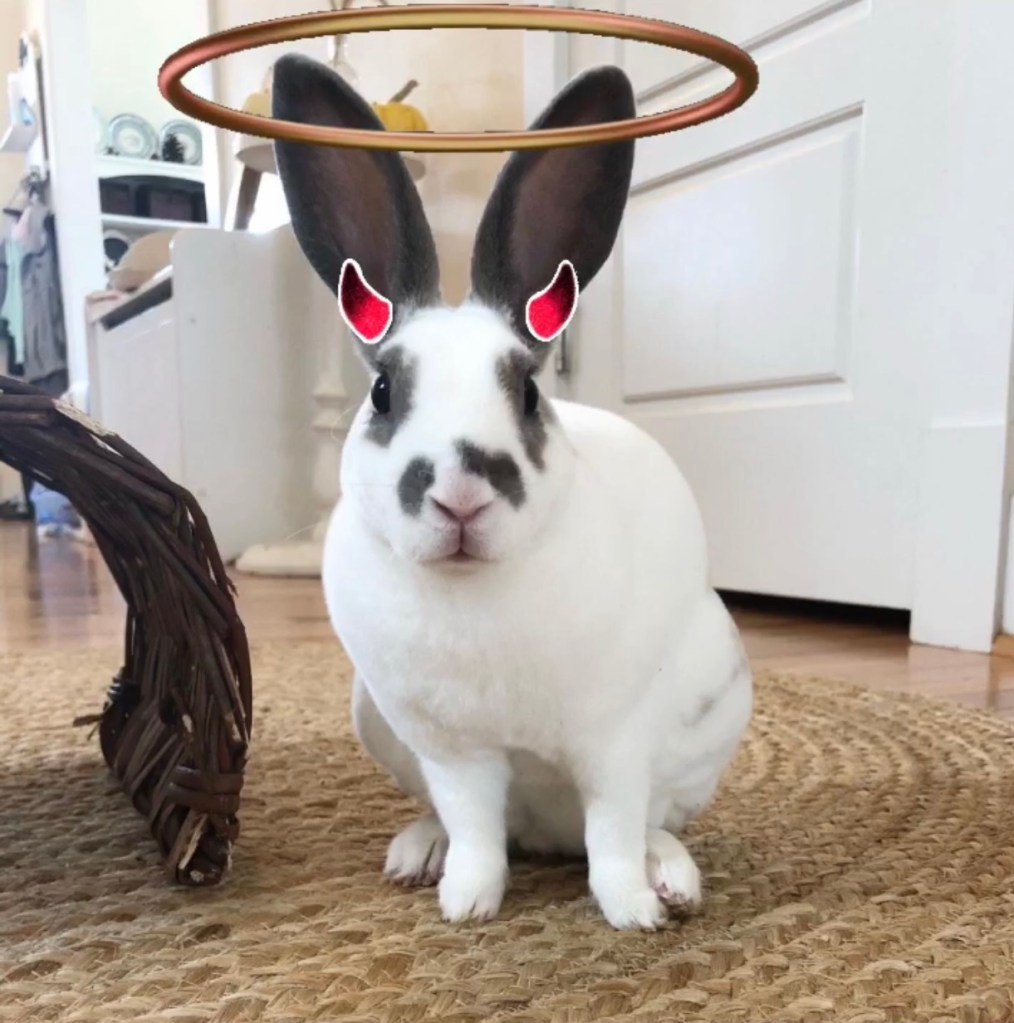
It’s been two months since we settled on the name Cecil for this new pet bunny of ours. Every afternoon when I collect the kids from school, they ask for a “Cecil Report” from me, as most days I’m home with him from dawn ’til the time I head to the pickup line. (They do this by singing “Cecil Report” to the tune of the “Creature Report” jingle from the show “Octonauts”, in case you’re familiar with it. I plan to explain to them that this is a play on “Bleacher Report” as soon as I have a better idea of what that actually is.) Many days, my report centers on his conniving antics in and around our home. The thing about Cecil is that he’s so smart and determined that often I find myself wondering who is training whom over here.

It started with the air vents in the floor. He loved to luxuriate on top of them while the air conditioning blasted through the swelter of August, which was really cute. EXCEPT. Something about the sensation triggered his system to release, and we began noticing deposits made right near the vents. So we closed the vents to prevent anything untoward finding its way into our duct system and began shooing him away from those areas whenever he bounded near them after enjoying some food. We got in the habit of nervously glancing at the vents whenever we didn’t have Cecil in a direct line of sight to ensure that he wasn’t slipping through the cracks of our training, so to speak. Next he became fixated on getting to the wires behind the TV cabinet, so I blocked off access to those. Then he discovered that he could leap onto the living room sofa, and what delight ensued! So much hopping and skittering, which we also thought was cute. EXCEPT. This excitement, compounded with the instinctive territorial impulse, also compelled him to deposit what we wanted to keep confined to a litterbox. So we made a “no bunnies on the sofa unless on a human lap” rule and trained him out of that behavior, nervously checking the sofa whenever we didn’t have a bead on his whereabouts. While we were worrying about the sofa, guess what Cecil was doing? You got it; while we were attentively haunting the couch cushions, he was pooping by the vents. I began to wonder if he was just trying to distract us with the sofa business so he could get to his favorite elimination spot.

Next up: the stairs. Perhaps emboldened by his newly-discovered vertical range, Cecil began jumping on the stairs to get to my trailing jasmine plant, which I was training to weave around the railing leading to the second floor. But he didn’t stop there; as soon as I’d reworked the jasmine to be out of his reach, he began disappearing upstairs whenever our backs were turned to explore the bedrooms. Well, that just wasn’t allowed, so we’d retrieve him and put him back in his hutch to send the message each time. Now our eyes were never far from the staircase, constantly scanning in that direction in case he tried to break the rules. Meanwhile, our vigilance directed toward the three areas we wanted Cecil to avoid, he discovered the candy shelf in the dining room. I heard noises coming from there one morning and, upon investigation, came upon the foolish animal positively chowing down (a term I don’t like, but it describes so well what he was doing) on dark chocolate Reese’s cups, almost in a fugue state of rapture over this newly-discovered flavor profile. I blocked the shelf off, using cases of seltzer as bricks to form a wall, but it was all over by then. Cecil had tasted chocolate, and he was HOOKED. Well, now the worry was next-level because it wasn’t our carpets or upholstery in the danger zone; now our concern was that our pet was hell-bent on poisoning himself. Cecil’s desire to reach the forbidden fruit was so strong that he began doing everything within his earthly abilities to get to that shelf. He leapt higher than anyone knew he could leap, contorted himself with circus-caliber calisthenics, tried ferreting under and squeezing between and climbing up…everything possible. I found him twice more having somehow gained access to his toxic Holy Grail (once it was Dove milk chocolate; the other time he’d found a Hershey’s miniature) and fortified my seltzer ramparts accordingly. Now the stakes were high enough that whenever I didn’t know his whereabouts, I’d hurry to the dining room to make sure he hadn’t breached the barrier. And guess what Cecil would do while I was hunting for him in the dining room, which was conveniently on the other side of the house from the staircase? That’s right.

This adorable, velvet-coated, mostly silent animal, so friendly and smart and companionable, so gentle and easy to care for, was also an artist of manipulation. He’d mastered the “bait and switch” so completely, as if he were thinking, “If I can get them paranoid about my safety, if I can guarantee that my impending mortality is at the forefront of their minds, if I can fool them into thinking I had scaled Mount Seltzer and ingested an amount of M&Ms equal to my body weight, THAT is the moment I can hop upstairs to find something else I love to chew but am not supposed to, like a hardback book or a rainbow loom bracelet or a peperomia plant or yet ANOTHER iPhone charger or perhaps a pencil, graphite and eraser and all.
One watched basket

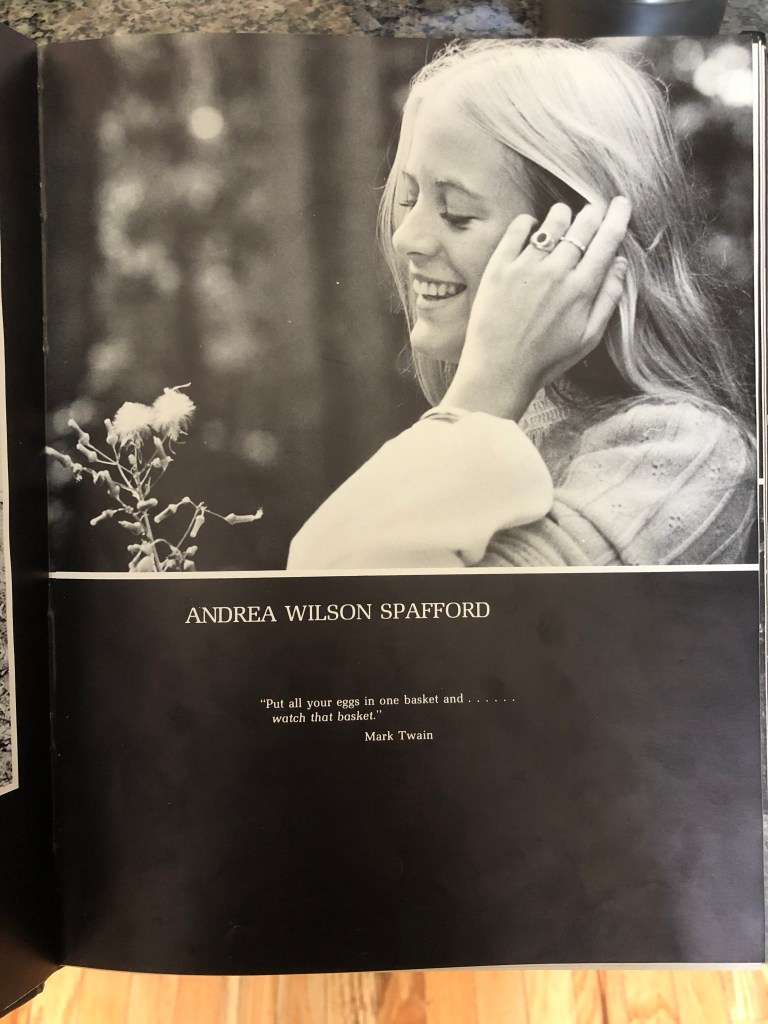
I think I was in middle school when I discovered my mom’s yearbook from 1973, the year she graduated from high school, and was fascinated. All of these young women with long hair and different ways of flaunting their free spiritedness, each one feeling like she owned the very parcel containing the wedge of world she saw in front of her and preparing to inscribe a gift tag to the universe in her own personal penmanship! I saw all of this and only sort of understood it. What I really didn’t understand, though, was the quotation my mom chose for her senior page: “Put all your eggs in one basket and…watch that basket.” (She attributes it to Mark Twain.)

I recognized that this was a reworking of the idiom “Don’t put all your eggs in one basket”, which traces back through Don Quixote and perhaps even finds its origin in a Latin proverb. This one, to me, seemed much more pragmatic. It just makes sense, right?! If you spread your eggs among several different baskets, and something untoward befalls one of your baskets (like a stampede or an avalanche or a bandit or a fowl kidnapper or simply being dropped from a height), you’d still have some eggs left to carry home for your breakfast. I was perplexed as to why my mom would subscribe to the risk of potentially losing every last one of her eggs in the event that something should compromise the welfare of her singular basket. Wouldn’t it make more sense to try to proactively cut one’s losses by meting out one’s wealth of eggs in hopes that at least some of them avoid sacrifice?

I think the wisdom of Twain’s reversal of Cervantes’s idiom really became clear to me this past spring. I’m not saying Cervantes was wrong in his assertion not to “venture all his eggs in one basket,” because 17th century thinking was certainly a far cry from today’s. And the earlier Latin proverb “Venture not all in one ship” makes a whole lot of sense considering the risks involved with sea travel inherent in those days (I’m looking at you, Aeneas). But now, in the year 2020, I completely appreciate the Twainism, especially as it relates to pandemic life. Back in March, we decided to create a closed circle with one group of precious people so the five kids and four adults involved could interact worry-free (or as close to that as humanly possible), prioritizing the kids’ social and emotional health and making it easier to stay careful and safe with others whose circles we couldn’t trace. This basket we wove, out of trust and hope and research and a great deal of consideration and discussion, both suspended and buoyed our families throughout the summer while we watched it in all of the ways we needed to ensure its optimum integrity.

I think what I couldn’t fully appreciate as a young person reading that quotation–the only one my mother chose for her senior page–was that if you only have one basket, you can actually watch all of your eggs at once. If you have multiple baskets scattered all over the place, either you’ll be constantly looking from one to another, rapid-eye movement style, or you’ll be always on the move, nervously checking on basket after basket, never questioning the assumption that it’s preferable to pour all of this energy out piecemeal in an effort to salvage a little bit rather than dispense the same amount of energy into focusing on and maintaining one whole lot? With many baskets, while your attention is on one, none of the others can be properly watched. This way, sure; you can ensure that you’ll have at least the eggs in whichever basket you happen to be attending in a given moment, but you could lose any number of other unsupervised baskets in that same moment. It would feel like frantically juggling while worrying about each ball as soon as it leaves your hand. Wouldn’t it be more peaceful and sustainable to weave one really strong, sturdy basket, nestle your entire clutch of eggs comfortably inside, then rest your full and steady, slow-wave gaze upon it?

P.S. This might be my all-time favorite photo of my mom. I’ve always loved it so much that, when it came time for me to graduate from that very same high school 25 years later, I used this photo of her as one of the images on my own senior page.

This post goes viral

When I was in elementary school, we frequently played dodgeball during PE class (this was in the 80s, long before the game attracted outcry and controversial attention). There are probably dozens of variations on dodgeball game play, but here’s how it went for us: the PE teachers chose two kids at random as presidents. The presidents took turns selecting people for their sides based on whatever factors they favored, which were primarily social hierarchy and/or athletic ability. After these public politics in the hands of children had divided the groups into two opposing teams, the final two kids to be picked on each side were named the “medics” for their team, and everyone else headed onto the court. According to this game’s strangely cruel rulebook, the medics then sat on the sidelines of the gym on their “gurneys”, which were flat plastic seats, approximately 18 inches square, set on four caster wheels. The kids on the court commenced to aim and pelt each other with playground balls (you know, the red rubber kind crosshatched with raised ridges), exercising social and physical target practice, and as soon as someone was hit, he or she had to sit in the spot of contact. This is when one of the medics for that kid’s team would spring into action, propelling herself on her gurney with feet and hands across that gym floor gauntlet of harm’s way to rescue the fallen teammate, who then took a seat on the gurney and was pushed by the medic back to the sidelines. Assuming that the pair made it across the court safely, the medic would then enter the game as a player and the fallen teammate would assume the post of medic, sitting on the gurney and scanning the court for others needing lifesaving.

However, if a medic was hit by an opposing team member as he scooted his way across to offer salvation, or if he was hit on his return trip to the safe zone, he was required to sit in place and await the team’s other medic to ferry him back (and the kid he was saving would have to be saved again). Now, if that second medic took a hit trying to save the first medic, the game ended immediately. Alternatively, if both medics were out in the field simultaneously and both were felled by the opposing team, this, too, marked the end of the game. No more medics. No one could be saved because there was no one left to do the saving. Game over.

The team that took out enough of its opponents to necessitate both medics being called to action, and that then was able to eliminate the medics, reigned triumphant. One-sided cheers reverberated in the echo chamber of that metal and cinderblock gymnasium, its walls decorated with banners hung to commemorate the victories of other champion teams. The PE teachers would blow their whistles, we’d toss the balls back in the giant wire bins, collect our sweaters from the bleachers, and carry on upstairs to say grace in the cafeteria.

Is it just me, or do those red balls remind you just a little bit of a certain particle? Is it just me, or does this bizarre game seem just a little too familiar? I do know that if a whistle existed right now that could signal the end of this period and the beginning of another, one full of goodness and grace, I think we’d all raise our cartons of chocolate milk and drink to that.

Proof of life (at school)

Some kids step off the bus or get into the car at pickup and immediately spill every detail from their day in an interminable flood, a breathless narrative. Others drop nuggets about their time at school hither and thither throughout the afternoon and evening. And there are some kids who pack the pithy matter of their hours away from home in a vault, slip the key in a pocket of their mind, and proffer not a word about anything specific that transpired between the morning “goodbye” and postprandial “hello.” Parents of these kids try all sorts of angles to find ways to scrape up information; they know “How was your day?” isn’t going to get them anywhere, so they try inventive lines of questioning such as, “Who was at your lunch table?” and “Was everyone kind to you today?” and “Did Hannah pretend to be a dog at recess again?” Or there’s the “try to shock a memory out of them” method, something like, “Have you noticed any snow leopards on the playground? Or three-toed sloths? No?”

My youngest is that first kind of kid: nonstop sharing, a constant outpouring so effusive it’s hard to stem the flow long enough to offer a response. My older two are more prone toward that second kind, the one who lets comments fall like breadcrumbs in the woods, giving me glimpses and leading me along to some idea of what life is like for them when I’m not around. But when they were younger, I had a hard time prying so much as a single vignette from them most days. When they were in preschool, I think the momentousness of their time in that building just somehow couldn’t fully transfer over the threshold between the special space they inhabited there and the remainder of their day. Their little minds and modes of verbal expression hadn’t found a synchronicity of pathways to meet in the form of language just yet, so I supplemented what little I could wrest from them about their days with what could be detected in other ways.

It was the archaeology of parenting, and I took every opportunity to capitalize on it. Black-stained uniform pants knees told me that he’d been practicing fake falling on the turf field. Sand in her shoes sang a sandbox song. Messy hair hinted at the swingset. Dirt in lunchboxes spoke of meals al fresco and dried glue on the backs of hands said they’d done something crafty. I’d scan for signs, Sherlock-style, looking in my rearview mirror for paint on faces, and would get a little excited to see raspberry-colored dribbles down the front of a white shirt because then I could ask, “Did they give you smoothies for snack?” and be almost guaranteed an affirmative response.

Hands down my favorite example of unearthing this kind of buried treasure actually occurred twice: once with Liam in preschool and again with Summerly, also in preschool, a couple of years later. Both of these instances took place during the third week of March, which is a season of many things for little kids, including the kind of cold that lasts a month, or seems to. The first time it happened, with Liam, here’s how it went: during dinner, I noticed he couldn’t chew with his mouth closed because he couldn’t breathe through his stuffy nose. “Ok, time to blow,” I said, and held a tissue at the ready. After the deed was done and I glanced in the tissue (you know we all do it…I mean we’ve got to check for signs of infection, right?!), there it was: green glitter. Right there in the tissue. Never was a mother more pleased to see green glitter blown out of her preschooler’s nose than I in that moment! All of a sudden, I knew what he’d done in school that morning! “Liam!” I said, “Did you guys make leprechaun traps today?”

Like many people, my husband has a phobia when it comes to glitter. He just can’t stand the stuff. As for me, I’ve always liked glitter, but now I appreciate it even a little bit more. Just think: one minute I had no clue how my child had spent his morning, and then, voilà! Green glitter in a tissue tells me all I need to know! Now that’s a kind of magic.

Shrimp and Couscous with Garden Guilt Salsa

I’ve mentioned the volunteer tomatillos in the garden, the ones that grew from last year’s volunteers, sprung from the prior year’s intentional planting. That year I planned the garden based on what I was hoping the deer wouldn’t eat, as we didn’t have a fence around the backyard yet, and deer in our neighborhood are known for going to great lengths to lay waste to vegetable plots, even eating pumpkins off people’s porches and scaling our precipitous front steps to feast on my pots of pansies late one fall. So I planted tomatillos and garlic chives and all sorts of things I neither really wanted nor knew what do with if they grew, but the need to cultivate was so compelling that I went so far as to put mint in my raised beds (I laboriously learned the hard way how foolhardy that was).

What I haven’t mentioned is just how proprietary these tomatillos are. They’ve done their best to elbow out everything else by creating a sprawling, yellow-flowering web of entanglement, and they’re fruiting like mad. Last year I made a nice autumnal chicken stew with a bunch and begged my brother to take away the rest, but this year I just kept collecting them with no earthly idea of what I would do until I just couldn’t stand it anymore. I also had a bowl of cherry tomatoes I’d picked almost too many days earlier sitting expectantly on the counter, so here’s how this ended:

Salsa Sorta Verde

1.5 lbs tomatillos, papery hulls removed
3/4 lb cherry tomatoes
1/2 a medium yellow onion
2-3 jalapeños (or serranos, etc.), seeds and ribs removed
4 large cloves garlic
1 large or 2 small limes’ worth of juice
salt

Halve tomatillos and toss with tomatoes and a little olive oil and place cut side down on baking sheets. Broil on high until skins begin to blister and char, 7-10 minutes. Roughly chop onion, peppers, and garlic. Once they’re cool enough, add tomatillos and tomatoes along with any juice they’ve released to a blender with all other ingredients and pulse until roughly smooth (or smoothly rough…whichever you prefer!). Season to taste.

We stirred about a cup of this into two cups of cooked couscous (3/4 c. dry Moroccan couscous added to one cup of boiling water with a chicken bouillon cube dissolved in it) and served it with shrimp, and my husband and I thought it was pretty great. It was also different, which was also pretty great. I’d suggest garnishing with avocado, a scoop of crème fraîche (or plain yogurt), and wedges of lime.

NB: This was too spicy for the children in my house. Well, it was too spicy for the one child who tried it, though he said he liked the flavor and requested that next time I cut the heat, so maybe I’ll add a bell pepper to that broiling pan as a substitute for the raw jalapeño next time the tomatillos overbear. Either way, I think I’ll serve it with a side of pizza because, well, kids. Also. Please wear gloves while working with hot peppers. I always forget, and each time I’m unpleasantly reminded of my mistake because we humans touch our faces WAY more than we’re even aware of. Just not in public anymore.

and my child is still alive.Taalkjx

A bedtime story

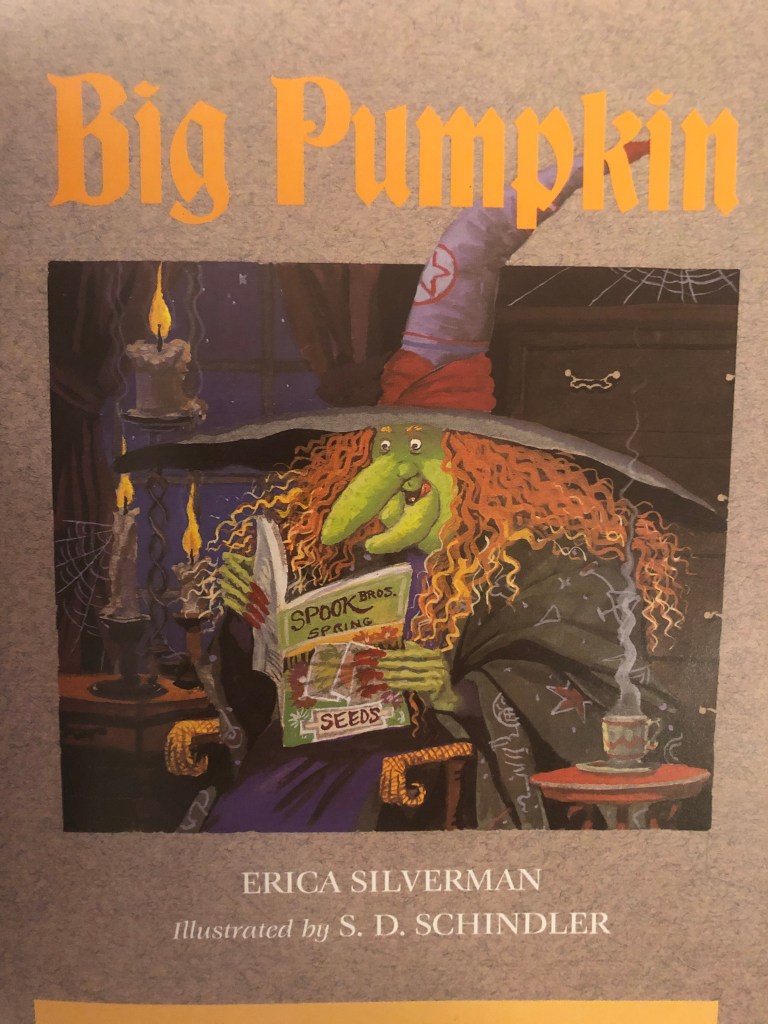
The other night, I was reading this book to the kids before bed, which seems like a simple thing. Just sit down, relax, and listen to a picture book, right? Wrong.

Liam: “I think it’s unsettling how her nose and her chin are practically the same length.”
Alison: “Yes, they’re both unusually long and pointy, aren’t they?”
Liam: “Her fingernails are also really long and pointy.”
Alison: “That’s true. Speaking of which, I need to clip Arlo’s nails because they’re getting scarily long.”
Summerly [cackling uproariously]: “GET IT?!?! Speaking of “WITCH”?!?!”

It took us all probably a full three minutes to recompose ourselves after that, but the giggles didn’t fully go away until we got to the page where the ghost “boasted” about his size and strength. Summerly said she didn’t like that he was being boastful. We discussed that it was true that the ghost was bigger and stronger than the witch, so it all depended on how he pointed out those facts: did he offer to lend a hand with the pumpkin in a helpful way, citing the likelihood that he could wrest the gourd from its vine by virtue of his physical capabilities? Or did his tone indicate a superiority complex, as suggested by the word “boast”? Since this book features rhyming, I suggested that he was being helpful, and the author used the word “boast” because it rhymes with “ghost” (“Look, guys! Isn’t it cool how words that are spelled so differently can still rhyme?”). However, when we encountered the next character, a vampire, he repeated the line the ghost used about being larger and mightier, again described as boasting. Since “vampire” and “boast” certainly do NOT rhyme, we decided that we wanted to change the motivation of these characters to make them helpful rather than self-aggrandizing. I read the line using the word “said” in place of “boasted”, but Summerly pointed out that at school they’re trying to use alternatives to “said” in their writing. So, for each of the characters we encountered until the end of the book, all who came to boast about their largesse and musculature, we substituted a different word each time. In our version, the ghost mentioned, the vampire exclaimed, and the mummy remarked. Then we discussed that the mummy identified as female, but we only knew this based on the use of feminine pronouns in the book to refer to her because, well, mummies are kind of inscrutable when it comes to identifying gender. Maybe the author chose to make the mummy a “she” because “mummy” also means “mommy”, one child said. Summerly also noticed that the word “and” appears on most of the pages of the book, to which Arlo added that “and” is one of his sight words. Then he sang the “sight words” song from school. We went on to discuss the author’s decision to rely heavily on repetition as well as rhyme, and why she may have chosen to incorporate so many words that, when spoken, sound like their meanings, prompting Summerly to ask if she could bring the book to school to show her teacher the examples of onomatopoeia.

You guys, we hadn’t even gotten to the part of the book where the bat comes on the scene yet. And we’d already completely eviscerated the book The Hallo-Weiner that night, practically cover-to-cover. (It features bullying, martyrdom, dysfunctional mother/child interactions, characters feeling shame about their fears, body image issues, borderline racism, and the protagonist ultimately being showered by the bullies, who never recognize the error of their ways, with candy and friendship, but not because they accept him for who he is; they’re only tolerant of him because he saved them from what they thought was a terrible spook. Don’t believe the positive reviews on amazon.com; author Dav Pilkey really screwed the pooch on that one.)

You know what’s exhausting? Bedtime stories!

A New Hello

Halloween in our neighborhood is extraordinary. There are so many friendly people behind the doors of these houses built in such close proximity to each other, and so many of these houses are decorated inventively and extensively for the holiday. Each year, there are also families from outside the neighborhood who visit for trick-or-treating, so our sidewalks see a tremendous amount of footfall that night. The past few Halloweens, we’ve invited friends (many of whom live in areas of town where the spread between homes is wide) to meet in our backyard and front-load the impending influx of simple sugar with some pizza before walking door-to-door in the early evening, leaving a couple of teenaged siblings at the house to hand out candy. It’s the only annual gathering we host, and we look forward to it every year. I’ve been particularly anticipating this Halloween because it falls on a Saturday, which not only would give me extra time to prepare for the evening event but would also allow for the potential of adding a fun activity to the afternoon for some of our guests to enjoy with us. And because that night falls in the middle of the weekend, it wouldn’t be as critical to get the kids home and settled and in bed to prevent them from awaking as zombies for school the next day; they could stay out a little later, enjoy glow sticks in actual darkness, run off the candy a bit longer, and silence that alarm clock to rise refreshed in a leisurely way: easy like Sunday morning. I mean, how often does Halloween fall on a Saturday when kids are all old enough to appreciate it and also young enough to appreciate it? Answer: once. This year. And, as if all of this weren’t exciting enough, October 31st falls on the night of a full moon, the second full moon of the month! Too good to be true, right? (Spoiler answer: yes.)

Because the world has become most unusual, those plans, like so many others these past eight months, had to change. I don’t feel comfortable taking my kids out to trick-or-treat among what could be thronging masses of people wearing the wrong kind of mask or not wearing any kind of mask at all (who would ever have thought that a bunch of barefaced people would be more terrifying than any gory, ghoulish, or otherwise ghastly costume?), so we’re opting out of the regular festivities. While trying to come up with an alternative plan to find fun for the kids, I began anagramming the word “Halloween”. I play with anagrams for many reasons, but in this case it felt symbolic: if we’re scrambling our plans and reworking the usual order of things; if we’re redesigning and restructuring and reorganizing the bare bones of normalcy; if we’re breaking the raw materials we have on hand into basically amino acid form and building them back up to create unprecedented situational proteins–well, it seems fitting that there should be new words to relate to whatever this process yields. Here is some of what I ended up with:

Lone Whale
All Owe Hen
An Eel Howl
Whole Lane
An Owl Heel
All Ewe, Hon
Hella We On?

A special one for my very special friend who loves to decorate for Halloween:

Whoa, Ellen!

And my personal favorite:

O, A New Hell

Which suddenly morphed into

A New Hello

And then I came up with an idea for reverse trick-or-treating: we’ll deliver treats to anyone in the neighborhood who puts up a sign saying theirs is a house where children live. I’ll send an email and invite others to do the same. We’ll wear costumes and walk around in the bright light of day (or maybe drive around in our costumes if it’s pouring rain) with plastic pumpkins full of candy, and we’ll toss it onto porches in the spirit of everything it takes to turn “hell” into “hello”, which sometimes feels like a lot but turns out to be really not that much at all.

How often does Halloween fall on a Saturday? Not very. How often does A New Hello fall on a Saturday in the year 2020? Exactly once in a blue moon.

P.S.: In the photo of my calendar above, you might notice that the paper has a furred look to it inside the Halloween square, between the words “Blue Moon” and “Halloween”. That’s because one of the kids put a sticker there, a black cat wearing a witch hat, which was later removed by said child. I don’t know why it was removed or which child did the removing, but I’m sure there was a very good reason.


Come Visit Ancient Athens

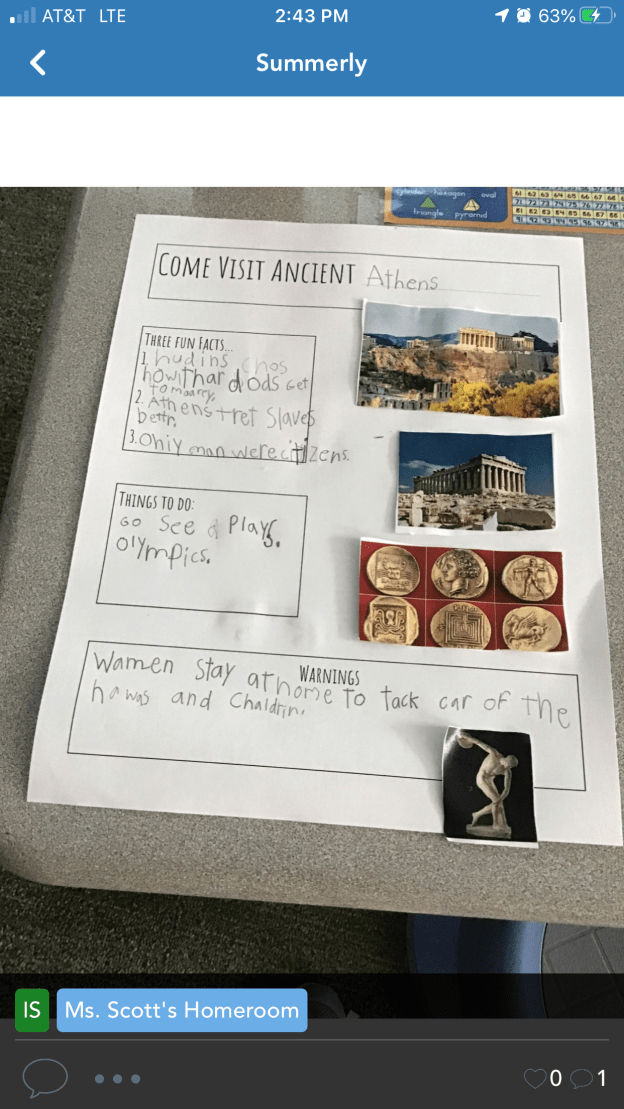
My second-grader posted a photo of some work she did at school recently, and because her spelling is still in a stage of development, I will disambiguate below.

***
Three fun facts…

  1. Husbands choose whom their daughters get to marry.
  2. Athenians treat slaves better (than Spartans do).
  3. Only men were citizens.

Things to do:

Go see plays.
Olympics.

Warnings

Women stay at home to take care of the house and children.
***

Who wants to visit Ancient Athens? Not my daughter, apparently.

Through a looking-glass

I recently came across some of my old poems, and this one was among them. In revisiting it, what’s so interesting to me is that I wrote this half my life ago, at the shiny penny age of 20, long before becoming a mother or even thinking about becoming one. Among my thoughts as I revised it just now: How did I know? And also: How little did I know!

Ablutions

He sits quietly,
curl-riddled head tipped back,
tiny red sockfeet
making a V at sofa cushion’s edge
I hope
while I shower,
ironing my skin with
a cake of green soap
shaped like a Stegosaurus
with tail serrated
and honeycombed hide.

Turned toward the television,
his eyes are sand-dollar round,

hair ringleted, coiled
like pulled springs.
He doesn’t even notice I’m gone
or blink an eye when Alice suddenly
shrinks like a wool sock,
having drunk from a bottle
ambiguously labeled.

Water slaloms down my shoulders,
drowning out the caterpillar’s smoke rings
sounding long syllables
in puffs like lavender eyeshadow,
hot droplets drowning the residue
of days, cleansing only what
we know to wash away.

How much can happen in seven minutes,
the time it takes to lathe a razor
over legs, to knead the soap
from my squinting eyes,
to paint a rosebush red?
I am guilty, every second
I am gone I am guilty,
putting faith in what diagram
of stars I cannot say.

The curtain rings clink
together like loose change.
Alice cries into her pinafore,
thinking she is lost forever,
but he answers when I call his name.
Another day, I am clean
and my child is still alive.

When life gives you lemonade

I’d picked up everything on my list at Costco, and on my way out I thought I’d walk by the book table to see what was there (Christmas is in less than three months’ time, you guys). Immediately my eyes fell on a box set of books I knew Liam would love, and (if you’re a kindred book lover, you’ll recognize this experience) I drifted to pick them up for a look as if the entire rest of the world had temporarily vanished. For all I knew, I floated there, I flew there, I vaporized and rematerialized with that book set in my hands. While enthralled in this approximately sixty-second rapture, a woman’s caustic voice cut through: “Is this your cart?” I looked up to find that, yes, this woman was addressing me, though her sunglasses indoors paired with a face covering gave me a moment’s hesitation, as did her tightly knotted neckerchief, and yes, she was in fact referencing my shopping cart that I’d left between the book table and a table covered in piles of loungewear when I’d been inexorably pulled away by the magnetism of new literature. “Yes,” I said, startled. “Why?”

“Because it’s blocking the way. It’s right in the way of EVERYONE.” I wish you could have heard the acid in her voice. Sure, my cart was totally in the middle of the aisle. Could another cart have maneuvered around it? Yes, thanks to Costco’s generously-sized everything, including space between displays, though it might have cost the cart’s driver an extra moment or two to manage the swerve-around. Still holding the books (don’t worry!), I promptly moved my cart and the woman pushed through, looking just where I don’t know because of those sunglasses, and when she’d passed, a woman folding inventory on the leisurewear table turned around and looked at me in horrified sympathy. I rolled my eyes in response (how great is it that we can convey these complicated expressions even while masked? And how many people now daily appreciate just how very powerfully and specifically eyes possess the ability to emote?!). When the sunglasses and neckscarf were out of earshot, the woman who’d shared my shock faced me fully, and I noticed her Costco nametag. “Why are people so rude?” she asked. I shook my head. “So sad,” I said, and she said, “I know! How hard is it just to politely ask someone to move a cart?”

We went on to have a conversation during which I told her that my first thought on the heels of the interaction was, ‘I’m glad my kids weren’t here to witness that example of adult unpleasantry’, which was immediately followed by ‘I wish my kids were here so I could use that as a teachable experience’. By now I’m quite familiar with the reactionary feelings of relief and regret coexisting within a moment, but it was interesting to share them as they were happening with this person who was at once a stranger and an ally. However, I’m not sure she understood what I meant when I said, “So sad,” which was this: I suspect that other woman must be so unhappy. And that makes me sad.

What kind of person is blatantly rude to strangers (especially during a worldwide pandemic)? What kind of person amplifies a small inconvenience in an effort to call public attention to another person’s mistake? What kind of person emanates unfriendliness energetically? The answer seems obvious: a person who’s unhappy in some deep and meaningful way. This woman, by the way, wasn’t someone with half her life left to enjoy, unfortunately; I’m guessing her age (again, it was difficult to discern much behind the facewear and the eyewear and the neckwear and the definitely dyed hair) was about 75. Taking all of this into account, it makes me think that this woman has been unhappy for very long time, and that’s what really struck me with a sadness. If we weren’t in this season of Covid, and if I’d been feeling particularly audaciously ambitious (perhaps empowered by the 20 oz. cup of Tropicana light lemonade I used to love sipping while trying samples throughout the store back in the recesses of 2019), I might have considered approaching this pillar of salt of a person, removing her sunglasses, and giving her a hug. At the very least, it would have been a fascinating interpersonal experiment. At the very best, she might have unfixed the snug knot in that scarf around her neck and waved it in the name of empowerment, then gone forth to purposefully change the frame of her world.

Ah, a woman can dream!