Allegory of the Matryoshka

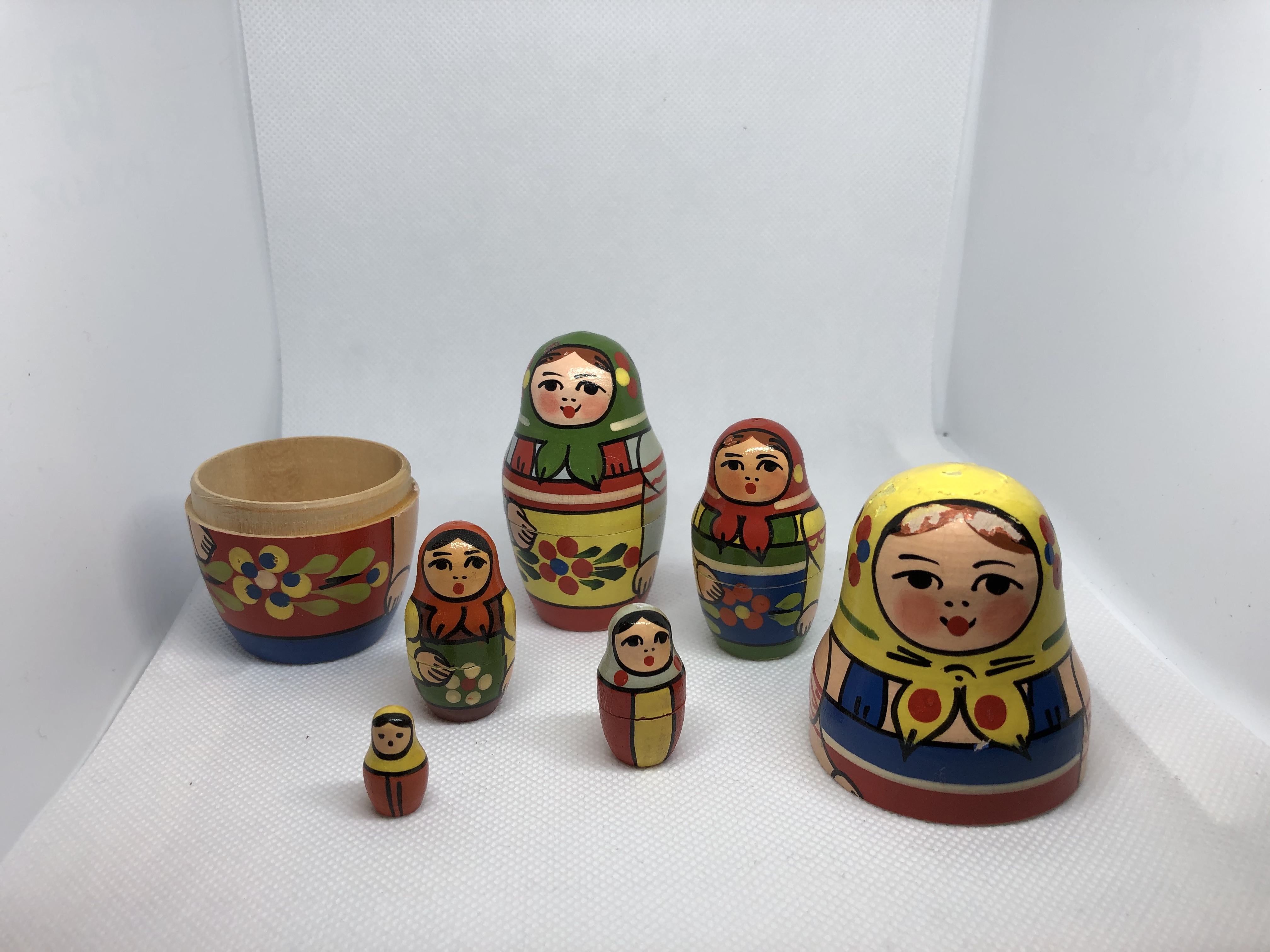
As a child, I loved them but I didn’t know what they were called, so I gave them a name of my own: “Open People”. Later on I learned that they carry various titles, including Matryoshka dolls, nesting dolls, stacking dolls, and Russian dolls, and I’ve accumulated a very small collection that I’d love to enlarge if I had a budget and small gallery dedicated to that end. I’m not sure why I’ve always been fascinated by them, considering their structural simplicity, but I think I’m beginning to understand.

Matryoshka dolls provide a facile metaphor, that of one generation of parents giving rise to another and another after that, and there are many other interpretations and iterations of the doll as a symbol, or so the internet tells me. In the spirit of layers upon layers, I’m having another idea: imagine that every person is like a Matryoshka doll. Within each of our identities we carry other versions of ourselves, postures from the past that date back to that moment of birth represented by the innermost doll, the one usually painted to look like a baby. This is the only doll that cannot be opened, and it’s traditionally hewn from a single piece of wood; it’s the only version of self that has no cracks. I do not believe that a human baby comes into this world with inborn sin, afflicted by the misdeeds of any human who has existed before. We are born innocent, fully intact in our purity, free of prejudice and bereft of belief. We are unbroken, wholly equipped with nothing but genetic material and instinct as directives. We are honest, faultless, guileless and real. If anyone can ever be considered perfect, this is the hour when that term can apply. Never are we more divine than in the moment we first breathe air.

From there, our child selves build upon each other like layers of pearl forming over that initial granule of sand, one after the other, eventually becoming adult selves, each containing every one that came before. All of these former selves coexist, even though they’re not necessarily perceptible to those around us, insomuch as they contribute to who our present selves have come to be. Without all of those other selves, our current selves could not be what they are; former selves are essential to the formation of present identities.

This is why face value is sometimes so approximate, why what’s inside a book should never be estimated by its cover. There’s implicit multiplicity within every personality, and the form in which we each walk through this world today is built upon an aggregation of every yesterday. Sometimes I imagine myself as a Matryoshka doll, each layer opened and laid out among the others, all unpacked, each edition of identity twisted at the waist, pulled apart. and set next to the rest. It helps, this image. We are never quantifiable by a singular identifier or a sole role in this life. Sometimes when I imagine my personal past this way, it’s as if so many former versions of myself are all sitting around a table, each carrying its own perspective, together trying to synthesize a deeper understanding of what it means to be this particular person. It’s a fraught conversation at times, but once in a while they agree to borrow parts from each other, try on each other’s bottoms or tops, twist around and see how it feels to live like the other half. And then, afterwards, I imagine them all reassembling, tucking back inside the largest shell, each folded against the contours of both the one that came before it and the one that came to be because of it, the most current self closing the others quietly in.

Sometimes it’s hard to remember that the reality we see laid out before us isn’t the only point of reference we have. So many moments have paved the way for now, and the paths we have yet to walk await us. I try to keep in mind that when I make my way along those paths, all of my selves are in accompaniment, sometimes offering a reminder or a observation from their perspective. It’s a comfort to know that who I’ll be down the road will be grateful to have the person I am today–with all of my faults and uncertainties and weaknesses and things I have yet to learn–along for the ride. I’ll remind her to never forget that allegorical line that encircles her midriff, an emblem of the Matryoshka doll of selfhood, and to remember that we all are Open People.
Glad she approves

One night at dinner recently, I mentioned to the kids that I’d seen a dear friend’s daughter waiting at pickup that afternoon and that she was wearing a mask matching the one they’d all worn that day. Brian heard this remark and said that the girl’s father, his best friend, had mentioned by text that he waves at me in the pickup line almost every day but doesn’t think I ever see him waving.

Alison: “Really? I haven’t seen him! I guess it’s because that’s my reading time and I’ve been totally engrossed in this book. Actually, I finished it waiting in the line today!”

Kids: (uproarious applause)

Alison: “Wow–thanks, guys! It really is an accomplishment for me. Want to hear the name of the next book I’m going to read?”

Kids: “Yes!”

Alison: “How to Talk so Kids Will Listen and Listen so Kids Will Talk

Summerly: (deep sigh of relief) “Oh, thank goodness. I saw that one in your pile and was wondering when you’d finally read it.”

I’m trying not to take it personally.

In the pink

When my youngest sister was very small, her favorite color was adamantly pink. When she was probably four or five, she uttered what is now a family-famous lament: “There’s just not enough pink in the world.”

My daughter fell off her scooter recently and scraped the inside of her elbow. As with all of their injuries, witnessing the progression of the healing process is fascinating for all of my kids, and we are often called upon to inspect and marvel over a scab or scar. A few nights ago, Summerly lifted up her arm and said, “Look, Mommy! It’s almost completely gone!” Sure enough, the scab was practically nonexistent by that point, leaving in its place a swath of shiny pink. “Yes,” I said, “the scab is almost gone, but the scar is there to remind you how you healed.” She looked at me and asked, “Are they always pink?” and I had to think about it for a minute. I explained that scars can be a variety of colors depending on one’s skin color, the type of injury, the age of the scar and its location, but that usually a new scar, one just past the scab phase, no matter what color the person’s skin is, is indeed a shade of pink. “Cool,” she said.

I hadn’t actually thought about this before. Of course we’re all aware that no matter what color a person’s epidermis happens to possess, if cut, it will bleed, and that blood will be red. But it was a new idea for me to consider what universally happens after a wound has mended itself: the new skin is pink before it fades to white or darkens to black or retains a rosy tint. It was comforting to add another line item to the “what do all people have in common” list, an item that is visible, tangible, simple and constant. In a time and a world supersaturated with uncertainty, it felt nice to lodge conviction in something as concrete as an axiom: freshly healed skin is pink. My appreciation for the color pink skyrocketed in that moment, as I was now seeing pink as a badge of convalescence, a flag survivors wave to show the capacity for repair. Let’s let pink be a banner for fresh healing in all things, not just skin; let’s co-opt the color as a symbol of recognition that something, anything, wasn’t whole or wasn’t healthy and means were taken to impart healing upon it. Whether a cut heals on its own, aided by robust biology, or it requires intervention to help it mend doesn’t really matter. It doesn’t matter whether a person experiencing all the slings and arrows of outrageous fortune is able to move through them unaided or if she benefits from a support system to buoy her on her journey. What matters is that we all live in a constant state of healing of some kind or another, or we try to. We’re always on our way from one pink process to the next, and we should count every pink moment in our past a point of pride.

The year 2020 has been cut-artery red. This country has been in danger of bleeding out on the table, presided over by a bad actor pretending he’s a surgeon. The last ten months have been a gaping wound of a time to be alive, and there is a monumental amount of healing to be done. I hope with every shred of being that 2021 will shed the red and herald a different color, one that bathes us all in its roseate light, because there’s just not enough pink in the world.

Even then

Arlo had been acting more tired than usual, and he looked a little wan, so I decided to keep him home from school out of an abundance of caution and made a virtual doctor’s appointment so he could get cleared to go back to school the next day. An hour later, he started running a low fever, so I called Brian and the other kids home per school pandemic policy. I took him for a covid test, which came back negative, so everyone else returned to school the day after the results came back, but Arlo needed one more day to recover from whatever had been afflicting him. That morning, he ate a bowl of cereal after taking ibuprofen on an empty stomach, having eaten very little of anything for almost a whole day. This resulted in the poor kid not being able to keep down the cereal, and unfortunately he was on the sofa at the time, so that meant a lot of cleanup and laundry on my part. The remainder of the day, however, was really pretty enjoyable, and it had been a very long time since I’d had that much time with just him. That night, as I was saying goodnight to him, I mentioned this.

Alison: “I really enjoyed spending time with you today.”

Arlo: “Even when I throwed up?”

Alison: “Even then.”

Arlo: “But I throwed up on me! And then I smelled like dead frogs! But I don’t anymore.”

Alison: “Yes, we cleaned you up. You don’t smell like dead frogs anymore.”

Arlo: “But you do!”

Alison: “No, you do!”

It’s amazing how quickly a Kindergartener can take the sublime and transform it so deftly into the ridiculous. It’s a special kind of genius that’s at once juvenile and rarefied, and it slips away, little by little, as they themselves undergo the inexorable metamorphosis that will eventually yield their adult selves. All parents feel that “nudge and tug” of watching their children grow: the longing for them to age into certain phases and out of others coexisting with our reluctance for time to pass and, with it, the youthful stages that our children possess at each selfsame point in their lives. It’s why we don’t correct Arlo when he still says “pupcake” for “cupcake”, why we were sad when he started referring to his favorite lunch as “pizza” instead of “eepza”, why we all fondly call the card game “Exploding Kittens” by the moniker he gave it: “Boom Cat”. I know someday we’ll reminisce about the magic that accompanies this age: a propensity for injecting the absurd into elevated moments, to color conversations with inanity, to doodle in the margins of life. I try to hold on to moments like this because I know there will come a day when I’ll miss them, when I’ll think back on this day–the day that my kid vomited directly onto the white Pottery Barn sofa, begged me all day for a pet tarantula, refused to eat anything except the inside of a piece of baguette for dinner, used a Sharpie to color straight through a piece of paper onto the hardwood floor, and told I me I smell like dead frogs–with a wistful smile in my mind.

Motif

My favorite time of day is from 2:20 until 3:00 on weekdays when my kids are in school, the time that I’m both in my car and alone. I say I’m alone, but I don’t feel alone because during this time I keep company with a podcast or a video update from a friend while I’m driving, familiar voices that invite me to listen without requiring any response: the kind of low-stakes communication that we’re hard pressed to fit into our days. I know that as soon as the kids climb in the car, it’ll be practically nonstop, time-sensitive responding on my part until they’re tucked away with a lullaby six hours later. During the day at home, I’m constantly responding in other ways: text messages, emails, Cecil’s burning desire to escape upstairs, dishes, grocery lists, meal planning and preparation, crumby floors, cluttered house, laundry…you get it because you live it too. The dead iris leaves are asking me to pull them. The piles of things that need to be put away in the basement are nagging constantly. The leftovers in the refrigerator are begging to be repurposed in a way that will appeal to at least one of the palates in this home. The shortage of sandwich bread is tapping my arm annoyingly to say I’d better do something about it. Too small boots are kicking me to find replacements in a larger size.

When I get to school for pickup, I park and silence the audio while I wait, and this is when I open a book. There I am in the pickup line, happily trapped in my car with no ability to clean the house or cook the food. No computer, no pets, no garden, no noise. This is the eye of the day’s storm, and I’m very grateful for it.

Another time of the day I enjoy, despite being tired and ready for the kids to just go to bed so I can finally collect my thoughts, is reading to them at night. When it’s my night to read, we start with a short book, something that hopefully will appeal to all of them despite their five-year age spread and very different interests, and then I read a few pages of a chapter book. Right now we’re halfway through A Cricket in Times Square, a selection plucked right out of my card catalog of nostalgia.

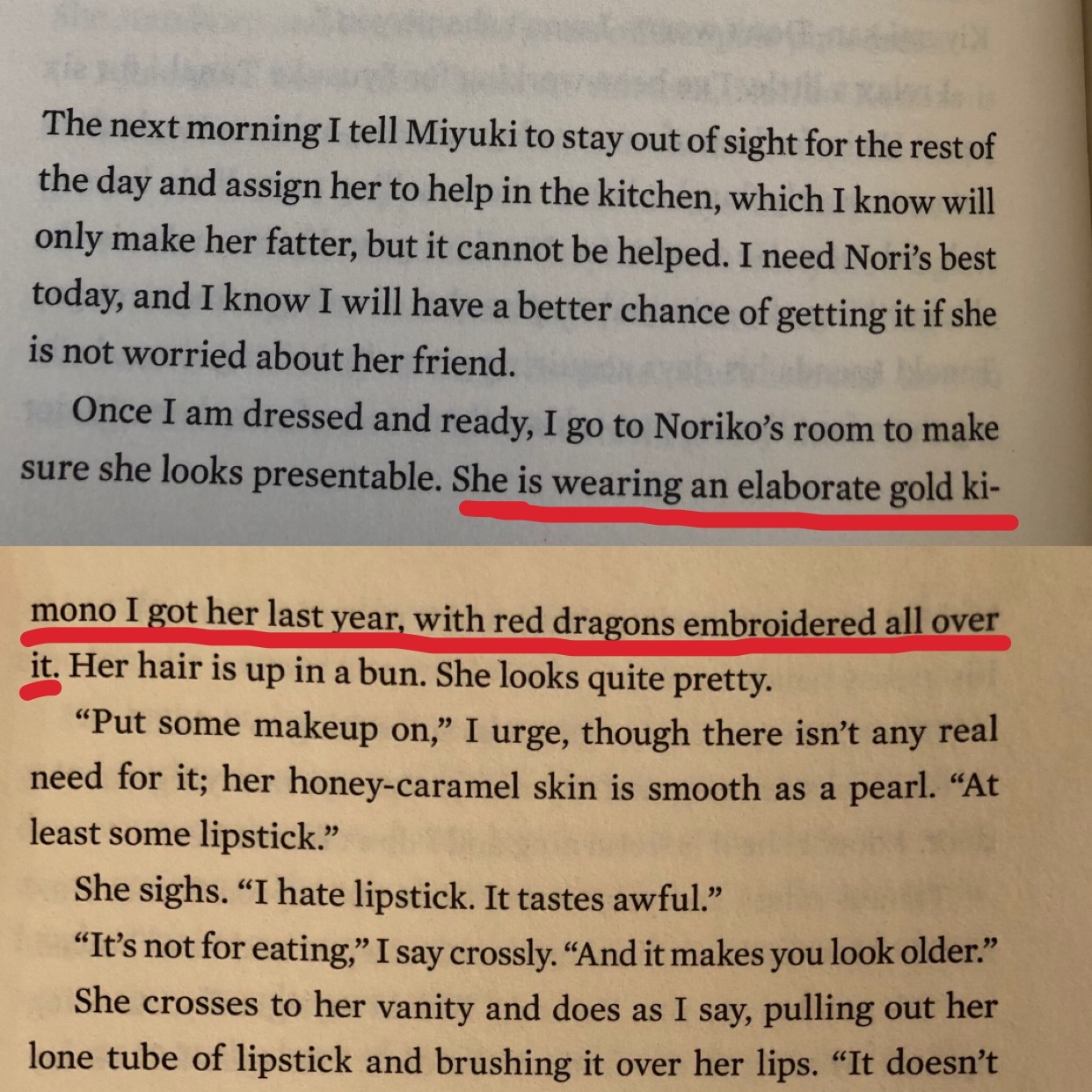
On October 29th, as I sat in my car enjoying the sunshine after a full day of downpours and darkness, I read these words on pages of my current novel, Fifty Words for Rain, loaned to me by a bibliophile administrator at my kids’ school:

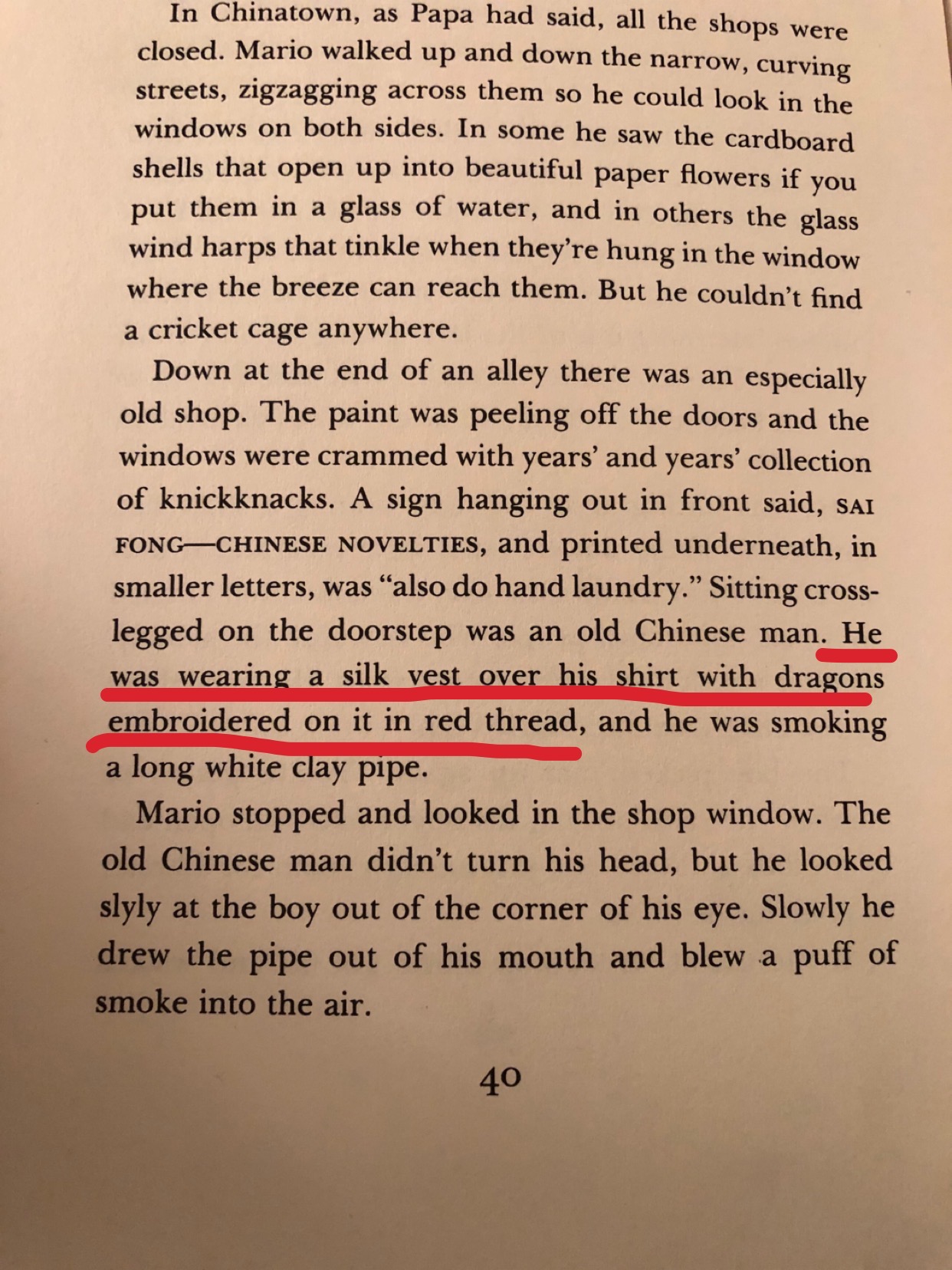
Five hours later, I read these words to the kids from A Cricket in Times Square:

The scene from my novel, published in 2020, is set in 1953 Japan, and the publication date for Cricket, the setting of which is NYC around the time it was written, is 1960. Here I was reading these two parts of these two books on the same day, one solo in the silent chamber of my car and other aloud with three kids on the sofa with me, and for some reason this coincidence made me catch my breath. What beautiful harmony of detail there was in these mirror images, and what luck to encounter them in such proximity of time to be noticed! If I’d read these two pages in different months, different weeks, different days, even, I might not have heard the echo. If these moments were musical notes played individually, two keys on a piano pressed separately, they would make their own sweet sounds. But played together they create a consonance, combining to engender something composite, something with nuance and dimension, and that’s what really strikes a chord. The music of coincidence, orchestrated by whatever powers that be, is a dulcet strain indeed.

These harmonic moments are uncommon, but when we hear their song, it’s like a little gift. It’s as if the cosmos were pulling out its needle, measuring out red thread, and embroidering decoration onto a day that, up until that moment, had been dark and damp and decidedly devoid of dragons.

Holy guacamole

There’s a local grocery spot, a facet of our town for more than half a century, that offers a limited but very interesting selection of imported pantry items. It used to be one of my favorite places to stop for a salad, a cup of coffee, or really excellent grab-and-go sushi at a surprisingly fair price to enjoy in the café with a side of WiFi. Although the store was known to be an expensive place to shop, there were certain items I couldn’t find elsewhere in town–capers jarred in oil, for example, which is a “must have” for the treasured Poor Man’s Linguine recipe given to me by a friend. The shop also had a lobster tank my kids loved to visit when they were smaller and a jellybean dispenser that I imagine one day they’ll reminisce about via text (or whatever replaces texting a couple of decades from now) the way my brother and I remember the bowl of pastel butter mints with its little metal serving shovel at a restaurant named Aloha that blended Hawaiian decor and music with a menu of the most Chinese-American food I’ve ever had and where we held all of our family birthday celebrations. At “the Aloha”, as we called it, my dad always drank a Dos Equis (this sounded like a single word to my child’s ears), we kids sipped Shirley Temples out of frosted glasses molded into the shape of totem poles, everyone wore around their necks complimentary leis made of neon plastic that smelled like dust, and whoever was celebrating a birthday enjoyed the distinction of sitting in the oversized bamboo chair at the head of the table flanked by tiki torches while the staff played a very Polynesian recording of “Happy Birthday” featuring ukulele and steel drums. The Aloha was a really incredible establishment and I have many memories of it, including that my grandfather usually ended up with a sneezing fit in the foyer because he had a sensitivity to MSG but enjoyed his pu pu platters nonetheless. That building is now home to a car dealership, and who knows what purpose the strange space served before its inception as a restaurant.

Back to Foods of all Nations, the place where this story began: when I was growing up, the clientele included longtime patrons who’d been shopping there since it was called “Seven Day General” in the late 60s/early 70s, when it was one of the only gigs in town, and I think it’s accurate to say that, in general, most of the people who frequented the place were not hard up for cash. Despite the international offerings on the shelves, I don’t think I saw anyone there who wasn’t white until probably college, and my friends in high school jokingly called it “Q-Tip Corral”. Anyway, I had a long-ingrained impression that people who shopped there were elderly and wealthy, as inaccurate as that generalization is today. This is why, a couple of years ago, when I was standing in the café facing the cash registers, a very young guy wearing cutoff camo cargo shorts and a tattered tank top caught my eye. It looked like he hadn’t seen a shower recently; his hair was matted, his whole appearance struck me as rough around the edges, and his expression was dour. I completely realize how judgmental I was being, but this was a few days after yet another mass shooting had hit the news, and this kid bore a strong resemblance to the white supremacist who’d opened fire at a church in Charleston a few years earlier, so it triggered something in me. He didn’t have a cart or basket; in fact, he had nothing in his hands as he waited in the checkout line, but a second later he reached into a side pocket of his shorts and pulled out what looked a whole lot like a hand grenade.

I thought, ‘This is it.’ I willed the faces of my children into my mind, cycling through them: one, two, three, and focused my thoughts on the magnitude of my love, pressing it toward them energetically, everlastingly, sending them every ounce of positive intention and hoping hard that somehow they’d know that I was thinking about the enormity of adoration I had for them in my final moments. All of this took about an instant, of course, at which point I realized that the boy was, in fact, not holding a grenade. It was an avocado.

I made sure to catch his eye and smile hard, paltry penance for my privately pegging him as a bomber targeting the upper class, and felt both foolish and ashamed for passing judgment on a completely innocent, probably really decent person just wanting to make a little avocado toast. But then I got angry, on behalf of him and people who look like he does, on behalf of everyone in this country, on behalf of humankind. We live in a world so troubled that we see a white kid pull an avocado out of his pocket and think, ‘That’s an explosive and I’m going to die today.’

Moments like this make me yearn for those days at the Aloha, when the most ominous thing in life was what may or may not have lain down the dark staircase off the long hallway leading to the bathrooms that was cordoned off with a red velvet rope like the ones demarcating ticket lines at movie theaters. I wonder when that tipping point happened, when we turned from the final page of Blake’s “Songs of Innocence” to the first page of “Songs of Experience”, when the sight of an avocado could cause us to assume imminent mortality, when our world view shifted to the point that a spooky staircase couldn’t hold a candle to a disturbed teenager with access to semiautomatic weapons. I know this shift will happen for my kids some day, too, that they’ll come to realize the depth and scope of evil that ribbons through human history, when the terrors implicit in everyday existence far outweigh fear of the unknown. I know it’s inevitable, but for now I’m savoring the phase of their lives when an unlit room is the most menacing entity, and I’ll hold their hands as they cross that dark threshold. Maybe this is what the deeply flawed saying “ignorance is bliss” is trying to express: that innocence is a golden hour of life that can only be fully appreciated in retrospect.

Oh, to be a child again, meltaway mint on the tongue, that frisson of thrilling fear in wondering what the downstairs of the Aloha contained! To imagine possibilities rather than lament realities! To have our first thought, upon seeing a boy take an avocado out of his pocket, be: ooooh, guacamole!

Golden joinery

The kids started making felt animals last spring, when their school was shut down and they were home with me all day. It was a pretty wonderful project during that time, since each creation required patience, focus, fine motor skills, reading and following graphical directions, personalization, and interpersonal interaction. The results weren’t immediately delivered, as they had to wait through two wash cycles and a dryer cycle to see the finished product, and sometimes what they ended up with didn’t resemble the vision they’d anticipated; frequently they were either disappointed or pleasantly surprised by the way their animals turned out, which is all good practice for life. Usually some stitchery was required to repair or reinforce portions of the wool that hadn’t felted together, so the kids learned how to thread a needle and sew. It was all very back-to-basics, old school homeschool stuff–de rigueur for that phase of pandemic living, and we spent many hours engaged this way. The smell of wet wool will probably always put me back on that hardwood floor surrounded by three kids bent over their individual cookie sheets, aiming spray bottles at foam felting forms.

The other night, Liam asked me to bring up the sewing supplies so he could work on a bear who needed a tummy tuck. I was tired and had zero interest in sitting on his carpet helping him knot thread at that moment while there were dishes to do and floors to sweep and places to exist where children were not within sight, but I hadn’t given him much attention that day, so I helped him with the knot and watched him sew while I drank a glass of wine (yes, the carpet is white and the wine was red, but don’t worry–the greatest atrocity that carpet has been subjected to is slime. Let me know if you need tips for removing slime from carpet, by the way).

After he’d made about three extra-long stitches, leaving at least an inch of thread visible with each one, I said, “That’s a great way to sew if you want to see the stitches. If you don’t want to see the thread, you might want to make your stitches smaller or use the other kind of stitch I showed you.” He said, “I do want to see the stitches. I want to remember this when I look at him.” I was stunned for a moment, appreciating the beautiful sentiment, wondering exactly why he wanted the visual reminder that this bear had been sewn. Was it a reminder of his own handiwork using a needle and thread? Was it a reminder that, when things come apart at the seams, like our lives had last spring, we have the power to put them back together as best we can while exercising agency over the process of reassembly? Was it a reminder that there is implicit imperfection in all things, or that those who wear their scars proudly are showcasing healing rather than wounds? Was it a reminder that there is value added to anything that has been repaired because it mattered enough to someone to do the repairing? Does my child understand the principles of wabi-sabi? Was he actually engaged in creating a kind of kintsugi? Does he know that’s one of my favorite art forms? Can I take any credit at all for his incredibly sophisticated perspective here?

I asked him what he wanted to remember when he looks at the stitches, and I should have known what he’d say. It’s just that he’s so very different from me, and I sometimes forget that the driving force within this child is his heart, which takes up so much space in his existence that it eclipses everything else sometimes. He said, “I want to remember being here with you while I’m doing this.”

Liam is a child of heart where I have always been a child of the mind, and I’m often struck by how we go through life guided by such discrete and disparate dominating forces. Sometimes it’s hard for a person stuck in her head to parent a child who inhabits his heart so completely. It’s a challenge to shift the paradigm from a habit of thought to the impulse of love. This is why, when I said to him a few days later, “I don’t think you’d ever do something unkind on purpose,” and his response was, “You don’t know how much I appreciate that,” I thought: maybe not. But I’m trying. We are all works in progress. May our cracks be filled with gold to highlight, not to hide, the ways we reassemble ourselves, over and over and over again, and to help us remember them.

The force is strong with this one

It had been a long day, and we were in the throes of bedtime when Summerly came into our room where I was rifling through a laundry basket and said, “I feel like I want to do a favor for you.” Well, this was new. Not that she’s an unhelpful person, but vocalizing her desire to do something unspecified for me out of kindness was pretty unprecedented. I said, “Thank you! I’d love that! I’ll think about a favor I’d appreciate,” and kept clawing through the laundry (WHERE is that black uniform shirt she wants to wear?!). About ten seconds later, Summerly came back into our room to declare, “I left my bag from the dentist in the car, but I really want to use my new toothpaste!” I told her she could bring the bag in tomorrow after school, or I’d bring it in later that night if I went to check the mail. She said, “I’d really like to use my new toothpaste tonight!” Well, the kid had had an awesome day. She’d been uncomplaining at the dentist that morning and fun to have around on our apple-picking excursion, acting impressively at the end of our time at the orchard when she could easily have made a fuss in a situation involving disappointment, which other kids weren’t weathering so well in the moment. When we got home, she asked if she could go upstairs and clean up her room, at which point she also made her bed (this kid’s room is typically a disaster zone). She’d been cooperative and patient throughout the entire evening, too, and wasn’t presenting her desire for the toothpaste in an unpleasant or entitled way at all. She was already ready to brush her teeth without having been asked while her brothers were decidedly NOT READY, which is the case practically every night. This was all on the heels of the day before, which had been VERY tough for her, culminating in a screaming fit that lasted at least thirty minutes. I wanted to reward her for turning things around and showing particular aplomb at the orchard. And the kid was excited about toothpaste, for god’s sake.

I knew it would probably take her longer to figure out how to unlock my car and actually locate the bag (this child has trouble following simple, explicit, repeated instructions to find things), so because Brian was attending to Arlo and Liam actually appeared to finally be putting on his pajamas, I said I’d go get the bag from my car. “Oh, no, Mommy; it’s ok!” she said. “I’ll get it for you! See? I’m doing you a favor!”

Well played, young daughter. Well played.

I have a beef with Crayola

The concept of synesthesia was introduced to me in high school by my brilliant AP English teacher during our reading of The Great Gatsby. The example was “yellow cocktail music”, and I’ll never forget the revelatory moment of reading those words and understanding them completely. I could hear that music: full of dulcimer, zither, handbell, triangle, glockenspiel, piano glissando: all yellow. I think everyone is synesthetic in different ways and to different degrees, but in that moment I recognized something I’d known about myself for as long as I could remember, and now I had a word for it! A beautiful Greek word, no less, with a prefix meaning “together” and a root meaning “perception”. It felt like a piece to a puzzle I didn’t know was missing had fit itself snugly into place; a breath I didn’t know I’d been holding finally exhaled.

Beginning when I was a kid, it felt clear that the days of the week were color coded by virtue of their names in conjunction with where within the seven-day period they fell. Monday was green (the week was new), Tuesday yellow, Wednesday blue, Thursday violet (the twilight of the week), Friday red. Some of these associations were more pronounced than others; Tuesday was bright as a lemon in the sunshine, Thursday wore a saturated purple mantle, and Friday flew a flag of vibrant crimson, while Monday and Wednesday were only somewhat green and mildly blue. This certainty on my part didn’t manifest in any real way other than the fact that I could see and feel the colors as synonymous with the names of the days. Strangely, Saturday and Sunday were both a kind of cloudy white, perhaps because they felt like punctuation days to me, or negative space, or possibly because they were less predictable and couldn’t conform to any kind of pattern. In my mind, the days of the week are still clothed in these colored capes.

Sounds have colors, too, and flavors shape. Sweetness is round like a cherry, salt paints acute angles on the tongue, and heat (like cayenne or wasabi) draws an exclamation mark of flavor. These things seem obvious and unremarkable; just like we we see a banana and know what it tastes like, what texture it possesses; we smell a steak on a charcoal grill and can instantly conjure its image in our minds; we hear thunder and think: rain. It’s all a neurological associative process, an interconnectedness within our unconscious that acts on our consciousness to help us identify and process sensory existence. Why do our mouths water when we smell cookies in the oven or bolognese bubbling on the stovetop? Why do certain songs make us think of certain people or places or moments in life? How can the fragrance of a particular perfume, sniffed by surprise, bring tears of nostalgia to our eyes?

The answer is the same every time: because our brains are all hotbeds of chemical interactions that affect our perceptive abilities in incredible ways. Just as naturally as the word “pineapple” conjures an image of that bouffant fruit with prickly scabs of scaly skin, so, to me, Thursday is a velvet violet and resonates a solid C sharp.

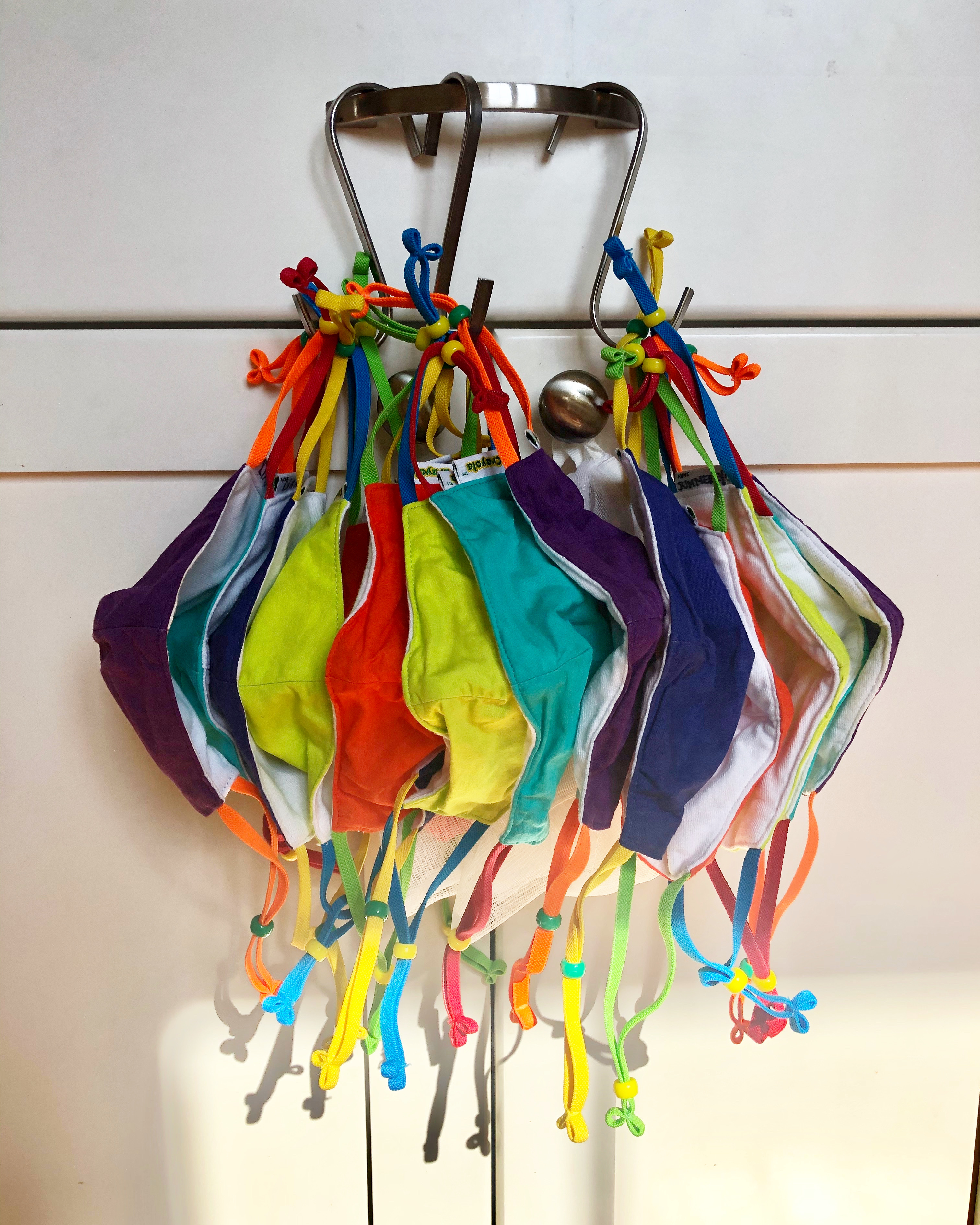
The reason I mention all of this is because of Crayola. Specifically, the Crayola face coverings my kids wear to school every day. I bought each kid a set of the “Maskpacks”, which include five differently-colored masks for each day of the school week. Early on in this “school during pandemic” game, I let the kids each choose which color they wanted to wear each day, but after a few days realized that was an unsustainable system for me from an organizational perspective. I decided that they’d all need to wear the same color and that each day would be assigned a color. However. The colors are ALL WRONG. There is no green. There is no red. Instead there are persimmon-level orange and turquoise, of all things. To make matters worse, the blue is too dark and the yellow is really almost chartreuse–like an unripe Bartlett pear. Oh, calamity!

I thought about temporarily giving teal to Monday and orange to Friday, but that just didn’t feel right, so I let the kids decide which color mask they’d assign to which day. We ended up with a Monday through Friday rotation of purple, teal, chartreuse, orange, and, blue. Although this goes against the very grain of my sensibilities, I’ve learned to live with seeing these incongruously-colored banners strapped to my kids’ faces every day. It’s just another example of this strange era requiring us to adjust in ways that we never imagined. Whoever wrote the meme that says “if 2020 were a drink, it would be vodka in a water bottle” really nailed it. I don’t know when it will happen, but some day, when I can put these Maskpacks in a memory box and do things like hug my parents again, our days will be ready to resemble themselves again. And I know their proper colors will be waiting.