Uncommon sense

One Sunday last month, we went to a local farm and winery for an hour of pumpkin-decorating and Halloween storytelling led by our beloved former school librarian who, in characteristic fashion, was dressed as Joy from the movie “Inside Out” (fortunately, she already had the perfectly purple hair for the part). Kids, most wearing costumes, rubber boots, and raincoats, gathered at picnic tables spaced out under a capacious, canopied sailcloth tent. It was a soggy, foggy morning, certainly the coldest outdoor experience my kids have had since early spring, and despite being dressed in terrycloth-lined windproof slickers, they nonetheless complained about the chill. We’d bought them hot apple ciders in hopes of warming them from the inside out, but the cups had gone basically untouched, the contents being dubbed “too hot” (shocker).

My pod mom friend, Ellen, and I were standing by the table while the kids painted their pumpkins, after which came the clarion call for snacks. We’d prepared for this, of course (she with stainless steel containers of individually portioned home-baked blueberry bread and I with a bag full of processed snacks fresh from Costco, most containing nuts or processed in a facility that handles nuts; our school is entirely nut-free, so any chance I get to ignore labels when packing snacks is such a liberating experience that I can almost hear angels playing trumpets while I’m reaching past the sun butter for Cracker Jack and Luna Bars). We told them to sanitize and that they had to stay at the table if they were going to take off their masks to eat (which, really, is the only way). Summerly, eight and a third years old, came back from sanitizing, saying that her hands were freezing cold, so I suggested that she hold her drink. The cups of cider had cooled down but were still warm, so it seemed like an easy fix. Isn’t it nice when there’s a readily accessible, tried and true method to counteract discomfort just sitting there in front of you? “Hold your drink,” I said helpfully, delighting in the sensibility and simplicity of that idea. Two palms curled around a warm paper cup wrapped in a corrugated insulation sleeve…what an iconic cold-weather method for warming one’s hands! And it felt like a win for me because here was a way to help her help herself without my having to move or DO anything! Maybe some day in the future when her hands are cold, she’ll reach for a warm cup herself and think of her mother, that beacon of reason who taught her this and so many other useful things, and that thought will warm the cockles of her heart.

The child nodded, ostensibly understanding the implicit logic behind this idea, and then Ellen and I, honest to god, watched her pick up her cup with one hand, pour warm apple cider into her other hand, which she’d cleverly cupped for this purpose, and proceed to rub her hands together. “Good idea, Mommy,” she said. “That really helps!”

If anyone was wondering about Summerly’s literal thinking skills, I think she’s got some.

Redemption song

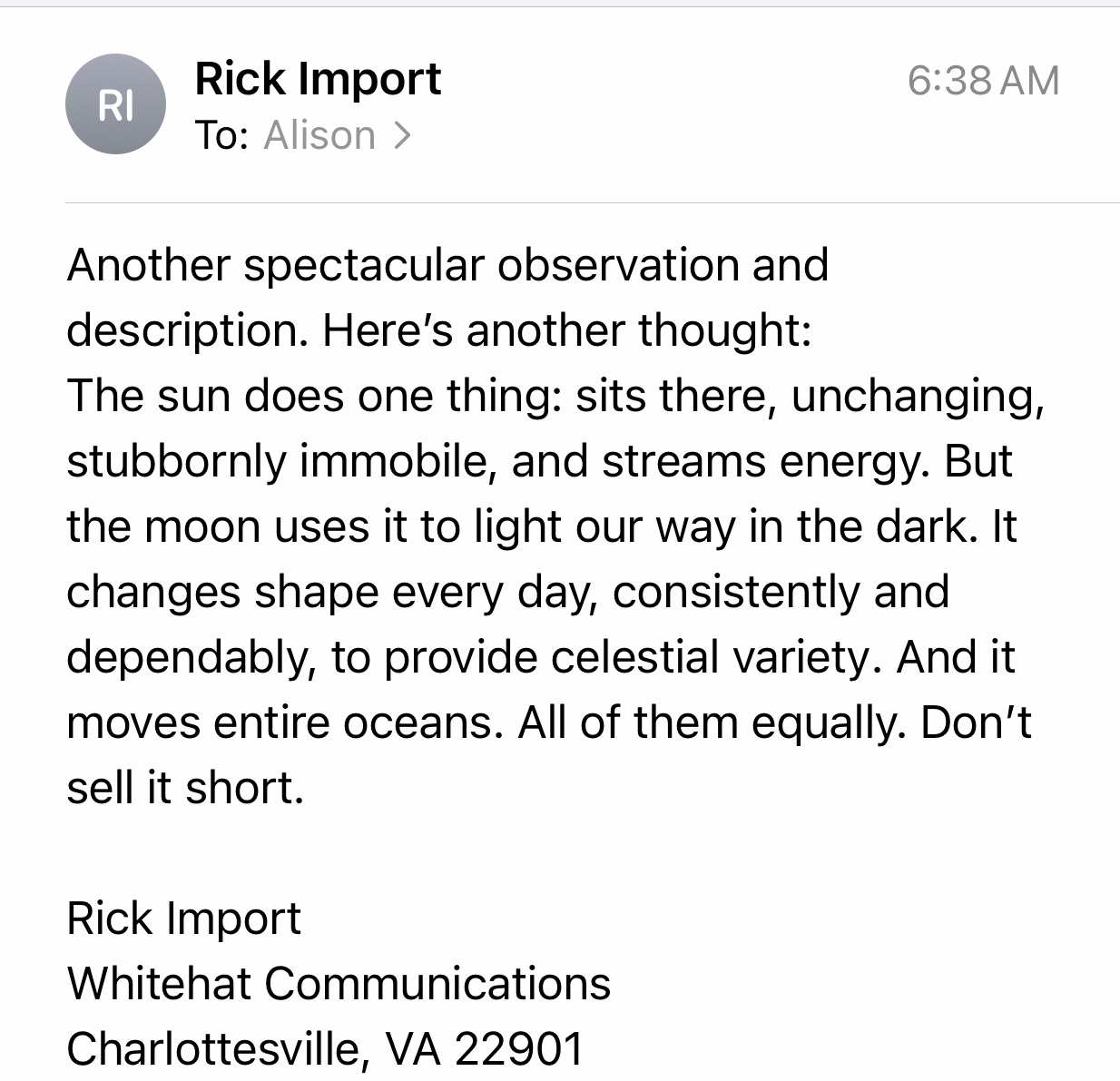
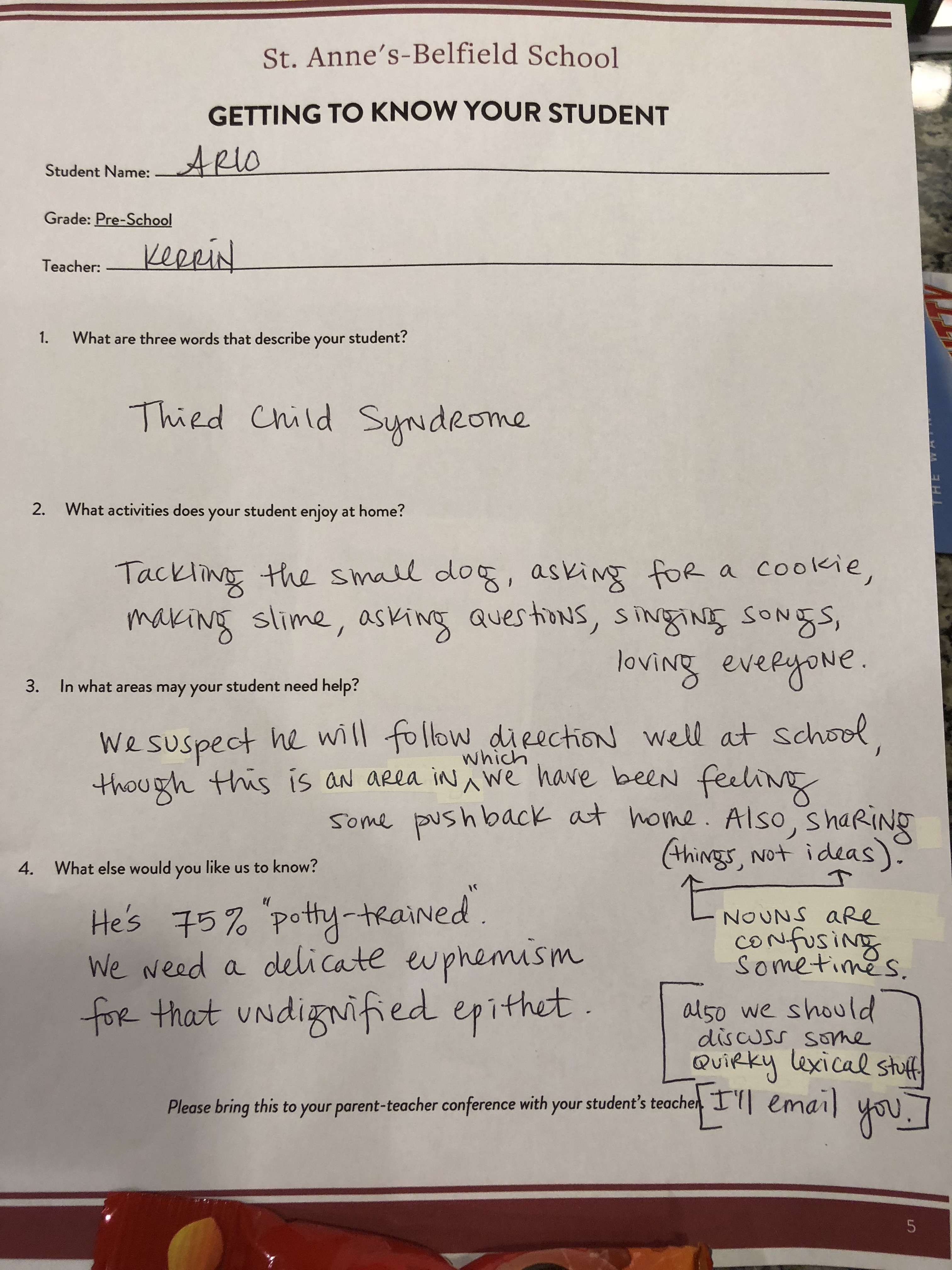
For several years, part of the back-to-school paperwork was a questionnaire entitled “Getting to Know Your Student”, and one of the questions was “What are three words to describe your child?”. Besides being reductive and potentially subjective, this question is just HARD to answer. One year I tried to liven things up by being funny (well, I thought I was; the teachers weren’t so sure…see images below), but most years we just chose three adjectives essential to each child’s personality. The first word we chose for Liam, every single time, was “sensitive”. When he was very small, songs like “Rockabye Baby” and “You Are My Sunshine” made him sad, and as a first-time parent who hadn’t worked through a lot of my own emotional issues, my reaction was to either avoid exposing him to them or to alter them to ensure a happy ending. I changed the end of “Rockabye Baby” to this: “And down will come cradle, baby and all / but baby was fine; his fall wasn’t far; / he slept the whole time ‘neath the moon and the stars.” I added a stanza to “You Are My Sunshine”, too, to wipe away the tears borne of waking up from a dream to face reality. I know, right?! This mistake is so egregious I’m calling it an infrared flag. But what’s even worse is what I did to “Humpty Dumpty”.

As a child with pronounced anxiety and “worst-case scenario as a knee-jerk reaction” syndrome, Liam was really troubled by the Humpty Dumpty ditty. I was trying to teach him that when things broke, we could try to fix them, and I was always gluing or repairing broken toys in an effort to show him the possibility and value of reparation. Similarly, I thought I could resurrect the nursery rhyme situation by appending this couplet: “But Mommy and Daddy got out the glue / And then Humpty Dumpty was fixed: good as new!” Looking back, I want to sit down with myself and have a serious conversation. What was I thinking? I was telling my kid that if all the king’s horses and all the king’s men couldn’t fix a broken egg, DON’T WORRY! Your parents will run to the rescue and solve all the problems for you! Your mommy and daddy are here to protect you from the world! We will shield you from pain, from sadness, from disappointment, from brokenness! We will carry you like an egg in the palms of our hands and keep you far from precipitous walls so there’s no chance you could fall and break! We will enshroud you in a force field of invincibility so that you shall never befall a situation that might make you feel anything but happiness and hope! I seriously had no idea that I was writing a much more damaging narrative than the preexisting nursery rhyme. All I had to do was talk it through with him, explore the situation and let him feel about it, rather than whip out a band-aid and wave away the discomfort. Sometimes sad things happen. Sometimes tragedy strikes for no comprehensible reason. Sometimes the universe deals good people a hand of really awful cards. Sometimes eggs just fall off walls. Reality is hard. The end.

However, I’ll offer two alternate additions to “Humpty Dumpty” in place of my dysfunctional one from years ago because a happy ending is something you make; it’s not something that happens to you.

“He called out for help in a fragmented breath:
‘Someone, come quickly! This can’t be my death!’
A family therapist happening by
called “Whoa” to her horse upon hearing his cry.
She handed to Humpty a fresh tube of glue,
said, ‘Here is a tool so that YOU can fix YOU!”

Or:

“It was so very sad, but when they’d all gone away,
the weather became very hot on that day
and Humpty was cooked! Right there on the ground!
The hungry townspeople–do you know what they found?
A feast of a fellow overflowing their cup:
their breakfast was Humpty: perfect sunny-side up!”

Final thought: Is Humpty Dumpty a child of Mother Goose? Did she lay him as an egg? If so, things just got more complicated.

P.S. Everyone should read the book After the Fall by Dan Santat. His idea gives the story wings.

Speaker of our house

If you look closely, you’ll see that Arlo is holding a seashell he decorated with marker up to his ear. Right before I took this photo, he said, “Guys, be quiet! I’m talking to the ocean on my shell phone!”

Once upon a time, we used to listen to the sound of the ocean. We could hold a conch shell to an ear and imagine the sound of waves in the white noise produced by that little echo chamber, a closed system of whorls. Then Arlo was born, and he started talking. Since then, not even the ocean has been able to get a word in edgewise.

Working title: “The Starving Artist”

Bedtime has been even more of a struggle recently, particularly with getting Arlo, five and one-third years old, to prepare for reading and then settle down enough to fall asleep. Getting him to take off his clothing, go to the bathroom, and put on clean clothes (by choice, he sleeps in the outfit he’ll wear the next day, and I’m completely fine with this because it saves time in the morning AND laundry *win-win*). I’ve been trying different methods to help him through this process, and one night I said I’d tell him a story while he got ready if he worked steadily until he was ready to brush teeth. The idea came to me spontaneously, so I had neither plot line nor characters in mind, but I started with “Once upon a time, there was a spider” as a hook because my child truly loves bugs and spiders, especially spiders. (He wants a tarantula pet for Christmas. Send help.)

“Once upon a time, there was a spider. She was a young spider and had just discovered her ability to make webs, which she found to be a delightful pastime. She scouted for a while and found a perfect spot between two branches of a sturdy tree for her to practice weaving. She worked all day to perfect her web–tightening here, strengthening there, adjusting left and right, until she’d spun the most intricate, elaborate, magnificent web she could imagine. Very happy with her work, she settled herself in the middle of it, tucked all eight of her tired legs up under her, and took a nap. A few minutes later, she awoke to find her web being jostled roughly back and forth. She felt like she was on a trampoline!” (Every other sentence or so I had to pause to give Arlo reminders, so this story was by no means uninterrupted.) “Well, she looked around to see what had caused this motion in her web and was surprised to see a praying mantis lodged in the lacework. She hurried over to him, and he greeted her with a smile. ‘Well, hello, there!’ he said. ‘Isn’t this a mighty fine canopy we’re sitting on? I mean, it’s just a beautiful piece of art! I wonder who wove this incredible creation!’ The spider cocked her head at him and said, ‘Oh, well, thank you! I wove this web myself.’ The praying mantis clapped his hands over his mandibles. ‘You don’t say! YOU are the artist behind this creation?! My, I am impressed. I can tell you put a lot of energy into making this! Might I also compliment you on those strong, nimble legs of yours? And you have so MANY of them! Why, you just look so different from me, different from anything I’ve ever seen, and I think that’s just exquisite! What are you, do you mind my asking?’

“Well, the spider had never encountered such a genteel fellow, and she was touched by his friendly kindness. She replied, ‘Aren’t you generous! I’m a spider. Have you never seen a spider before?’ The praying mantis clasped his front legs, wiggled his antennae, and said, ‘I most certainly have not, but you are remarkable indeed! I am very glad to have met you and seen this amazing thing you call a web. What do you do with this web? Or is it simply a decoration?’ The spider shifted uneasily. ‘This web is for catching insects,’ she responded. ‘Oh,’ said the praying mantis, ‘isn’t that wonderful! A work of art that attracts attention in a most unique way! And it really works, because I am an insect! Why is your target audience the insect world, might I ask?’ The spider wrung at least half of her hands. ‘Well, it’s because…it’s because spiders eat insects. We catch our meals in our webs,’ she said sadly. ‘Oh my goodness,’ was the mantis’s reply. ‘It’s even more magical an invention than I thought! It’s not just a bit of art that attracts an audience; it also puts food on the artist’s table! Well, I never. I can’t believe I was able to meet something as miraculous as a spider during my lifetime. What a special day this is!’

“The spider was thoroughly dumbfounded. After about a minute, she went over to the praying mantis, who was still admiring the web and remarking on its many virtues, and began unmaking the threads in which he was entangled, extricating his legs. ‘You know,’ she said, as she was finishing up, ‘I’m not really very hungry today. I don’t need a snack as big as you are, anyway. Why don’t you come back and visit sometime?’ The praying mantis tipped an imaginary hat and said, ‘Why, thank you! I’ve had such a nice visit, and I’d like that very much. I’ll be back on Sunday!’ and he flew off. The spider went back to finish her nap.”

To be clear, this story took three nights to finish, and when it was finally over, Arlo said, “And then what?” I said, “Then an aphid came to visit. I’ll tell you the next part tomorrow.” But Arlo kept on. “Yeah! And the aphid was really nice too, so she didn’t eat him either! And all the bugs are nice, so she lets them all go!” At this point, I felt pretty accomplished. He’d gotten ready for bed more quickly, and I’d told him a story about the benefits of kindness, appreciating diversity, praising hard work, and the value of art. And then it happened. He looked at me, concerned, and asked, “But then what will the spider eat?”

Oh. Right. It didn’t take a deep-dive Google search to verify that your garden-variety spider’s sole source of sustenance is, indeed, a single ingredient: insect. What on earth had I just done? Had I told a story celebrating martyrdom the same way The Giving Tree, a book I despise, does so egregiously? Or did I just invent an arachnid with an eating disorder? Maybe she will only eat mosquitos. But mosquitos aren’t THAT bad; I mean, they’re trying to live the only way they know how, and just because humans don’t like them doesn’t mean I should sanction mosquito genocide or countenance entomological racism of any kind. Maybe just the baddest baddies would be her victims. But how dastardly would an insect have to be for her to quench her hunger? I mean, it would take some pretty epic evildoings to enforce a death sentence on a bug, and even then why should the poor, beneficent spider be fed only on unsavory characters? I don’t think I want to tell a story to my kids about an insect mafioso’s life of crime and subsequent execution anyway.

Oh, dear. If this is what happens when I improvise a new bedtime strategy, I’ll never go off-script again.

Incantation

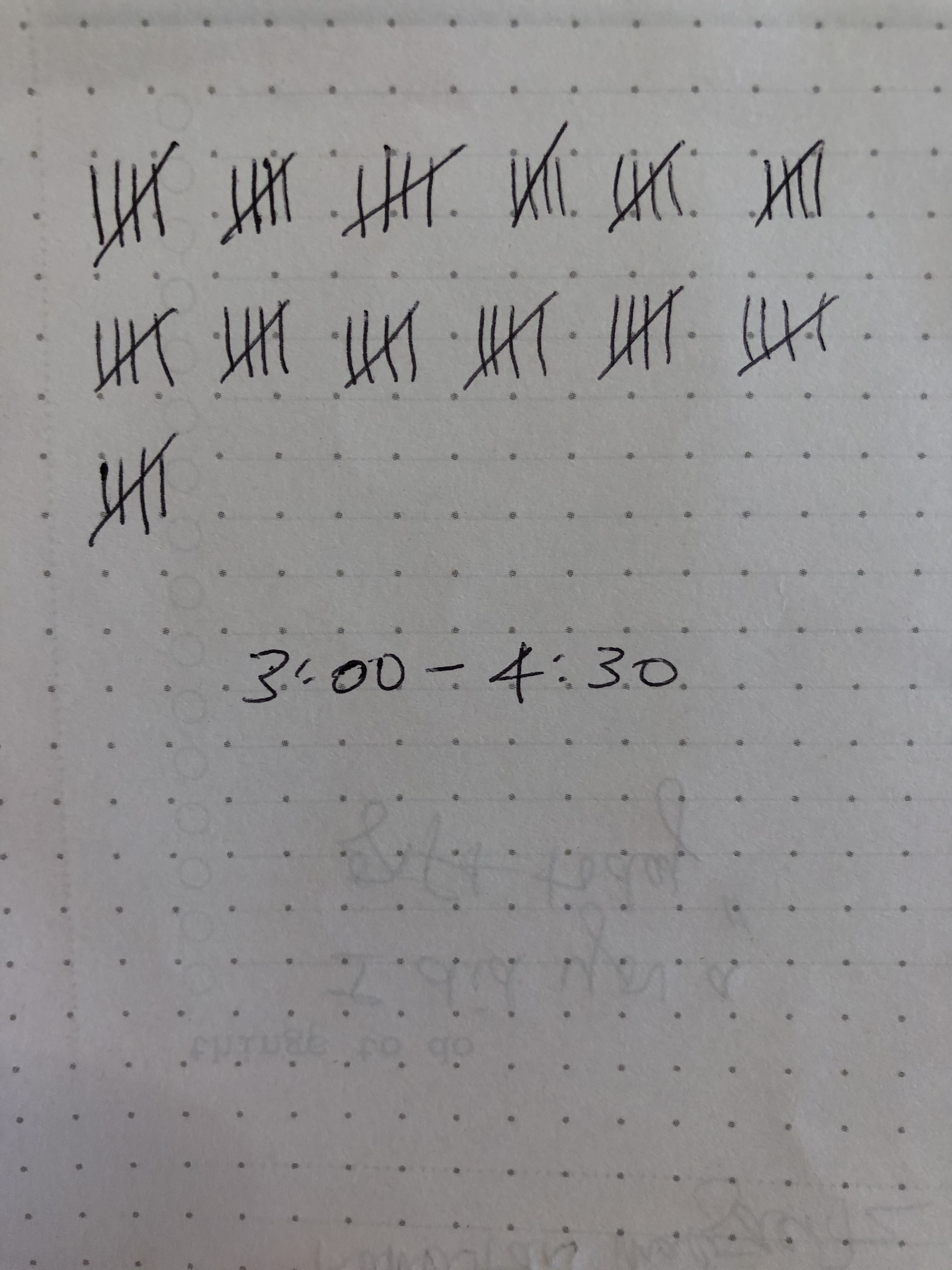
The other day, I decided to record the number of times Arlo used the word “Mommy” as a noun in direct address. I did this for the ninety-minute period following school pickup, making a tally every time I heard him say it, but I’m pretty sure I missed a few. This is the piece of paper I used, and the number of tallies is thirteen sets of five. Arlo said “Mommy” at least 65 times in an hour and a half. Thank you and good night.

Out of the limelight

Summerly’s bed is pushed up against a wall directly beneath a bank of windows spanning its entire length, from pillows to footboard. We always used to close her curtains to prevent sunlight from keeping her awake or rousing her too early, but in the fall she started wanting to sleep with the curtains open so she could see the stars. On the night of Halloween, however, that Blue Moon was so big and bright and shining directly through her window that she opted to close her curtains to sleep, asking me as I drew them against the lunar glare, “Can it hurt your eyes to look at the moon?”

I explained that the moon doesn’t produce any light of its own, that the brightness we see is merely a reflection of sunlight that bounces off its surface, making it visible to us, and that because the moon isn’t the actual source of the light, it’s not bright enough to hurt our eyes like the sun. It was late, so I pretty much left the explanation at that for the moment, but as I blew her a kiss, wished her happy dreams, and closed the door, I had a thought that I’m surprised hadn’t occurred to me before then.

In this country, at least, we generally associate the sun with the masculine and the moon with the feminine. We’re taught about the Greek god of the sun, Helios, and goddess of the moon, Selene. We have the Latin words for sun (sol, solis, masculine) and moon (luna, lunae, feminine), and plenty of derivative English vocabulary. We have the association of the lunar cycle with menstruation. The English words “sun” and “son” are homophones, which I realize is a coincidence, but it’s still something. Recently I read the myth of Chang’e, the Chinese goddess of the moon, to the kids so they could put into context the storyline of the movie “Over the Moon”. In some cultures, there are different associations regarding celestial bodies and gender, but I’d be surprised if many people living in this country would ascribe masculinity to the moon or femininity to the sun. Think about Jupiter, too: it’s named for the god of the sky, and its moons are named for his lovers, which were almost exclusively female. All of his conquests, revolving around him, caught in his gravitational grip.

Meanwhile our moon produces no light of its own, borrowing its glow from a more powerful body, one with the most gravity of all, and can only show Earth its luminescent full face about a dozen times a year, the rest of the time only sparing us crescent or gibbous glimpses, gifts of partial exposure to the sun. The rest of the time the moon is veiled in visual obscurity, its image only accessible to the naked eye by virtue of how much the sun affords light unto it. The moon can only claim secondary energy; it owes its outline to the sun.

Is claiming masculinity for the sun and bestowing femininity upon the moon an intentional overture on behalf of a patriarchy so ancient and entrenched that it embeds in our language, our folklore, manifesting itself in ways both egregious and so subtle that we don’t even think to notice? Is this a symptom of a societal disease root-bound in a mass of money and power, a sun so strong it juggles the entire solar system in ceaseless circles around it and bequeaths budgeted light on loan, only in controlled allowances?

No, my child, the light of the moon won’t hurt your eyes. It’s harmless because the light isn’t its own; that power is only a reflection. It’s just putting a shine on. But the moon is a ball of rock, and we need not associate ourselves with far-flung inanimate matter, capable neither of creating nor supporting life, which are skills that we happen to be biologically programmed to favor. There’s a whole lot of power there, maybe the most power there is, and it comes from within. That light is ours because we generate it in and of ourselves. We don’t need to see ourselves as illuminated by anything other than the light we create and emanate. Look at the moon, baby, and remember: that’s one beautiful ball of rock. But we are women. We are radiant. And we will not be eclipsed.

Human Scouts, Troop 2020

Recently my dear friend Kate sent me a recipe for Pumpkin Taco Soup in the slow cooker, and I was pleased to see that I had every ingredient already in house; all I had to do was take chicken out of the freezer and pull things off the counter and the pantry shelves. A few days later I asked my sister-in-law for her Black Bean Brownie Muffin recipe, and once again felt glad when I realized that everything I’d need to fulfill that muffin tin was already inside of my home.

My first feeling was one of relief and comfort: nothing would need to be added to the grocery list, nothing would need to be purchased, and nothing would need to be carried into the house to create this meal for my family. I’d prepared for the possibility of these recipes by keeping plenty of a lot on hand. I could create wholesome, protein-rich, hearty food to nourish my people (bonus: I can even share with my Pod Squad member who is gluten-free!). How wonderful it was to already have in my possession the hardware for assembling this dinner! How satisfying to already own within my equipment the tools necessary to put it together! What a feeling it is to have one’s needs met before they even really become needs.

There is implicit privilege in going through day-to-day life with stocked shelves. A full larder is something too few people on this planet can claim. The fact that this was my second thought pronounces that privilege. These thoughts struck and stuck. They’re still there.

Another thought also occurred that transposed this idea from within the home to within a human. This is what we’re all doing here, day in and day out; we don’t know what we’re preparing for, but we’re doing the best to be ready for it. We’re shopping every experience, everything we read, everything we hear, and sampling from things we already know or think we know, to collect the best stock of supplies for facing whatever life is going to present us with (I promise I tried writing both that sentence and the penultimate clause in the previous sentence to avoid ending with a preposition, but it didn’t go so well). We don’t know what’s going to come next, but we’re bound and determined to take every measure necessary to gather those things–both concrete and immaterial–that might help us later.

For example: you find a snappy blue blazer a size too big for your son at a consignment store. Your sister has been dating the same guy for a few years, so you’ve been thinking they might get engaged soon. It’s a really good deal for the price, and those things are EXPENSIVE at full retail. So you buy it and hang it in his closet in case there’s a wedding next year. Or a funeral. Or something else fancy that you haven’t even considered yet. You never know, right? You’re front-loading that feeling of relief when an invitation arrives to find you already prepared! You’re putting stock in your future sense of comfort, of knowing, literally, “I’ve got this.”

Another example: you’re a parent, and raising kids is hard. You don’t know how the next phase of their lives will present, so you read. You talk and you listen. You watch other parents. You learn and you learn and you learn, cherry-picking what knowledge might serve you next time a child is in the midst of a tantrum or asks if “hell” is a bad word or still won’t eat solid food at eight months old or tells you that a kid at school says that evolution isn’t real or still wets the bed at the age of ten. This process usually begins when your first child is on the way and you find yourself with the book What to Expect When You’re Expecting in your hands.

A final example: you’re always searching for ways to improve your ability to react to things. You’re panning everything in life for those little flecks of gold that you can slip into your psychological pocket, touchstones to center you when faced with challenges. You know these gold flecks when you encounter them; sometimes it’s a sentence that resonates (“negative energy transfers from one person to another like cold air blows through an open door”); sometimes it’s an idea (“the way you react to things other people say tells you something about yourself”); sometimes it’s an example set by another (“when you spilled your cup of coffee all over your grandmother’s plush white carpet, she just laughed”); sometimes it’s a reminder (“the child is just seeing how far she can push before you lose your temper, so it’s important that you don’t”). It’s these gold flecks that buoy us through those moments when an unwelcome emotion raises its hand to slap us upside the head. The flecks steady us, give us breath, help us take that emotion’s raised hand and bring it to our lips.

Whether we’re doing it consciously or not, we are in a constant process of stocking the shelves of our ability to handle whatever recipe life hands us and demands we make. No one has all of the ingredients for every recipe, nor does anyone have all of the ingredients for some recipes all the time. Sometimes a person runs out of eggs the same way she’d run out of patience; sometimes we don’t have enough soy sauce for the amount of pork we’re told to cook just as our confidence might run thin when faced with an onerous task. Some people, for a variety of reasons, have more pantry items than others, and some people have more inventory of certain items at any given moment. I imagine the Dalai Llama has several jam-packed cellars full, whereas an abuse victim in foster care might have more dust on his shelves than cans. Can you imagine how it would be to experience this world with an unlimited supply of every ingredient one could possibly need, no matter what page of what cookbook the universe could slap on your countertop of life? Maybe that’s what divinity is.

Stick to writing books, please, Edward

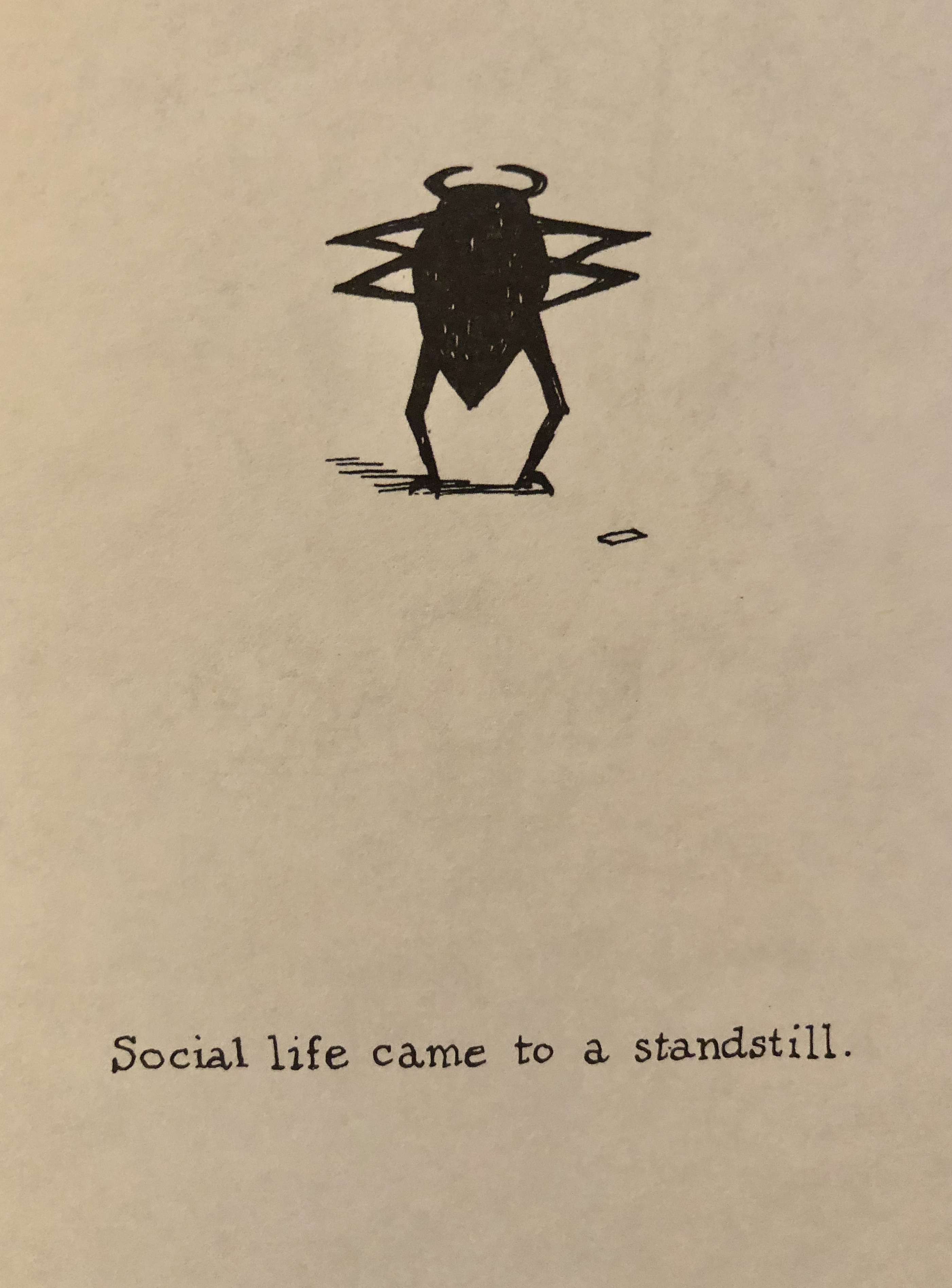
This is a page from The Bug Book by Edward Gorey. The story is about a bunch of bug cousins who are happy and carefree until this new bug (the one in the illustration above) arrives, breaks up their parties, and waylays them whenever they go visiting. The cousins conspire to solve the problem by rolling a rock off a cliff to crush the big bad bug, which they successfully do. The story ends with them slipping the remains into an envelope, addressing it “To whom it may concern”, and propping it up against the fatal stone. That’s it. Then they throw a party.

Edward Gorey, if you’re somehow in charge of the universe in your postmortem form, I just know you’re the scriptwriter for 2020 and those bugs finally mailed that envelope.

Hallelujah Cookies

As a student of Latin, a former English teacher, and a lifelong language enthusiast in general, I’ve always cared a lot about two topics I find compelling and important: grammar and punctuation. As a young learner, I delighted in books by Richard Lederer, grand master of wordplay, and diagramming sentences brought me great satisfaction in seventh grade. I offered a grammar elective at the school where I used to teach (we had so much fun!), and I’ve made a collection of drawings using only punctuation and diacritical marks. (What amazing names these graphological characters possess! I’ve always wanted to write a story featuring characters named Umlaut, Cedilla, Tilde, Circumflex, Macron…the list can obviously continue.) One year, I dressed up as a compound sentence for Halloween by wearing a banner with the words “independent clause” on each arm and a sign saying “coordinating conjunction” around my neck, instrumentally decorated with a big fat comma in black Sharpie. Some mornings I wake up and scroll through posts and comments in my Facebook grammar group, which is frequently fun, sometimes distressing, but always elucidating. Let me tell you, these people have OPINIONS.

Recently there was yet another debate about the Oxford comma, and some of those arguing in favor cited humorous examples of what happens when it isn’t used, such as “Among those interviewed were Merle Haggard’s two ex-wives, Kris Kristofferson and Robert Duvall” and “This book is dedicated to my parents, Ayn Rand and God” (that one had me rolling). I agree that punctuation matters because using it, and using it correctly, favors specificity within language, which then favors clear communication, and who doesn’t love that? Conversely, punctuation can also be used intentionally with the purpose of ambiguation, often with fascinating outcomes.

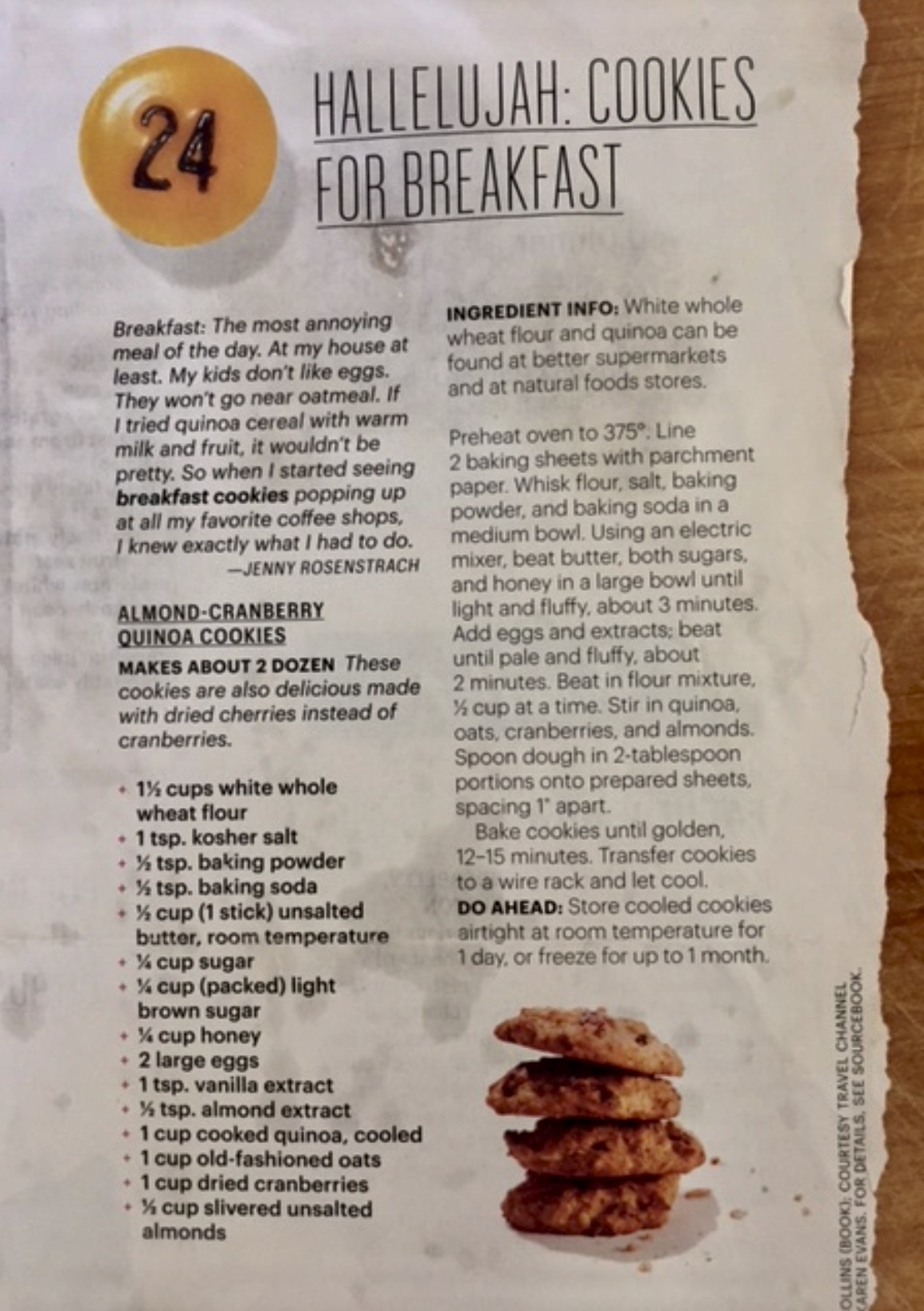
However, there is something to be said for what can happen when mistakes are made. For example, how many accidents in the kitchen have produced something new and entirely wonderful? This is supposedly how we ended up with things like potato chips and Worcestershire sauce and ice cream cones, after all, and our world is decidedly a better place for those inventions. Similarly, when punctuation is overlooked or omitted, new turns of phrase can be born that deserve to exist if only for their novelty, similar to how autocorrect has provided so many inside jokes for so many people in the age of text messaging. One of my favorite examples of punctuation falling through the cracks was told to me by my platinum friend, Becca, one day when I arrived at her house. We had both baked that day, unbeknownst to the other, and greeted each other with gifts from our ovens. Hers for me was a packet of foil containing a most sublime confection: Hallelujah Cookies. This is their name now, given to them by Becca, who found the recipe below in a magazine and didn’t notice the colon in the first line.

Rules: we need them. They keep us safe and help us make sense of the world around us. They facilitate our ability to interact constructively with each other and exchange ideas in productive ways. They give us a language of regularity and structure. They often account for predictability, stability, and cooperation. But also! Rules: when we break them, sometimes, just look what beauty is engendered there! Bear witness; therein can exist a kind of revelation. Hallelujah.

P.S. Becca’s kids recommend adding chocolate chips to these. I have to say, as kids brought up on the kind of incredible food their parents produce, they know what’s good.