A New Hello

Halloween in our neighborhood is extraordinary. There are so many friendly people behind the doors of these houses built in such close proximity to each other, and so many of these houses are decorated inventively and extensively for the holiday. Each year, there are also families from outside the neighborhood who visit for trick-or-treating, so our sidewalks see a tremendous amount of footfall that night. The past few Halloweens, we’ve invited friends (many of whom live in areas of town where the spread between homes is wide) to meet in our backyard and front-load the impending influx of simple sugar with some pizza before walking door-to-door in the early evening, leaving a couple of teenaged siblings at the house to hand out candy. It’s the only annual gathering we host, and we look forward to it every year. I’ve been particularly anticipating this Halloween because it falls on a Saturday, which not only would give me extra time to prepare for the evening event but would also allow for the potential of adding a fun activity to the afternoon for some of our guests to enjoy with us. And because that night falls in the middle of the weekend, it wouldn’t be as critical to get the kids home and settled and in bed to prevent them from awaking as zombies for school the next day; they could stay out a little later, enjoy glow sticks in actual darkness, run off the candy a bit longer, and silence that alarm clock to rise refreshed in a leisurely way: easy like Sunday morning. I mean, how often does Halloween fall on a Saturday when kids are all old enough to appreciate it and also young enough to appreciate it? Answer: once. This year. And, as if all of this weren’t exciting enough, October 31st falls on the night of a full moon, the second full moon of the month! Too good to be true, right? (Spoiler answer: yes.)

Because the world has become most unusual, those plans, like so many others these past eight months, had to change. I don’t feel comfortable taking my kids out to trick-or-treat among what could be thronging masses of people wearing the wrong kind of mask or not wearing any kind of mask at all (who would ever have thought that a bunch of barefaced people would be more terrifying than any gory, ghoulish, or otherwise ghastly costume?), so we’re opting out of the regular festivities. While trying to come up with an alternative plan to find fun for the kids, I began anagramming the word “Halloween”. I play with anagrams for many reasons, but in this case it felt symbolic: if we’re scrambling our plans and reworking the usual order of things; if we’re redesigning and restructuring and reorganizing the bare bones of normalcy; if we’re breaking the raw materials we have on hand into basically amino acid form and building them back up to create unprecedented situational proteins–well, it seems fitting that there should be new words to relate to whatever this process yields. Here is some of what I ended up with:

Lone Whale
All Owe Hen
An Eel Howl
Whole Lane
An Owl Heel
All Ewe, Hon
Hella We On?

A special one for my very special friend who loves to decorate for Halloween:

Whoa, Ellen!

And my personal favorite:

O, A New Hell

Which suddenly morphed into

A New Hello

And then I came up with an idea for reverse trick-or-treating: we’ll deliver treats to anyone in the neighborhood who puts up a sign saying theirs is a house where children live. I’ll send an email and invite others to do the same. We’ll wear costumes and walk around in the bright light of day (or maybe drive around in our costumes if it’s pouring rain) with plastic pumpkins full of candy, and we’ll toss it onto porches in the spirit of everything it takes to turn “hell” into “hello”, which sometimes feels like a lot but turns out to be really not that much at all.

How often does Halloween fall on a Saturday? Not very. How often does A New Hello fall on a Saturday in the year 2020? Exactly once in a blue moon.

P.S.: In the photo of my calendar above, you might notice that the paper has a furred look to it inside the Halloween square, between the words “Blue Moon” and “Halloween”. That’s because one of the kids put a sticker there, a black cat wearing a witch hat, which was later removed by said child. I don’t know why it was removed or which child did the removing, but I’m sure there was a very good reason.
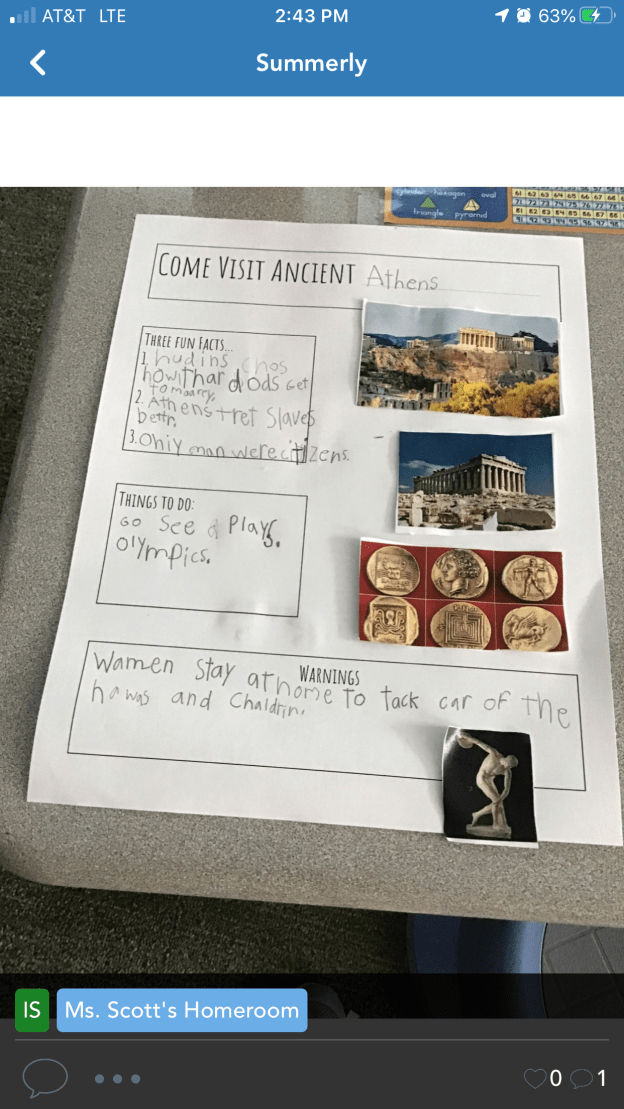
Come Visit Ancient Athens

My second-grader posted a photo of some work she did at school recently, and because her spelling is still in a stage of development, I will disambiguate below.

***
Three fun facts…

  1. Husbands choose whom their daughters get to marry.
  2. Athenians treat slaves better (than Spartans do).
  3. Only men were citizens.

Things to do:

Go see plays.
Olympics.

Warnings

Women stay at home to take care of the house and children.
***

Who wants to visit Ancient Athens? Not my daughter, apparently.

Through a looking-glass

I recently came across some of my old poems, and this one was among them. In revisiting it, what’s so interesting to me is that I wrote this half my life ago, at the shiny penny age of 20, long before becoming a mother or even thinking about becoming one. Among my thoughts as I revised it just now: How did I know? And also: How little did I know!

Ablutions

He sits quietly,
curl-riddled head tipped back,
tiny red sockfeet
making a V at sofa cushion’s edge
I hope
while I shower,
ironing my skin with
a cake of green soap
shaped like a Stegosaurus
with tail serrated
and honeycombed hide.

Turned toward the television,
his eyes are sand-dollar round,

hair ringleted, coiled
like pulled springs.
He doesn’t even notice I’m gone
or blink an eye when Alice suddenly
shrinks like a wool sock,
having drunk from a bottle
ambiguously labeled.

Water slaloms down my shoulders,
drowning out the caterpillar’s smoke rings
sounding long syllables
in puffs like lavender eyeshadow,
hot droplets drowning the residue
of days, cleansing only what
we know to wash away.

How much can happen in seven minutes,
the time it takes to lathe a razor
over legs, to knead the soap
from my squinting eyes,
to paint a rosebush red?
I am guilty, every second
I am gone I am guilty,
putting faith in what diagram
of stars I cannot say.

The curtain rings clink
together like loose change.
Alice cries into her pinafore,
thinking she is lost forever,
but he answers when I call his name.
Another day, I am clean
and my child is still alive.

When life gives you lemonade

I’d picked up everything on my list at Costco, and on my way out I thought I’d walk by the book table to see what was there (Christmas is in less than three months’ time, you guys). Immediately my eyes fell on a box set of books I knew Liam would love, and (if you’re a kindred book lover, you’ll recognize this experience) I drifted to pick them up for a look as if the entire rest of the world had temporarily vanished. For all I knew, I floated there, I flew there, I vaporized and rematerialized with that book set in my hands. While enthralled in this approximately sixty-second rapture, a woman’s caustic voice cut through: “Is this your cart?” I looked up to find that, yes, this woman was addressing me, though her sunglasses indoors paired with a face covering gave me a moment’s hesitation, as did her tightly knotted neckerchief, and yes, she was in fact referencing my shopping cart that I’d left between the book table and a table covered in piles of loungewear when I’d been inexorably pulled away by the magnetism of new literature. “Yes,” I said, startled. “Why?”

“Because it’s blocking the way. It’s right in the way of EVERYONE.” I wish you could have heard the acid in her voice. Sure, my cart was totally in the middle of the aisle. Could another cart have maneuvered around it? Yes, thanks to Costco’s generously-sized everything, including space between displays, though it might have cost the cart’s driver an extra moment or two to manage the swerve-around. Still holding the books (don’t worry!), I promptly moved my cart and the woman pushed through, looking just where I don’t know because of those sunglasses, and when she’d passed, a woman folding inventory on the leisurewear table turned around and looked at me in horrified sympathy. I rolled my eyes in response (how great is it that we can convey these complicated expressions even while masked? And how many people now daily appreciate just how very powerfully and specifically eyes possess the ability to emote?!). When the sunglasses and neckscarf were out of earshot, the woman who’d shared my shock faced me fully, and I noticed her Costco nametag. “Why are people so rude?” she asked. I shook my head. “So sad,” I said, and she said, “I know! How hard is it just to politely ask someone to move a cart?”

We went on to have a conversation during which I told her that my first thought on the heels of the interaction was, ‘I’m glad my kids weren’t here to witness that example of adult unpleasantry’, which was immediately followed by ‘I wish my kids were here so I could use that as a teachable experience’. By now I’m quite familiar with the reactionary feelings of relief and regret coexisting within a moment, but it was interesting to share them as they were happening with this person who was at once a stranger and an ally. However, I’m not sure she understood what I meant when I said, “So sad,” which was this: I suspect that other woman must be so unhappy. And that makes me sad.

What kind of person is blatantly rude to strangers (especially during a worldwide pandemic)? What kind of person amplifies a small inconvenience in an effort to call public attention to another person’s mistake? What kind of person emanates unfriendliness energetically? The answer seems obvious: a person who’s unhappy in some deep and meaningful way. This woman, by the way, wasn’t someone with half her life left to enjoy, unfortunately; I’m guessing her age (again, it was difficult to discern much behind the facewear and the eyewear and the neckwear and the definitely dyed hair) was about 75. Taking all of this into account, it makes me think that this woman has been unhappy for very long time, and that’s what really struck me with a sadness. If we weren’t in this season of Covid, and if I’d been feeling particularly audaciously ambitious (perhaps empowered by the 20 oz. cup of Tropicana light lemonade I used to love sipping while trying samples throughout the store back in the recesses of 2019), I might have considered approaching this pillar of salt of a person, removing her sunglasses, and giving her a hug. At the very least, it would have been a fascinating interpersonal experiment. At the very best, she might have unfixed the snug knot in that scarf around her neck and waved it in the name of empowerment, then gone forth to purposefully change the frame of her world.

Ah, a woman can dream!

Two conversations

A Conversation with My Husband

Brian (noticing I wasn’t really eating dinner): “Are you not going to have any?”

Alison: “I’m really not hungry. I just ate some stuff.”

Brian: “Oh yeah? What did you have?”

Alison: “I unpacked all the lunchboxes.”

Brian, “Oh, right. Ok.”

A Conversation with my Kindergartener (in his bed at bedtime, of course)

Arlo: “I want to invite Broccoli to my party.” (His classmate is named Barclay. But I don’t correct him.)

Alison: “Absolutely. We’ll make sure to invite him to your next birthday party. I think we’ll be able to have birthday parties next year.”

Arlo: “And I want to go the the Discovery Museum.”

Alison: “I do too. It’s closed now, but I think they’re planning to reopen as soon as they can.”

Arlo: “It’s all because of the virus. I know you don’t like this word, but I think the virus is…”

Alison: “Stupid. I know; you want to say the virus is stupid.”

Arlo: “I’m so mad at the virus.”

Alison: “I hear you. I’m also mad that people aren’t wearing masks when they should be.”

Arlo: “We should teach them!”

Alison: “Yes, we should!”

Arlo: “Or punch them!”

Alison: “No, that would just make things worse.”

Arlo: “Or kick them!”

Alison: “No, not that either. I liked your idea about teaching them. What if we could punch and kick the virus, though?”

Arlo: “YEAH!”

Alison: “Maybe we could invent a virus for the virus!”

Arlo: “YEAH! We could make a virus that’s on our side!”

Alison: “Yes! A Supervirus!”

Arlo: “Ok! Goodnight! Have a good day! Work hard!”

In vino veritas indeed

One morning last week I attended my first meeting as a Garden Club member, where I received a nametag with a sunflower sticker on it to designate me as “new” and a beautiful floral face covering made by one of the other members. The gathering took place outdoors on a patio at a local vineyard/winery and began with a presentation by the founder and owner of the vineyard, who talked to us a bit about her journey to now and some of what she’s learned about growing grapes and making wine. While she spoke, there were a few moments when I repeated her words in my mind a few times because the ideas, which just rang so true, transcend the topics of grapes and wine (not that those topics aren’t important. They ARE. But grapes are mostly important to me because, well, wine).

For instance, she said, “When we started out, we had questions like, ‘How do you make Merlot?’ and we learned that you don’t make Merlot; you grow Merlot.”

A little while later she told a story about having a viticulturist come in to answer why some of the Cabernet Sauvignon vines weren’t doing as well as their neighbors, why they seemed more susceptible to powdery mold, why they weren’t putting out healthy growth. When the expert took a look at the plants, she said, “Those aren’t Cabernet Sauvignon vines. Those are Pinot Noir. You’re treating them like Cabernet Sauvignon, but they need to be treated like Pinot Noir if you want them to grow well and produce.”

It was about then that I thought, “At what point did she stop talking about winemaking and start talking about parenting?”

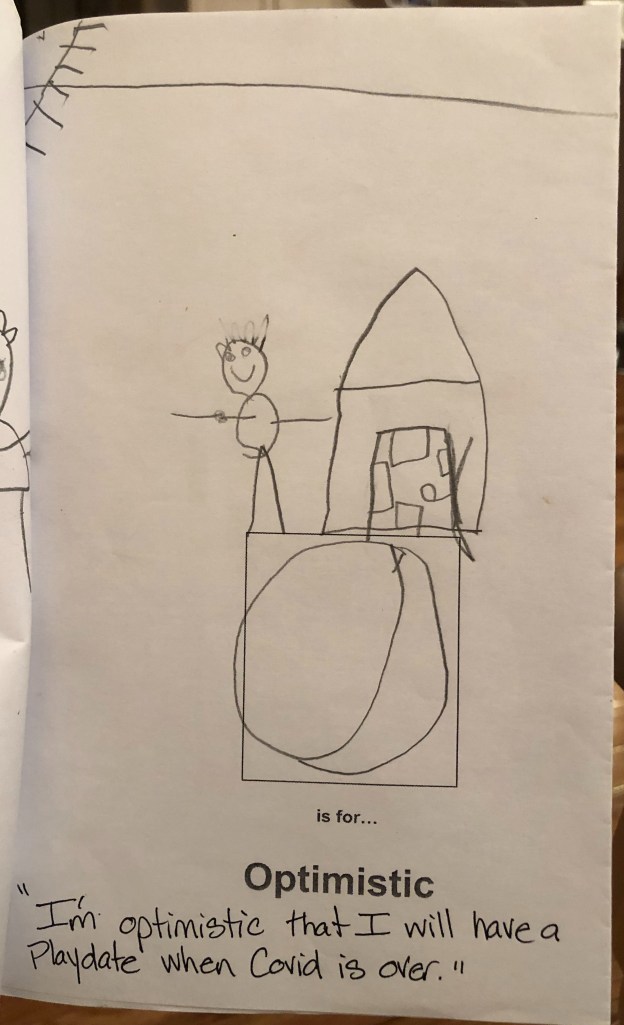
O is for…

My newly-minted Kindergartener brought home a book he’d made at school entitled My Feelings A to Z. This is page 15. Just look at that sun punctuating the top left corner, trying so hard–oh so very, very hard–to shine.

Why they bloom

The garden is a mess right now. This happens every year: we plant in the spring with so much hope and intention, weeding and watering and scouting for sprouts, delighting when the potential we buried in that soil rewards us with growth. It’s such a tangible thing, gardening, and so simple in those early days: water, weed, repeat. And then it gets more complicated: thinning the seedlings, staking the peas, caging tomatoes. After that, the questions begin: To pull the suckers or not to pull the suckers? Why are all these zinnias and cosmos and garden balsam growing where I planted only bush beans? What in the world is this pox of a weed that replicates with furious multiplicity? Why are the tomato roots growing so shallowly? Next it’s time for assault by insects. How do I remove squash bug eggs from zucchini leaves without damaging them? Is that seriously a hornworm on the grapevine? What can I safely spray on aphids? I HATE JAPANESE BEETLES. Then the harvesting: what do I do with seven thousand curly mustard greens? How can I use all of these tomatoes before they froth and ooze all over the countertop? Why doesn’t anyone want any of the 12 zucchini that all ripened within the past 48 hours?

There’s so much learning that happens throughout this process, which is wonderful, but it’s also just SO MUCH WORK. And it’s positively heart-rending when squash borers show up and massacre in their messy and most unpleasant way, when the deer lay waste to crops in minutes that they’d ignored for months, when the cucumber leaves turn yellow and then brown literally overnight. These disappointments are counteracted by gardening success stories, of course: for instance, this year the brown turkey fig was so prolific that we all ate as many of those sweet little jewel-bags as we could, then I made jam, and still there are dozens more on the way. This, after two years of the little tree growing lots of hard little green figs, only to drop all of its fruit before any ripening had a chance to occur–what a surprise to find it flourishing in this, the weirdest year ever! The grapes, too, gave us bountiful bunches, and we even got a handful of blackberries over the course of many weeks. But the stars of the garden, I think, are the volunteers.

This year, our cast of volunteers wasn’t limited to the flowers flourishing where I hadn’t planted them; we also had volunteer tomatoes, basil, lettuce, tomatillos, and exactly one cantaloupe vine, which came up late in the game. These were all children of last year’s plants, seeds that overwintered where they’d fallen, the seasons all having happened to them while they waited for that final frost to pass. These are the seeds that survived, that withstood the slings and arrows nature flung their way, holding within them a spark of their future selves. These were the proto-plants self-selected to LIVE. The word “volunteer” comes from the Latin verb “velle”, which means “to want.” Sure, we’re talking about seeds, but whoever chose the word “volunteer” for these plants recognized some kind of volition, at least etymologically. Does this make these plants predisposed to be hardier or healthier, considering the harrows they’ve endured to make it to the moment they could finally put down roots? Does this mean that they’ve earned themselves a garden plot by virtue of their horticultural fortitude? Is proof of life warrant enough to grant them space to grow?

I don’t know, but I’m glad I let the garden take itself over a little. I finally realized that the prosperous flower patch was likely the work of our backyard birds, who feasted on the seeds nested inside petals last fall then sat on our fence to chitchat and defecate directly into the raised bed underneath. Perhaps the capsule of fertilizer that accompanied these seeds to the ground is the reason the flowers grew to six feet and have bloomed for three months, but I have to say: any seeds that have passed through the digestive tract of a bird deserve some respect. I mean, the gizzard is basically a rock tumbler of an organ, so those little seeds that made it through are the American Ninja Warriors of the garden, and I’m going to let them flex their survival muscles in hopes that next year a third generation of volunteers will poke their little green crowns through the surface of the soil. And I will say to them that their parents went through a lot to give them life, that being a volunteer means more than just saying, “I’ll do it.” It’s not just about giving, it’s about wanting to give. It’s about facing things like a hard freeze, a drought, a gullet and two rough stomachs. It’s about a lot of patience and waiting for good timing, fighting for space and light, incorporating resources in ways that favor health. I will say to them that I watched their parents strive, literally in some cases bending over backwards, to find a way to bloom. I watched them bloom, and why did they bloom? For you.

Dad jokes: not just for dads

Arlo, using a pair of toddler safety scissors to try to open his yogurt tube: “This isn’t working!”

Alison, opening the drawer for the utility kitchen shears commonly known as “my scissors”: “Here, buddy, try these. Those little scissors just aren’t going to cut it.”

I might have been the only one laughing at that one.

***

Alison, trying to get people to perk up in the morning when feeling significantly sub-perky myself: “Hey, guys, I have a joke! How do you know that Cecil (our pet bunny) is always listening to us?”

Them: “How?”

Alison: “He’s all ears!”

(They didn’t get it.)

***

Cecil had been trying to mark the sofa as his territory (god forbid we humans own any part of the downstairs anymore), and we’d been enforcing a new “no bunnies on the sofa without people on it too” policy to avoid territorial deposits of both liquid and solid form. One night, he kept trying to hop on up, only to have Brian scoop him to the floor repeatedly. Cecil wasn’t happy about this. Brian: “He’s so p!ssed off. Literally!” Alison: “Yeah, no sh!t.”

This time there were actually two people amused. Cecil? Not so much.

Wrong number

A year or so after I graduated from UVA, I moved to rural Connecticut and worked in a publishing house and then a junior boarding school, met my husband, and had our first baby. Those tristate New England environs were so remote that it was about an hour’s drive to anywhere nationally recognizable (think DMV, Target, any chain grocery store), and we frequently had to leave the state to source things that seem pretty basic from an urban perspective. This is why I currently own three items procured from Pittsfield, MA: my engagement ring, my wedding ring, and my mobile number (area code 413 to this very day!).

Not long after setting up my first cell phone (I was very late in the game in owning one of those because there was no cell tower that serviced our little town until soon before we moved back to VA), I started getting phone calls and texts from people looking for the person who previously possessed my phone number. But these weren’t your run-of-the-mill old friends with outdated records or telemarketers or crowdsourcing cold calls; no, these were people either looking to buy drugs or looking to make a lockup.

The name “Stephanie Danforth” sounds like a litigator in a John Grisham book, right? Or a private investigator starring in a series of books published in the 80s and 90s? Well, this Stephanie Danforth, the woman who used my digits before they were mine, appears to be quite a different kind of colorful character. I’d get texts saying things like “hey you holding” or “I’m in for some when u got it” and repeated phone calls from collection agencies looking to track her down for past due payments. I got several calls stating, “This is your final reminder to appear in court on [whatever date] at [whatever time]. Failure to comply with subpoena will result in your losing your right to testify.” Plenty of laypeople called, too, sometimes late at night with nightclub beats thudding in the background to the point that I had to shout, “THIS IS NOT STEPHANIE’S PHONE NUMBER ANYMORE!”

Why didn’t I change my number, you ask? Well, I thought all of this would end after a few weeks. Or months. It did not. And by then, it just seemed like too much trouble when we were about to move anyway. At first, I found all of it annoying. Then it started to fascinate me. Who IS this person? (A google search turned up nothing.) And HOW does she keep avoiding being apprehended? She’s like my very own Carmen San Diego for the 21st century, and I developed a strange respect for her ability to float along under the radar. Now, over a decade later, I haven’t gotten any calls or texts meant for Steph in a long time, and I don’t exactly miss them, but it was nice once in a while to be able to say, “You have the wrong person–I’m not the one you’re trying to arrest or shake down or meet up with to make an illegal exchange!” There was something gratifying about being purely self-righteous, even to a stranger, maybe especially to a stranger. Saying, “I didn’t do it! Not guilty!” and knowing that was completely, empirically true, was oddly liberating.

I still wonder about Stephanie and what’s happened with her. Is she alive? Did justice ever prevail against her misdoings? How old is she and what does she look like? For the purposes of wrapping everything up in a little bow, as we have every right to do when we’re making up stories, here’s what I hope: that Stephanie Danforth, having seen the error of her ways, abandoned her life of crime along with her old cellular plan, used all the money she’d saved from selling coke to buy a motorcycle, and rode it all the way from Pittsfield to Playa Del Carmen, where she worked her way up to manager at a popular crab shack and now teaches surfing pro bono to underprivileged youth. She, too, recently turned 40, and spent the day on the beach with her German Shepherd, Soldedad, drinking Palomas by the pitcher and reading Michelle Obama’s autobiography until it was too dark to see.

Steph, if you’re out there, please call me (you know my number). I have so many questions.