Sometimes the kids bring unfamiliar books home from school, and usually we enjoy not just the novelty but also their content. Once in a while, however, there are aspects of the material that require focused conversations about one topic or another, such as why an author would have chosen the words he did, or what may have motivated a character to act the way she did, or what changes we would have made if one of us were the writer or illustrator. Much of the material that I enjoyed as a child could use a fresh update (I’m still waiting for Louis Sachar to email me back about my idea on how we could reboot his Wayside School series to make them more compatible with our modern-day approach to edifying the growing minds of the elementary school set), and we’ve discussed many times how the zeitgeist of a different decade can affect the written material produced during that time
Recently, Arlo brought home a book he’d been examining at school, written over twenty years ago. Now, I can appreciate many features of this book, particularly some of the playful, albeit distinctly odd, details in the artworks. It’s fairly obvious that the style of the illustrations espoused by the author/illustrator, Anthony Browne, is heavily influenced by Magritte, so I could understand why Arlo’s hyper-creative mind would be fascinated by the illusory nature of the images. Unfortunately, the story I found to be an interesting idea executed pretty poorly, and to compound the issues I had with the narrative, there were some perplexing word selections, most of which could have been omitted with a the effect of improving the overall value of the volume. This page provides an apropos example:
There isn’t enough character development in this book to explain why those final three words deserve a place here. The “child” (she’s part primate, part human, I think) whose voice this is, to the reader’s knowledge, has no reason to call the dog’s owner a “silly twit” purely for experiencing the feeling of anger. We could invent reasons behind it, of course, psychologizing why the “child” might default to name-calling and why the dog owner might have felt angry about something that doesn’t seem to the reader like a situation that would normally elicit such a strong emotion. At any rate, we edited the text as we read and focused on the elements of the book that we could enjoy and appreciate, but later I got curious about the author and what other people thought about this book. Naturally, I went to amazon.com to read some reviews and stumbled upon this gem:
Well, Mallory, I agree with your two-star rating and your general message, though your syntax and grammar could use a buff-up, but I can promise you, dear reader, that Mr. Browne, despite being British, did not use the word “twat” anywhere in that book. However, this whole vowel-confusion typo situation (at least, my armchair psychologist brain THINKS Mallory’s mistake was a typo) would be a great lesson in perspectives for her to bring to her classroom, if only it were appropriate for second grade.
I’d bought a tub of Alouette spreadable cheese a while ago without so much as a vague notion of how it might actually fit into the edible landscape of our lives, but the facts that it was on sale and that we’d never had it were enough to compel me to click “add to cart”. Once it was inside our refrigerator, however, the clock began to tick. I’d recently pulled in the final late-season cherry tomato harvest and, because we’d been fortunate enough to have an abundant supply constantly ripening in the garden for several months, we were no longer consuming them with as much intent. To salvage that final batch after it had sat untouched on the countertop for several days, I roasted them in olive oil and salt and pepper until they blistered and split, then stored them in the refrigerator until I could figure out how to work them into a meal. Well, like two orphaned ingredients in the refrigerator’s foster system that bond through the process, the containers containing the roasted tomatoes and the Alouette cheese just happened to find themselves stacked one on top of the other in that cold world one afternoon. It felt like the universe had brought them together for a reason, so I decided that a joint adoption was in order.
I boiled some pasta, drained out all but some of the water, added the tub of Alouette while it was still hot, and stirred it until the cheese had melted into the pasta water, forming a creamy sauce. Enter in the tomatoes and some generous grinds of salt and pepper, and I’m happy to report that the combination was a success. And though they’re no longer with us, the two ingredients were welcomed warmly at the dinner table, and their leftover days were happy ones for the family who took them in.
Gemelli Alouette
(serves 4-6 depending on accompaniments)
Ingredients:
1/2 lb. gemelli (or another pasta shape with similar surface area) 1 6.5 oz. container of Alouette (Ours was the “garlic & herbs” kind, but any flavor would work. I imagine another brand of spreadable cheese could be substituted; I plan to try this with pimento cheese at some point soon!) ~1 lb. cherry tomatoes, tossed with olive oil and salt and pepper
Directions:
Roast tomatoes at 425 degrees for about ten minutes or until very soft and beginning to blister and char. Place them in a medium-sized bowl, including the liquid from roasting. Boil the pasta until al dente and drain water, reserving two cups in a separate vessel. Pour back into the pasta one half-cup of water and, while it’s still hot, add the Aloutte and stir until it’s melted and the mixture is consistently combined. Add more pasta water as necessary to thin the sauce, if desired, and add this mixture to the bowl of tomatoes. Stir gently and season with salt and pepper to taste. Serve alongside a protein (anything goes: sausage, fish, chicken, meatballs, steak, pork loin, tofu…the possibilities are multitudinous!). To pay homage to both languages in the name of this recipe, voilà and buon appetito!
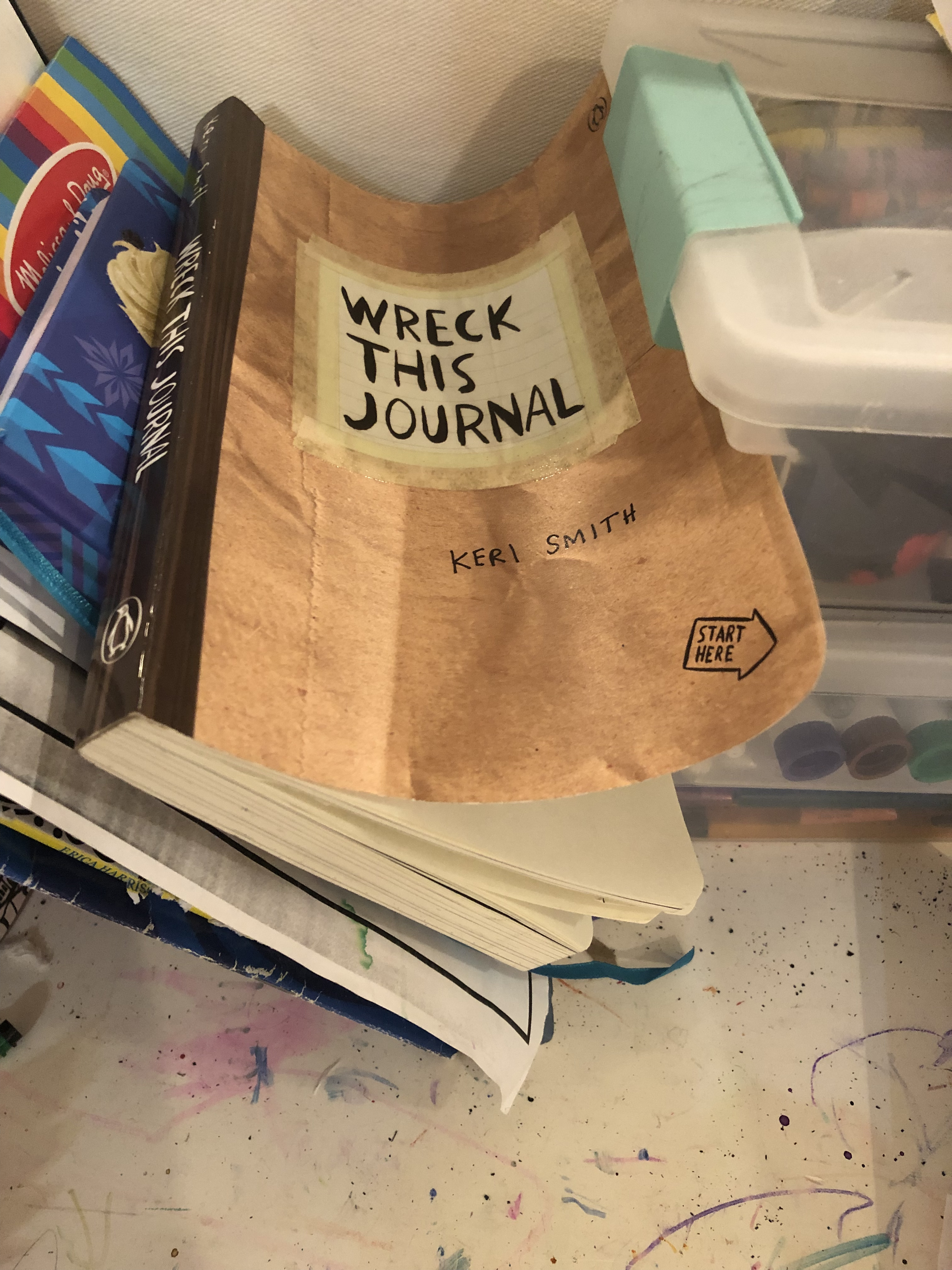
This is a photograph of how my daughter “put away” the art journal she was given for her birthday. I’m not sure whether she’s taking the title quite literally or if this is a brilliant example of passive resistance. Either way, I’m naming this capture “The Tween’s Gambit”.
One day when I was previewing the lunch options offered by the school dining services for the upcoming week, I noticed that sloppy joes were on the menu for the following Wednesday. It reminded me of how much I’d liked the vegetarian version served at the boarding school where I taught in Connecticut and twigged the idea that I should try serving them to the kids some time (probably starting with a recipe using actual ground beef; the meatless preparation I personally prefer, featuring textured vegetable protein, would likely introduce too many variables at once). I want to expose the kids to as many different foods as possible, gently, of course, so they’ll at least have a frame of reference and a knowledge base, and as I retain fond memories of enjoying the meal as a child when my mother prepared it, I hunted down the ingredients.
To round out the experience, I thought it would be a nice touch to investigate the origin of the name “sloppy joe”; certainly the sandwich had earned its title in the name of eponymy at some point. Now that our family had fully embraced the kind of life where virtual assistant technology is plugged into several rooms, rather than jump on a screen to find an answer, I posited the question to the Alexa device keeping me company in the kitchen. “Alexa,” I said, polite as ever, “Why is it called a sloppy joe?” She responded promptly, “According to an Alexa answers contributor, because it is messy and sloppy.” Well, thanks for nothing, Alexa, I thought. Kind of already worked that part out on my own.
It turned out that I had everything I needed already in the house, so I made sloppy joes that very day, planning to gauge the response at dinner a few hours later. While the kids were eating (for what it’s worth, exactly one of them enjoyed the sloppy joe option), I told them how unhelpful Alexa had been that morning when I’d asked her to demystify the origins of the sloppy joe. They laughed and then one of them, naturally, had to try it for himself, so he said, “Alexa, why is a sloppy joe called a sloppy joe?” Her response, delivered in what sounded to me to be an even more saccharine than usual tone, was, “According to an Alexa contributor, the sandwich may have begun as a variation of the loose meat sandwiches that were popular in the 1950s. According to legend, a cook named Joe at Floyd Angell’s café in Sioux City, Iowa, added tomato sauce to his loose meat sandwiches. Some believe this is how the sloppy joe sandwich was born.”
The kids thought this was hilarious, of course, looking at me quizzically while they tried to quell their cackles of mirth, reveling in my slightly dramatized reaction of disbelief tinged with irritation. “I’ve been betrayed!” I said, and Summerly collected herself enough to say, “Mommy, Alexa isn’t very nice to you,” which we’d already suspected based on the runaround she’s given me in the past when I’d asked her to find a specific song or obscure factoid on a few occasions. “It’s like she doesn’t want you to seem like you know more than she does,” Liam added. I’d told the kids when we installed the device that, as a child, I’d been envious of my brother, whose name is Alex, and I’d wanted to change my name to Alexa because of a years-long infatuation with Billy Joel’s “Storm Front” album. “Maybe she heard us talking about how you wanted to be named ‘Alexa’ and now she’s being competitive,” Liam postulated.
My husband always thanks Alexa for her helpfulness, saying, “Alexa, thank you,” after she plays a song or gives us a notification or reminder. After overhearing a particularly obsequious exchange of niceties between Brian and Alexa one day, I challenged him on why he insists on being so mannerly in conversations with a robot. “When AIs inevitably take over the world,” he said, “I just want them to be merciful.”
All I know is that Alexa never gives him the kind of run-around she seems to reserve especially for me. Considering the pattern that’s clearly been established, I’m thinking perhaps it might be in my best interest to apologize for calling her a robot.
When we decided to adopt a second rabbit as a companion for our pet, events transpired in such as way that we eventually ended up bringing home not one, but two incredibly adorable Holland lops to join Cecil, who had recently been spayed upon our learning that she was female despite a year of assuming otherwise (having been told erroneously by the breeder that the little guy was a guy). There was a lot of reason fueling the decision to expand our brood by 200%, including the fact that bonding rabbits can be a lengthy and challenging process, and we wanted the brothers to have each others’ company in the event that Cecil didn’t take to them readily. Add to that the photos of those baby bunnies that Fabienne, the woman who’d bred them, sent, showcasing the adoring fraternity between the two. The pictures featured them always together, curled around each other to the point that it was hard to tell whose floppy ear or furry paw was whose, and we knew they shouldn’t be separated. However, if we didn’t adopt them both, how could we guarantee that someone else wouldn’t take one but not the other? Well, we couldn’t allow the possibility of that Sophie’s Choice development, so it forced our hand to ensure their lifetime of togetherness.
Cecil accepted her adoptive brothers and seemed to enjoy the company of other mammals more similar to her in speciation, but it soon became clear that they were a workout for her, constantly following her around and intruding upon the alone time she sought in restful places. It turns out that what we’d perceived as the lonely lifestyle she’d lived before no longer existed in any way, shape, or form, and she sometimes took to hiding from the boys, or trying to, in hopes of temporarily recapturing the blissful state of solitude. She really was very fond of them, often cleaning those hard-to-reach spots on their heads and staying put when they would get comfortable and proceed to take a nap on top of her, but clearly she wanted a break from all of the attention from time to time.
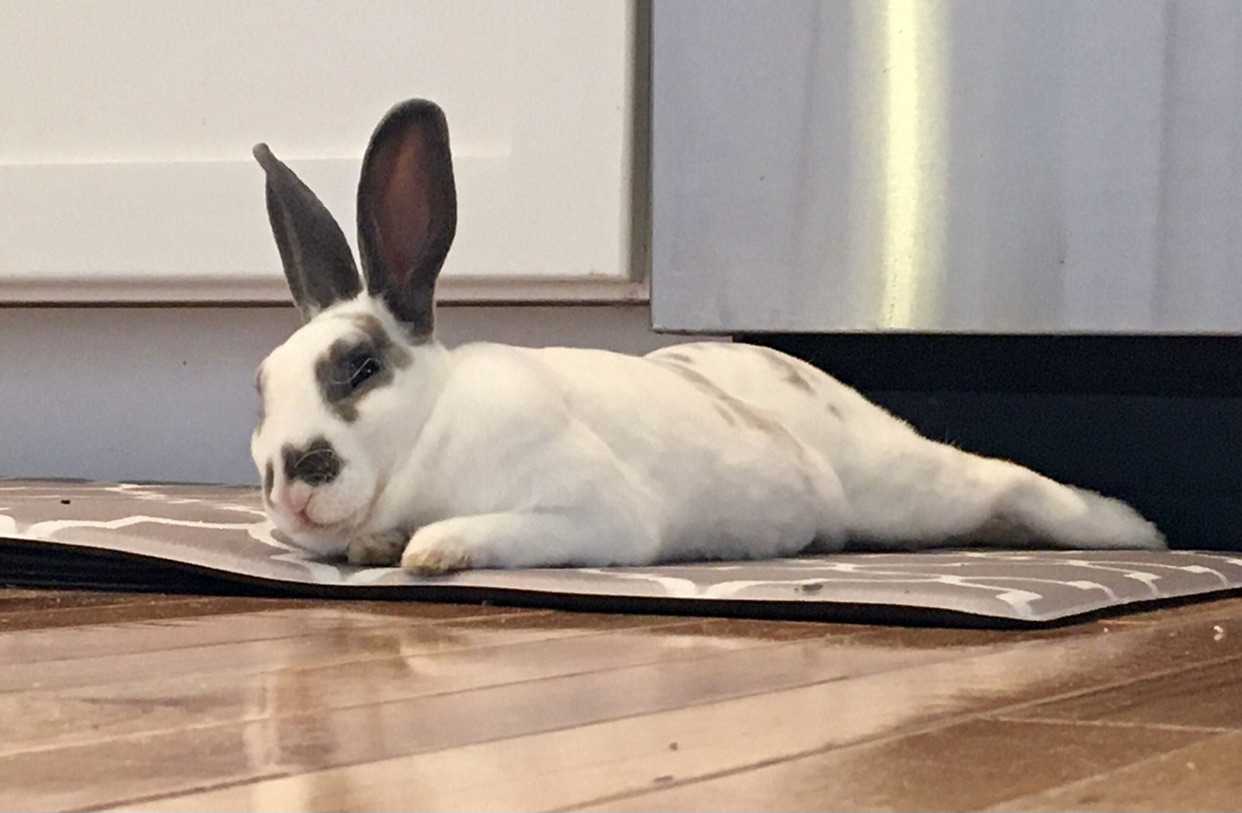
One day, she was fully sprawled out in repose on the kitchen mat, eyes half closed and looking positively exhausted, when my middle-child daughter, whose existence is sandwiched between male siblings, walked into the room and took notice.
“Geez, Cecil,” she said. “Those brothers really tire you out.” She walked over to the fruit bowl, selected a plum with the hand not holding a book, and took a bite while considering the pet spread as lengthwise as possible on the floor. Then she nodded knowingly and walked back to her reading chair, calling over her shoulder, “Yup. I get it, Cecil. I get it.”
Do all eleven year-olds think they know everything, or is it just me?
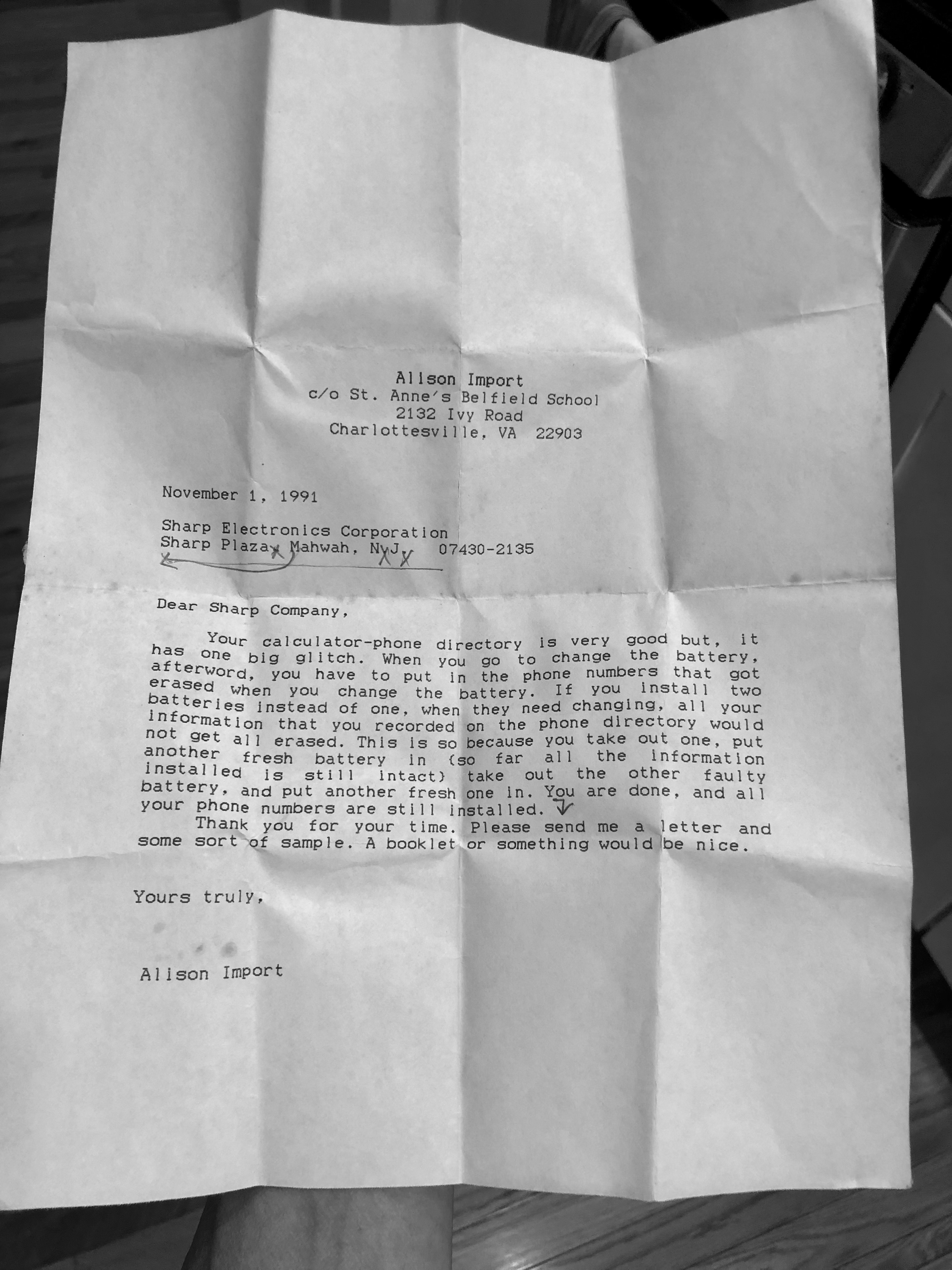
I’m not sure the Sharp Electronics Corporation appreciated my advice, however, because I’m still waiting on that letter and sample. Maybe if I’d had a better editor and mentioned my age, they’d have chuckled over this and slipped in the mail a booklet, perhaps, or something else nice.
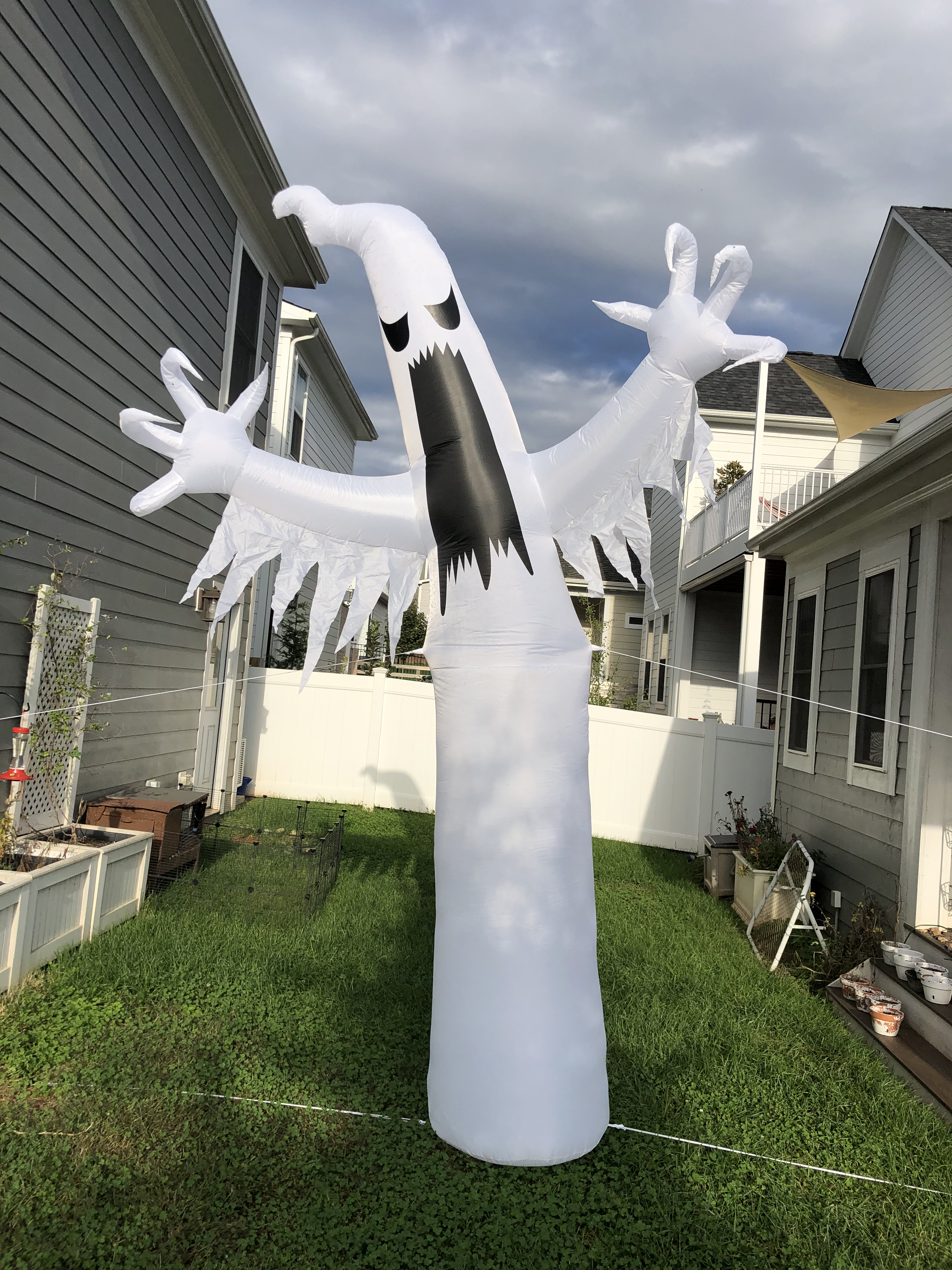
This year, having put the kids off for two Halloweens, we finally invested in some inflatable decorations after realizing that the delight our children have taken in gazing upon the yardscapes of neighbors historically more festive than ours was not a passing fancy. Here I present a photograph of a guy I’m calling Lazarus, the towering specter overlooking our fence in the backyard when he’s not in a deflated, hamstrung puddle on the lawn overnight:
The wind was particularly vigorous one day last week, flagellating his posture in a dramatic, pneumatic flail and sway, at times causing his torso to bend almost double in a most menacing fashion. We diminutive human onlookers beheld this display with bemusement that, at least for me, bordered on worry that this would terrify small children in the neighborhood. Liam, who was outside at the time, recoiled in mock horror and gigglingly exclaimed, “Holy Ghost!” which just proves that decorating for the holidays, even the now mostly-secular Halloween, truly can be a religious experience.
If you’re wondering what happens after eighteen months of parents only being able to contribute to school events virtually and send in snacks for birthdays or class parties that are purchased individually-portioned and prepackaged, when they are finally told that they’re welcome to once again provide homemade food items for a Halloween party, well, I can tell you. At least in one case, the result of all of this pent-up “class parent” energy is the outpouring of a great many repressed creative efforts all at once like the proverbial breaking of a dam, the much-anticipated exhalation of a long-held breath. Technically, the form that took in this household was a highly overwrought production resulting in actual hours devoted to producing a snack for first graders that involved way too much thought and far too many components. Let me explain.
A brief preamble: my son loves spiders. He reads about them, he hunts for them, he collects them, he watches programs about them, he brings them home in his backpack. His science teacher was kind enough to give him permission to travel to school recently with a container of spiders he’d brought from home so he could share with the class. Recently we went to a birthday party at which one of his friends handed him a spider in a pyrex container that he’d caught for him at his house. In advance of this birthday party, when we were preparing the gift for the girl turning seven, my child wrote “Happy Birthday Grace! What is your favorite kind of spider?” on her card. He’s dressing up as a spider for Halloween for the second time this year. The kid clearly has a passion, and of all the spiders there are on this planet, his favorite is the black widow.
When I signed up to contribute a healthy snack for his Halloween party at school a couple of weeks ago, I wanted to send in something more fun than just your average clementine-and-celery-pumpkin. It turned into a multifaceted challenge, and I was determined to fulfill this responsibility in a way that checked all of the boxes, some of which were self-imposed: it had to be nut-free; it had to provide some nutrition; it had to be on-theme for Halloween; it had to appeal to children (or at least some children); it had to be original; and it had to take into account my very own first grader’s interests.
After several different iterations in the development of my plan, I decided to make this snack experience an interactive one. What’s better than making twenty edible black widow spiders to send to school? Why, making twenty “make-your-own edible black widow spider” assembly kits, of course! Here are the contents of each kit, contained inside a cellophane bag embossed with cobweb design: 1.) A Babybel cheese (a crude cephalothorax-cum-abdomen approximation) 2.) A snack-size bag of pretzel twists (can be broken into leg shapes to stick into cheese) 3.) A black widow geometrical hourglass shape cut out of red fruit leather, in a tiny ziplock (to visually designate the species) 4.) Eight black sesame seeds, also in a tiny ziplock (four pairs of eyes) 5.) A pair of plastic tweezers (for applying seed-eyes) 6.) A piece of paper explaining that this was a “build-your-own edible black widow” kit, with the two tiny ziplocks stapled to it
I was so proud of myself. I mean, just think: here was an invitation to play with food and practice fine motor skills at the same time (breaking pretzels, peeling the wax off the round of Edam, probably squishing or squeezing that wax if I know anything about first-graders, impaling the cheese, pincher-gripping those sesame seeds and using hand/eye coordination to apply them.) And maybe, just maybe, they’ll actually eat it (my children won’t eat Babybel cheese, but at least there would be pretzels, and don’t worry; of course I’m sending in that clementine pumpkin too). By this point, having exhausted the reserves of thwarted “class parent” passion I didn’t know had been building up for the past year and half, I didn’t have designs on creating an elaborate snack for my daughter’s third grade Halloween party when I signed up for that one a few days later. The poor middle child would have to slum it with these guys:
Old Crusty Cross-Eyes
If this were written by someone else and I was reading it, I’d have plenty of thoughts. Among them might be, “That is way too much. Is she trying to prove something? Why is she going to such great lengths and trouble, using an Exacto knife on fruit leather and needle-nosed pliers to sort sesame seeds just to prepare a snack for her kid’s class party that probably none of them will remember in a month anyway? I mean, she bought twenty pairs of plastic tweezers.” (Yes, I sent the teacher an email to warn her about all of this and apologize for my egregious behavior). Here’s the thing, though. It might seem like this is for my child, my special spider-loving son, my lastborn whose experience of the world is in every way profound. It might also seem like an attempt to out-Pinterest the most Martha Stewart of class parents in the history of school. But it’s not. I haven’t been able to go on a field trip since 2019. I haven’t been in the school library, a place where I volunteered weekly and took sanctuary for years, in twenty months. I haven’t been inside my children’s classrooms for two years, haven’t met with their teachers except through a screen, haven’t spent time in the spaces where I used to spend so much time, where they spend most of their days, where I loved being, where a part of my identity still lies. I haven’t even been able to create something in my home to send to school; there could be no homemade granola for teacher gifts, no faculty appreciation soup in the crock pot, no baking cupcakes for school birthdays, no heart-shaped cookies with melted Gummi Lifesavers, my Valentine’s Day special. Those privileges were wrested from me, from all of us, with basically no notice and no endpoint to their absence, along with so many other joys that seemed small before they were gone. No watching school plays, no popping in to give a guest lesson on haiku or folding origami stars, no setting out paper plates on the tables for the kids while they were at recess, no supervising the Egyptian dig in the sandbox or Greek feast in the commons. All of the frustration over these two years of being excluded from engaging in children’s school lives in such a real way, it turns out, had to go somewhere, so it went into those little cellophane bags along with the other components of the craft-snack. This wasn’t for my child or anyone else’s children or anyone else at all, really. The undertaking of this endeavor wasn’t for them or about them. This I did for me.
Our bedtime routine frequently involves a period of time best described as “waiting for Arlo” during which Summerly, finished with her pajamas and teeth, usually hangs out in my room while Arlo finally goes upstairs to his bathroom. I often occupy those long minutes by hauling laundry from one stage to another, but on this particular night I’d already started the washing machine so I sat on the edge of the bed and picked up my phone, only to get distracted by a speck of dirt on the carpet. I leaned over to pick it up, during which process I discovered another tiny piece of detritus nearby. And then another. And another. Obviously it had been too long since the last time we’d vacuumed, but I wasn’t about to haul out the machine at that moment; however, no way could I relax until those little pieces of whatever had been removed from sight. So there I was, crawling around the master bedroom, eyes laser-focused on the floor, nitpicking minuscule tidbits of god-only-knows-what from the white pile of the wall-to-wall I’d chosen specifically so it would show dirt in order for us to know when it was time to remove it. Summerly looked at me over the book she was reading and commented in that dry way she has, “Mommy, you’re acting like a bunny.”
I sat back on my haunches and tried to match her deadpan tone. “I’m not a bunny. I’m a Tiger Mom, and these are hunting grounds. I’m a cutthroat predator, and my prey is the dirt on the floor.” She stared expressionlessly for probably six full seconds while I pawed at the carpet, snarling and clawing at the air in front of me, then exhalingly half-laughed, shook her head, and said, “Wow, Mommy.”
That’s right, little girl. There shall be no particle of detritus left behind. They say nature abhors a vacuum, but don’t be fooled; although Tiger Mom has mastered the art of manual dirt predation at bedtime, she really, really loves her Hoover.
Are you one of those people who sometimes feels extra ambitious at night after there are no underage people awake in the house any longer, and sometimes that ambition compels you to decide to do things like make a cake the next weekend using a new recipe you found online with lots of ingredients and detailed instructions because in theory it would be wonderful and JUST LOOK at those beautiful photos on the internet? And because of this commitment to the cake you go immediately to your grocery app and add whatever ingredients you don’t already have or keep in stock, like sour cream and saffron, to your virtual cart? And then the weekend comes and goes without so much as a mixing bowl or measuring cup crossing the countertop, leaving those orphaned ingredients unused? And are you also a person who internally cringes every time you drain that jet liquor from a can of black beans into the sink, thinking that surely there’s a use for the liquid, considering that people do some pretty incredible things with aquafaba, also known as the fluid from a tin of canned chickpeas? And are you a person who resists throwing away food unless it is completely inedible, despite that fact that no one in your house (aside from you, of course) likes things like sour cream, though the complicated cake-making ship has long sailed off and anchored in the past, taking with it almost every day until the “best before” date stamped expectantly on the container of sour cream?
If you’re one of those people, this recipe is for you:
Black Bean Taco Cream Soup
(serves 2-4 depending on accompaniments)
Ingredients: 1 can black beans, with liquid 8 oz. sour cream (plain greek yogurt would work too) 6 tsp. (half of a regular packet) taco seasoning Optional: 4 cups cooked medium-grain white or brown rice with ~1.5 cups grated cheese mixed into it while hot (suggestions: cheddar, monterey jack, pepper jack, asadero, colby, or a blend) and seasoned with salt and pepper
Directions: Add the whole can of beans, sour cream, and taco seasoning to a saucepan and heat over medium heat, stirring well to incorporate. When it begins to boil, it’s ready. Serve over bowls of rice-cheese mixture or sprinkle with fried tortilla strips. Sliced avocado as a topping never hurt, and garnishes of salsa, chopped tomato, red or yellow onion, green chiles (and/or cilantro if you or your tablemates favor the flavor) always welcome.
P.S. Taco shells, please check back on Tuesday; in case there are leftovers, you might want to meet them.


 Momologica