More magic

An ongoing topic of discussion in our household is how we handle “spoilers” in literature and film. It came up again one evening when one of the kids asked to flip ahead in the illustrated version of the Harry Potter book Brian was reading to them. His instinct was that this should be off-limits because the pictures can give things away about the story they have yet to read, and this, for him, tarnishes the experience. I’m of a different mind about it because sometimes I like to have an idea of what’s going to happen, especially considering the enormity of “unknowns” in real life. In my opinion, depending on the material, it can improve one’s experience of engaging with the content to know what to expect. For instance, for Arlo, if he flips ahead in the book and sees something scary, at least he knows to prepare himself for it and can pluck up his courage as they approach that chapter. Similarly, there are some cases in which I want to know what happens in a text or a movie so I don’t become emotionally invested in a character who, let’s say, doesn’t live ’til through final chapter or until the credits roll.

Sure, it’s great to experience all of the feelings as they would unfold in real time for some content, but there are instances in which I would elect to eliminate suspense, and I think I have the right to choose to experience the material in whatever way would maximize my enjoyment of it as long as I remain respectful of others’ choices surrounding the dissemination, or lack thereof, as it pertains to giving things away. Sometimes Summerly asks if she can preview one of the mini mysteries in the books I read to them at night before we experience it together, and I say yes because she never gives anything away unless expressly given permission, and she enjoys hearing the story a second time while knowing the ending. This way she gets to participate in the experience of witnessing us encounter the material for the first time, which can provide an interesting filter for interaction.

At the preschool my kids attended, the way they celebrated the kids’ birthdays involved something called the Birthday Fairy. This fairy would arrive bedecked in all manner of fancy attire, including wings and a (usually pink) wig, and she always had some kind of ornate face mask (I mean the pre-covid type of mask, the kind worn at masquerade parties, to disguise the fact that the fairy was actually one of the kids’ moms flying incognito). She would come toting her wand to guide the kids through a short birthday activity, give them a little gauze bag with the number of glass pebbles in it that corresponded to the number of years they were turning, and after she departed, the class would always run to the window to look for the wake of pink fairy dust trailing into the sky as she flew off to wherever Birthday Parties live.

After Arlo celebrated his fourth birthday at school, he came home disappointed and confused. I asked him what was on his mind and he said, “All of my friends said they saw the pink dust in the sky, but I couldn’t see it. I was looking right where they were looking, and there wasn’t any pink dust at all. Why could they see it and I couldn’t?” It was probably at this point that I poured myself a glass of wine because, although I’d somehow avoided this line of questioning with my older two kids, nothing gets past Arlo. I’d been to enough birthdays at the preschool to have seen this firsthand; there are always several, if not many, kids who claim to see the pink dust, and it made me a little uncomfortable every time. I told myself that their active imaginations were at work here, and that the power of suggestion combined with belief in magical ideas like Birthday Fairies combined with a real desire to see evidence of magic could indeed color their vision just like it colors the way kids see the world in so many other ways. I knew this was the only explanation I could give Arlo, so I gave it, believing at the time that he wanted some truth but wasn’t ready to have the whole Birthday Fairy bubble burst completely just yet.

As a parent, sometimes it’s hard to know when kids are ready to discover the reality of certain things, and we live in a culture where Santa Claus and the Easter Bunny and the Tooth Fairy are all commonplace concepts. In our family, we decided to keep Santa real for now, but we never led the kids to believe that the Easter Bunny or the Tooth Fairy were anything other than anthropomorphized familial goodwill, so my feelings about the Birthday Fairy tradition were ambivalent. I hadn’t thought about it in a long time, however, until one night when I was saying goodnight to Arlo, who was about to turn six, and he told me about what had happened at school that day.

“So, Mommy, I figured something out at school today. When I was over in the Nature Playground, I saw a Birthday Fairy come out of the preschool and get into her car and drive away. So now I know why I couldn’t see the pink dust in the sky.”
“That’s right,” I said. “So you figured it out, huh? She doesn’t really fly away. What do you think about this?”
“Well, Sophie says the Birthday Fairy is just a mom dressed up.”
“That’s true. Sophie’s got it right.”
“But Bee said she thought the Birthday Fairy was an actual fairy. Isn’t that sweet?”

In this case, the spoiler seems to have come at just the right time, which is always a relief. As I closed his bedroom door, I remembered a few years ago when Liam had lost a front tooth. I told him he could put it under his pillow so the Tooth Fairy could exchange it for a dollar, tossing a wink his way as I said it. He puffed himself up theatrically and pointed at me, one hand on his hip, and said, “That’s YOU! Put on some wings immediately!”

It was that moment when life dropped a spoiler alert on me: sometimes the best magic comes from a place where no magic ever needed to be.

“We are the music makers, / And we are the dreamers of dreams”

Compelling an almost-six-year-old to go through the motions at bedtime is an exercise in patience, to say the least. Near the end of Arlo’s Kindergarten year, he was still taking an inordinate amount of time to undress and redress before brushing his teeth in advance of reading, and we’d tried all manner of methods to expedite the process, each stratagem meeting with mixed success. One technique that favored cooperation was playing the counting game, wherein I’d say, “By the time I get to ‘three’, I expect you to have all of your clothes off and in the hamper,” calibrating the intervals between spoken numbers to align with his progress. This worked pretty well for a few nights, and then Arlo characteristically put his own spin on it, saying, “I’ll tell you when I’m ready for you to start counting, and then you can count to ‘one.'” I knew where he was going with this, so I straightened the bedsheets and sorted laundry while he took off his clothes and walked toward the hamper, at which point he said, “Ok, I’m ready for you to count,” and I’d say “ONE!” then act gobsmacked to discover that he’d already attained a state of clotheslessness. We’d repeat this for the next steps until he was ready to head up to his bathroom where the toothbrush was patiently awaiting his arrival.

This game phased in and out over the course of a few months, recently resurfacing during a particularly exhausting week. I was trying not to appear as close to wit’s end as I felt one night when Arlo said, “I’ll tell you when I’m ready for you to you count to ‘one'”, so I feigned obliviousness and fake-waited for him to ready himself for the count to begin undressing while he faux-secretly completed the task.

“Ok, you can start counting!” he said, so I said, “One!” and looked over to see him pulling off his final sock. “What?!?!” I said. “You’re already finished! I don’t believe it. How did you do that?”

“I know!” he replied, laughing. “It’s magic! You’re magic! I’M MAGIC!” For some reason this made me think of the Arthur O’Shaughnessy poem, “Ode”, famously quoted in the movie “Willy Wonka and the Chocolate Factory”, and these lines sprang to mind:

“For each age is a dream that is dying,
Or one that is coming to birth.

A breath of our inspiration
Is the life of each generation;
A wondrous thing of our dreaming
Unearthly, impossible seeming–“

I agree with Arlo: finding harmonious ways to elicit cooperation from challenging kids is a kind of real magic indeed. I said to him, “You’re right. It is magic. It’s magic I never could have learned without you to teach me how to make it.” Skipping out of the room on the way to his toothbrush, he clapped his hands and said, “You’re welcome.”

Denouement

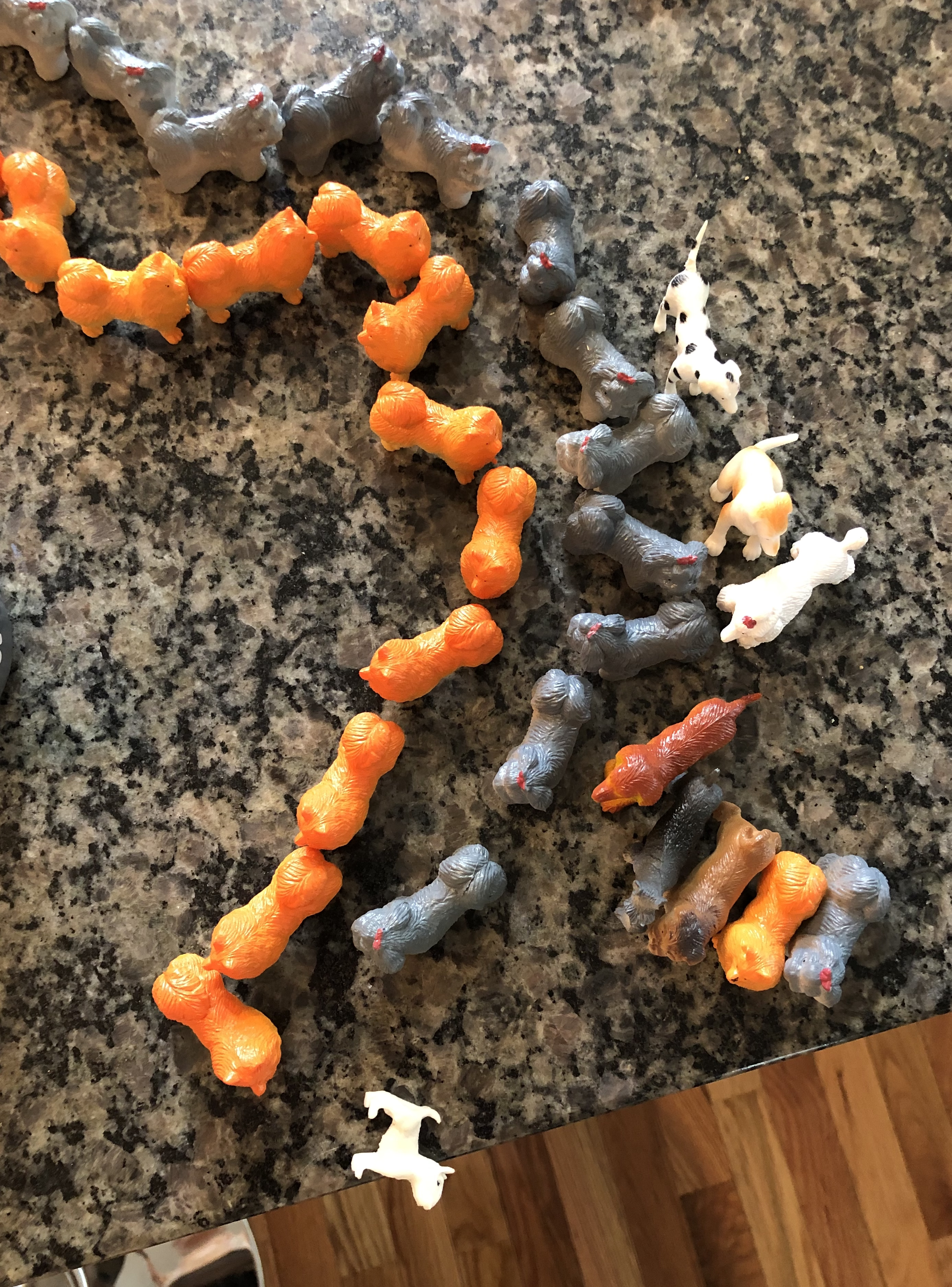
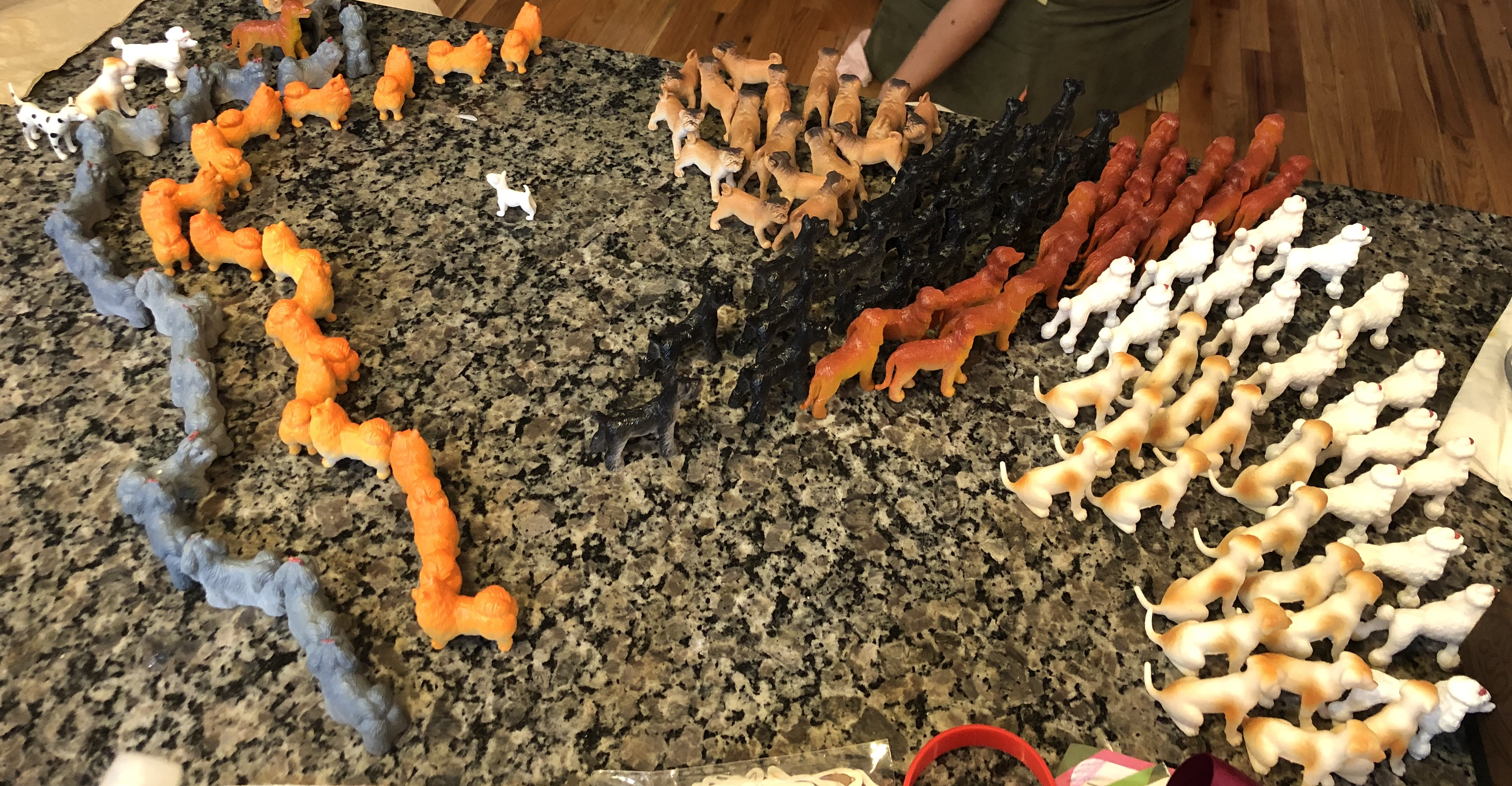
It all began one weekend when I asked my daughter if she’d like to choose a game to play. The one she selected was “Walk the Dogs”, and we actually have a double set that we combine to enhance the game play, along with some original improvisations relating to how points are scored to add dimension and strategy. This game involves manipulatives in the form of little plastic dogs, and as we find other little plastic dogs around the house, we add them to the group and assign them special point values. Recently we’d added a little white guy to the mix (we’ll call him Jack Russell), joining throngs of identical Poodles, identical Schnauzers, identical Gugs, identical Pomeranians, identical Shih Tzus, identical Labradors, and what appear to be identical Golden Retrievers crossed with identical Newfoundlands. We’d already introduced a Dalmatian singleton to the groups of lookalikes, and since she was unique she was worth an extra five points. Before we could settle down to get a game started, the Muse of Creative Play struck my child, and before I knew it, a grand drama was underway. Here’s how things started:

New dogs on the block

See the two in the foreground of this shot? That’s the Dalmatian with her new friend, Jack Russell. Apparently they’re in a stare-off with one of the poodles and one of the Golden Newfies. (I don’t know what’s happening over there on the right with the small dogs, but it looks like a puppy pile populated by pugs and poms with a few tzus mixed up in it.) I’m not sure what happened next, but soon this was the lay of the kitchen island land:

Stranger in a strange land

Now it appears that Jack is being given the cold shoulder by the carbon copy canines, marooned in that granite patch of no-dog’s land, and all are refusing eye contact, aside from maybe a few individuals from the lines of toy breeds. Of course Jack’s friend the Dalmatian, who somehow has become separated from him and seems to be barricaded by a double corridor of nose-to-tail characters, is watching from afar but looks to be doing precious little to attempt a reunion. It’s hard to explain why there are a few lone wolves over there on the left with her, but perhaps she was slowly infiltrating this unwelcoming community, one poodle, lab, and Newfie-cross at a time. Now here’s when I started to worry:

A turn for the worse?

By this point Jack has either been pushed to the brink or is considering a dire means of escaping this Stepford bunch, but either way there is cause for concern. What’s also alarming is the disinterest his turncoat comrade is displaying, her spotted head turned away from this poor portrait of desperation, not to mention the bystanders witnessing the sad scene but doing nothing to come to Jack’s assistance. From another angle, the situation is particularly grim:

Tipping point

The worst is that Pomeranian a paw’s length from little Jack’s back feet, just watching him without stepping in to help or bark him back from the ledge. You can see the deadness in her eyes in the picture that precedes this one, while almost everyone else’s attention seems fixed on something off-camera on stage right. But there’s no mistaking that this heartless animal’s pom-pom appearance belies the hidden workings of a wicked mind. And what’s even more disturbing is that my daughter had to go to bed before the curtain had closed on this developing story, and Jack spent the whole night with his head hung over the abyss (I knew better than to mess with her game, despite my inclinations to put Jack back to rights). But just when it appeared that all was lost, things somehow rectified themselves the next morning.

Back on his feet

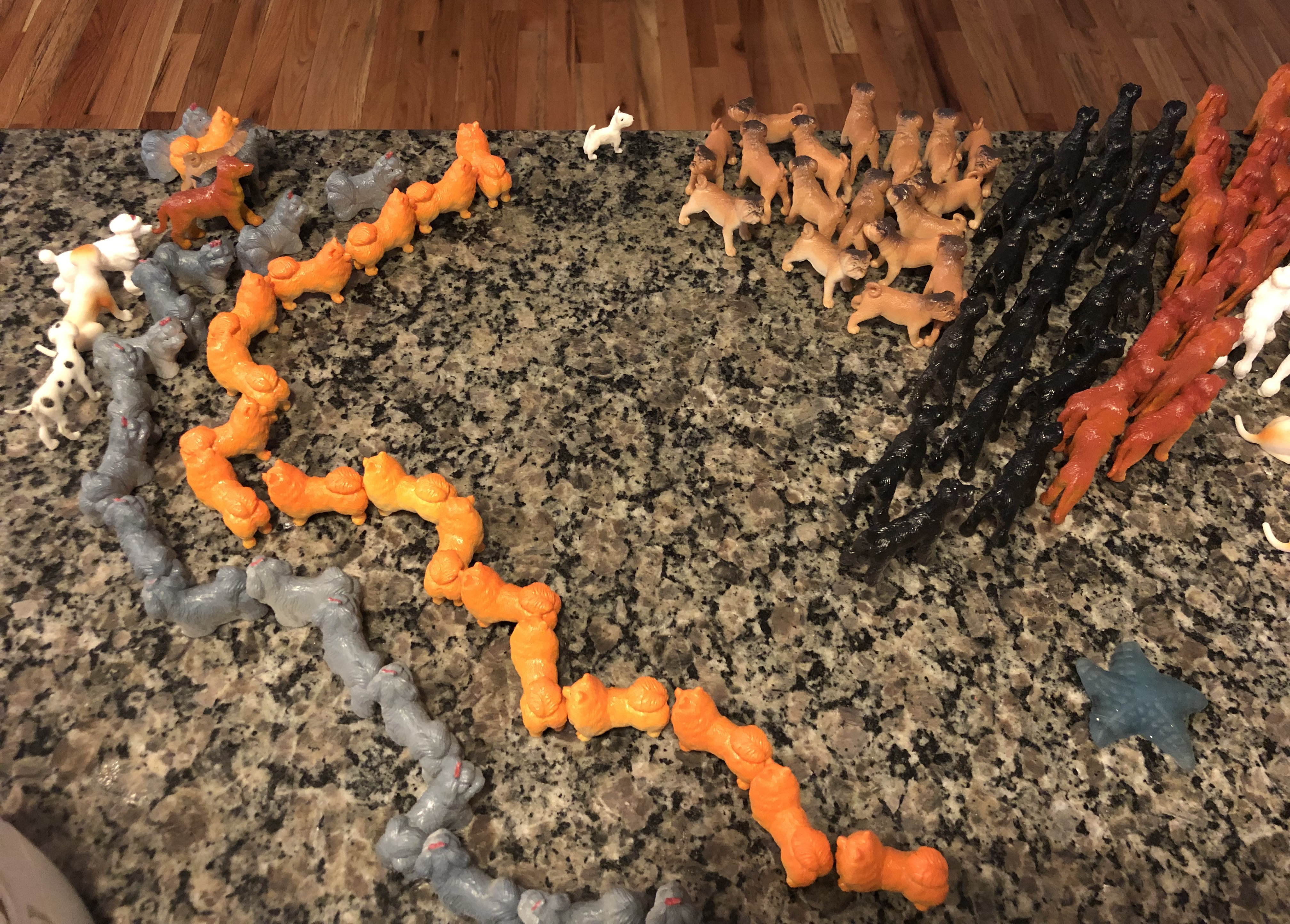
Despite the lack of outreach on the part of the droves of clones, Jack has regained his foothold on the counter, standing as tall as the genetics of his breed will allow, the cant of his ears exuding renewed confidence and determination. Perhaps he found a sounding board in that pug whose attention is trained upon him in this capture, or perhaps the sheer grit he exhibited by resisting the hardwood depths of despair have gained him respect among the denizens of this tough crowd. Don’t miss the rubber sea star over there in the right corner, because it comes into play during the final act of this magnum opus.

On a pedestal

And there you have it, folks. Despite the inauspicious inception of this tale, it concludes with Jack in what I can only assume is a place of honor, a starfish throne of sorts. Whether this is a makeshift situation to put him at eye level with his loftier audience, or if the five-pointed perch is some kind of totem, remains to be discovered, but it certainly seems to be a very special seat indeed. And one representative from each breed, including the Dalmatian, whose lapse of loyalty earlier can probably be attributed to the tragic effects of inbreeding, are devoting rapt attention to our protagonist, Jack the Undaunted. He’s holding court here, possibly extolling the virtues of inner strength and valor despite the harsh realities of an inhospitable environment, sharing his story as a way to embolden others to embrace their individuality rather than identify only as part of a pack. Maybe wee Jack is the messiah these dogbots have been dreaming of, the one who would come and teach them the way to a more meaningful, authentic, open-minded existence. Regardless of the specifics of the conversation that’s happening here, it sure is nice to see Jack’s story culminate with the prospect of happily ever after, after all.*

*I hope. As soon as he realizes that he’s actually a bull terrier, he might do an identity double-take that will require some soul-searching, if not a good long talk with his parents about why they chose to name him after such a barky breed.

Praise for a glaze (with a side of meat oil)

I’m just wild about a new culinary discovery! It all began with Costco, as many of my kitchen adventures do, and a purchase I made that was proving difficult to fit in the freezer, which resulted in my pulling out a few sirloins and deciding that the time had come to cook them. A couple of days later, after they’d defrosted, I thought a marinade would be a good idea, so I pulled out some trusty old faithful pantry staples and just went rogue with the measurements. This is more or less what I added to the mix:

About three pounds of steak
As much olive oil as you can pour while saying “La la la la la la”
A generous dousing of soy sauce (substitute coconut aminos for GF)
Garlic powder aplenty
A roughly ten-second pour of Worcestershire sauce
About a handful plus a couple of dashes of balsamic vinegar

When it came time to fire up the grill pan, I forlornly considered unceremoniously disposing of the leftover marinade, but I couldn’t bring myself to do it considering the liberal quantities of product my heavy hand had dispensed, so I committed to try repurposing it. Out came a saucepan, in went the marinade, on went the gas range. I boiled the concoction until I felt certain that no contaminant could have survived, at which point the oil and the solids had separated, resulting in a layer of seasoning silt the color of stained walnut on the bottom of the pan beneath a hot blanket of honey-hued oil. I poured the oil off into a bowl, then scraped the umami sediment into another bowl, at this point unsure of what I’d created.

Meanwhile, the steaks had great grill marks, so I slid them into the oven at 425 to nudge them a little closer to medium rare, at which point I removed them to a plate to rest and cut a corner off of one to test the temperature. After a few minutes, the plate had collected a modest lagoon of au jus, and just then (and just in time), inspiration struck. I poured the liquid off the plate and into the bowl containing the savory marinade alluvium, and what resulted was a most delightfully glossy gravy with the consistency of a glaze. Naturally, the proof was in the pudding, so I tasted it and was pleasantly surprised. I knew better than to sucker punch my kids’ taste buds by lathering it on their steak slices, but they were given the option to dip (one out of three opted in), but the glaze got the green light from the adult contingent to the point that I will do everything the same next time (but maybe I’ll go nuts and add a second or two to the Worcestershire pour).

And what about the bowl of oil? Well, that gorgeous, golden plant fat had now been married with the flavor of grilled steak and a bouquet of piquant flavors from the other marinade ingredients. The infusion was at once decadent and restrained, yielding a most beautiful balance on the palate, and I couldn’t think of a better use for it than to toss it into a bowl of cherry tomatoes (about a pound). From there, the lot went into a glass baking dish with a shake of salt and pepper then onto the middle rack of the oven (now set to 400) for the better part of an hour, and the resulting liquor made a most delicious dressing for a bowl of fettuccine.

I rode the endorphins from this creative cookery experience for a few minutes, delighting in the unexpected success of the experiment and congratulating myself on the choice to try boiling the marinade, but reality quickly tugged me back to Earth with these words: “Mommy? Can we have hotdogs and fries for dinner tomorrow?”

I guess she won’t be telling all of her friends about her mom’s special meat oil pasta tomorrow. Hebrew National and Ore-Ida, you win this round.

Just deserts

Some days are harder than others, and even though I’d only been awake for two hours on a Saturday morning a few weeks ago, it had already been a hard day. Sometimes our six year-old can muster open an emotional umbrella to keep the deluge of his feelings from sweeping him clean off his feet and whisking him away in a maelstrom of troubling behavior, but sometimes the umbrella sticks shut and he gets sucked down into a miserable Charybdis of distress that spits out ballistically at the rest of us. I’d been the recipient of several of those fallout projectiles already, and feeling at once the pique of unjustified ill-treatment and the even more distressful wound of worry, I thought it might be a good idea to put some distance between myself and the situation. I grabbed my keys and started the car with no idea where I was going aside from a general concept of “away from this” for a little while.

After a few minutes of aimless driving, I was in the area of a drive-through Starbucks and thought I’d assign it as a destination to my wandering, treat myself to a coffee, and bring back something for the kids have as a treat later, after the tempest had abated and the dust settled. I collected myself, infusing my tone with friendly cheer for the purpose of placing the order, and the voice of the girl on the intercom responded in kind. She was positively effervescent, ebullience practically exuding through the speaker system, and it felt so great to be met with such congeniality that I thought I was on the road to complete composure in time to return to the scene of family entropy. A few more deep breaths and I’d be ready to reboot.

I pulled up to the window to pay and collect my coffee and iced slice of lemon loaf to go, continuing the sociable stranger-banter that I was relearning how to carry on after so long in lockdown mode, and when the girl handed back my credit card, she offhandedly asked, “So where are you off to this morning?” In most cases this is a purely innocuous question, which is certainly how it was intended, but my response was to begin sobbing, much to her obvious astonishment and concern. Apparently I must have hidden my inner turmoil so successfully as to convince her that I was in a thoroughly happy-go-lucky frame of mind, and her horror at my reaction further horrified me at having burst our quippy bubble of small talk that had felt anything but small. She backed away from the window, understandably, as I babbled apologies and that I was going back home and it had been a rough morning with my kid, and she returned a few moments later with my coffees (I was bringing one home for said child’s father, who was still in the trenches of the homestead) and a brown paper sack of lemon cake.

I thanked her, apologizing again amidst her words of compassion and sympathy, and then she held out another small bag as I looked up to thank her one more time. “What’s that?” I asked, and she said, “I thought a cake pop might help cheer you up.” Inside the bag was, indeed, a cake pop, but it was unlike any cake pop I’d ever seen.

The Starbucks website describes their unicorn cake pop as consisting of “creamy vanilla cake with confetti sprinkles shaped into a unicorn, dipped in a white chocolaty icing and finished with a magical design”. Of all of the cheerful items in the pastry case, the sweet girl at Starbucks that day picked the most fanciful, the most sunshiny, the most fairy-tale treat she could, and she put it in a bag as a gift for me. Now, those of you who know me understand that this is not the kind of dessert I enjoy eating, but believe me when I say it’s one of the best desserts I’ve ever been given. Here I was, a woman alone in a minivan with two coffees and tears all over the sleeves of the shirt I’d worn to bed the night before, being handed a sugar-drenched treat decorated like a fantastical beast by a girl at least half my age in an effort to brighten my day.

She couldn’t have known how moved I was by this gesture, by the sheer generosity of spirit that drove the gift, by the realization that the reason she’d retreated in response to my outburst wasn’t discomfort, at least not completely; she saw what she saw and immediately did what she could, which probably felt like very little to her, but it meant a whole lot to me. And she couldn’t have known that so many times since then, during a trying moment of feeling ill-equipped to gracefully manage a painful parenting moment, I’d recall that morning and the sight of the frivolous little cake on a stick that I would never, ever order for myself, and it’s felt like a continuance of mercy. If she’d known me at all, she might have reached for a more healthful option with a fraction of the sugar, something far less adorable and colorful, but the fact that she was a stranger choosing the most flamboyant and whimsical delectation in hopes of providing comfort to a person feeling upset; well, it made it that much more meaningful. A sous-vide egg bite might have been more attractive to my palate, but the unicorn cake pop was just the richness my heart had been craving. And the message that accompanied it–the inestimable value of kindness simply for the sake of it–is surely the most delicious thing to have ever been handed through a drive-through window.

The Color Monster: a saga

When I originally discovered a book my daughter had written and illustrated, I was surprised and delighted by the insightfulness of the content and evocative expression in the artwork. I was floored that she had created such a composition and proudly photographed each page, preparing to share them with friends and family, beginning with my friend Ellen, who I knew would appreciate it. The plot here thickens a bit, but first I shall share the child-created book I discovered while flipping through a notepad on the art table:

The Color Monster by Summerly

Those four illustrations on the corners of the cover of this book, I assumed, are each intended to express a different emotion.

Page 1.

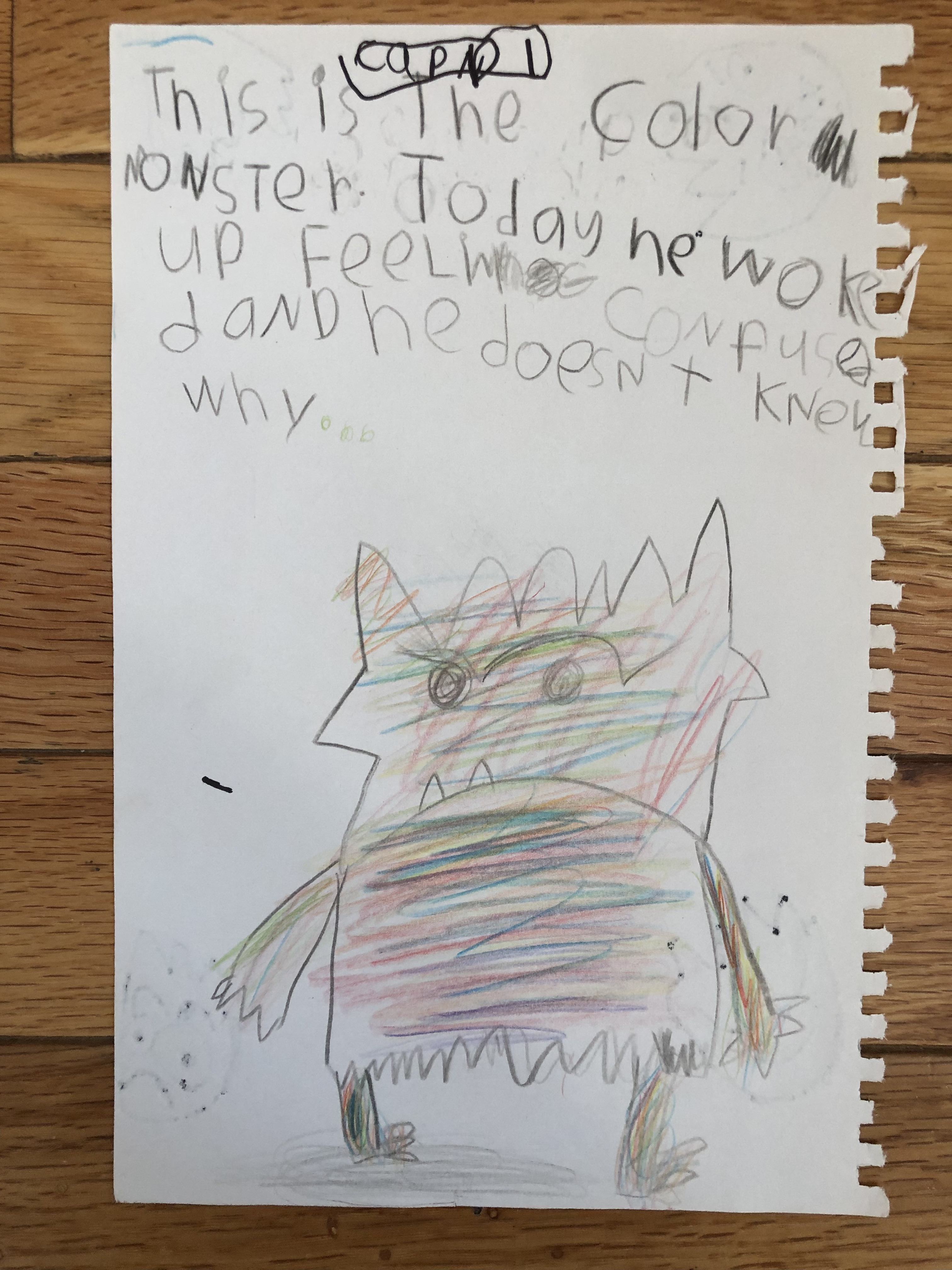
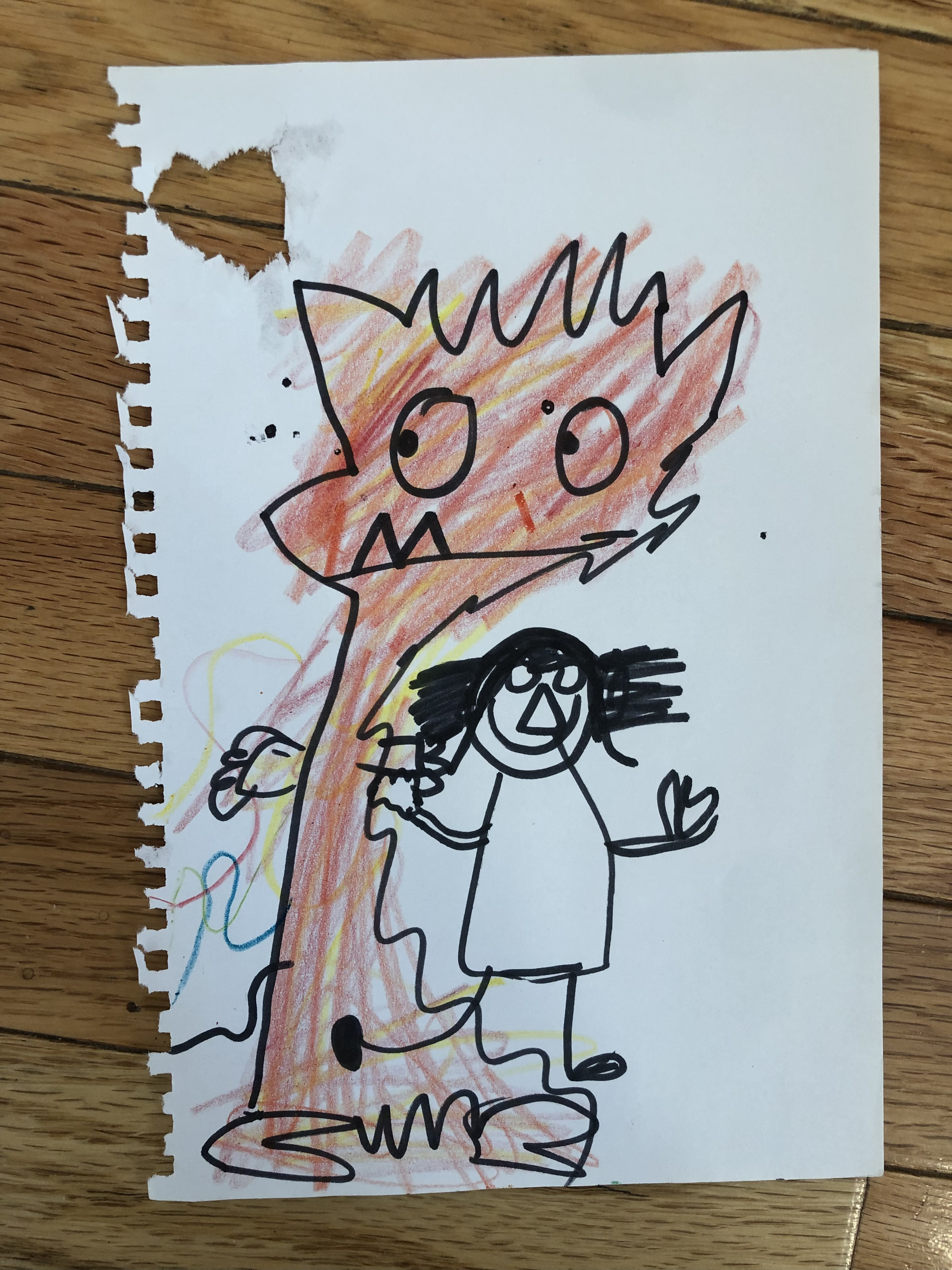
Chapter 1. “This is the Color Monster. Today he woke up feeling confused and he doesn’t know why…”

Page 2.

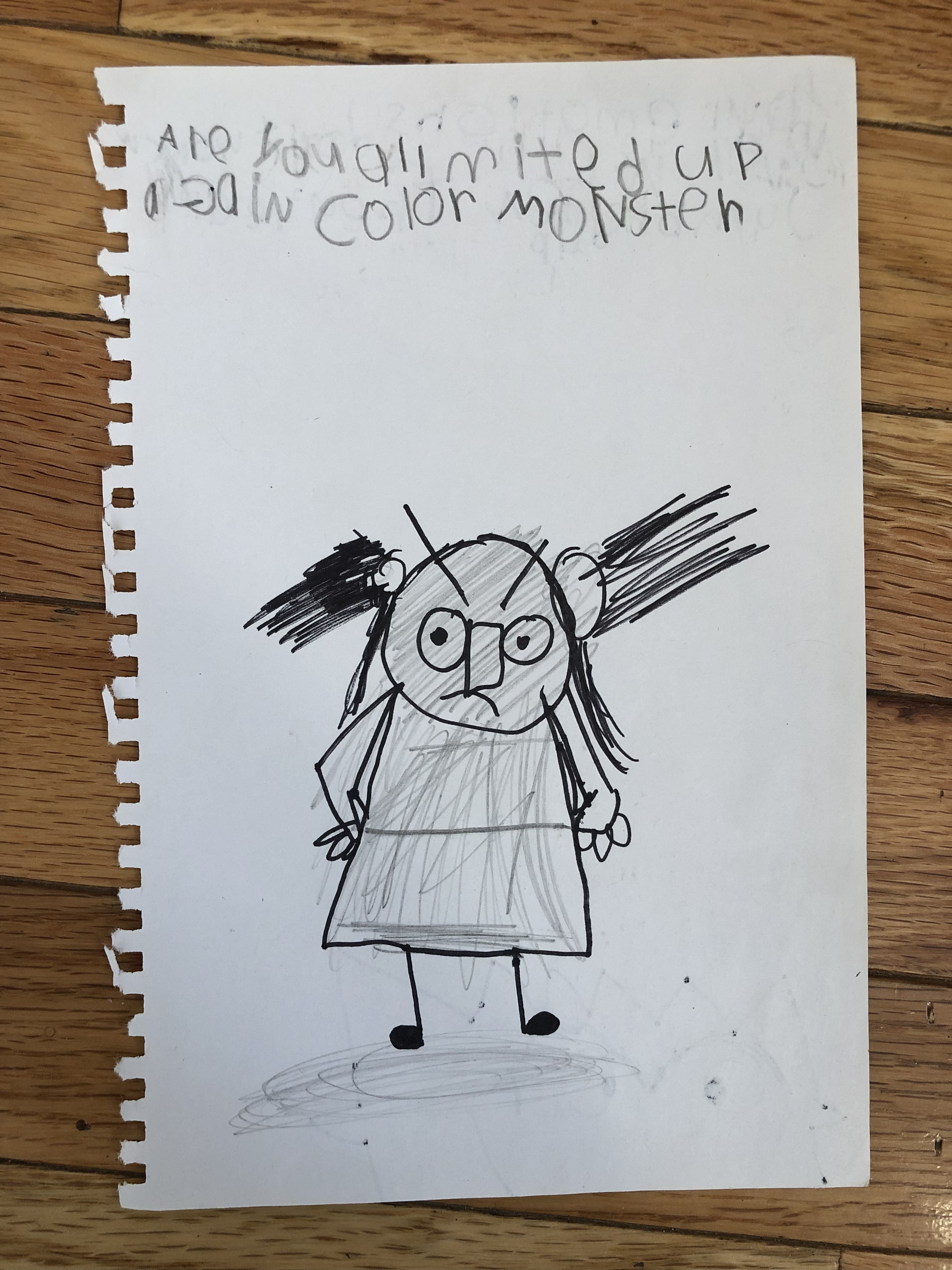
“Are you all mixed up again, Color Monster?” (Summerly’s editor has added punctuation for clarity. I guessed that this character is The Color Monster’s friend.)

Page 3.

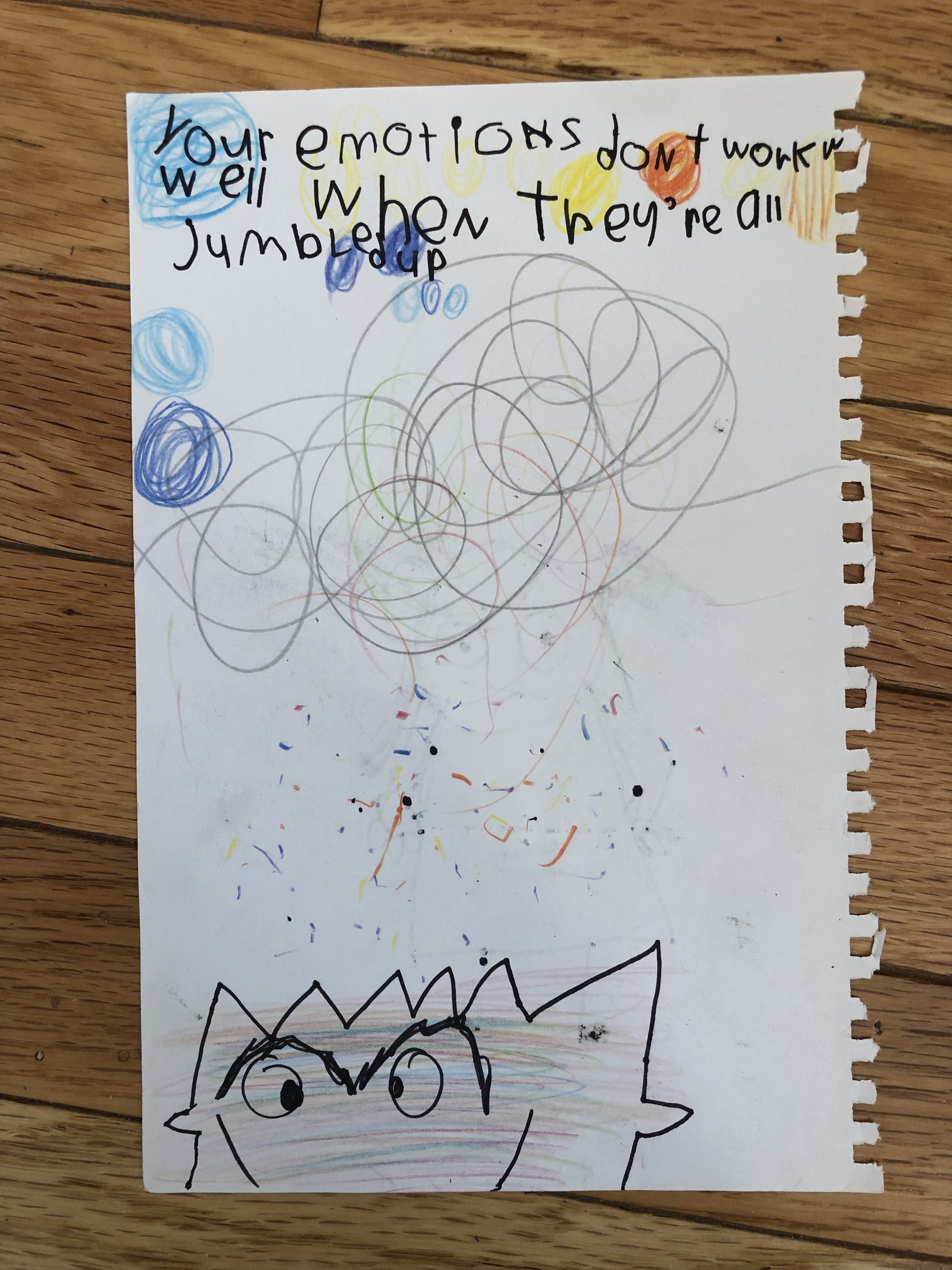
“Your emotions don’t work well when they’re all jumbled up.”

Page 4.

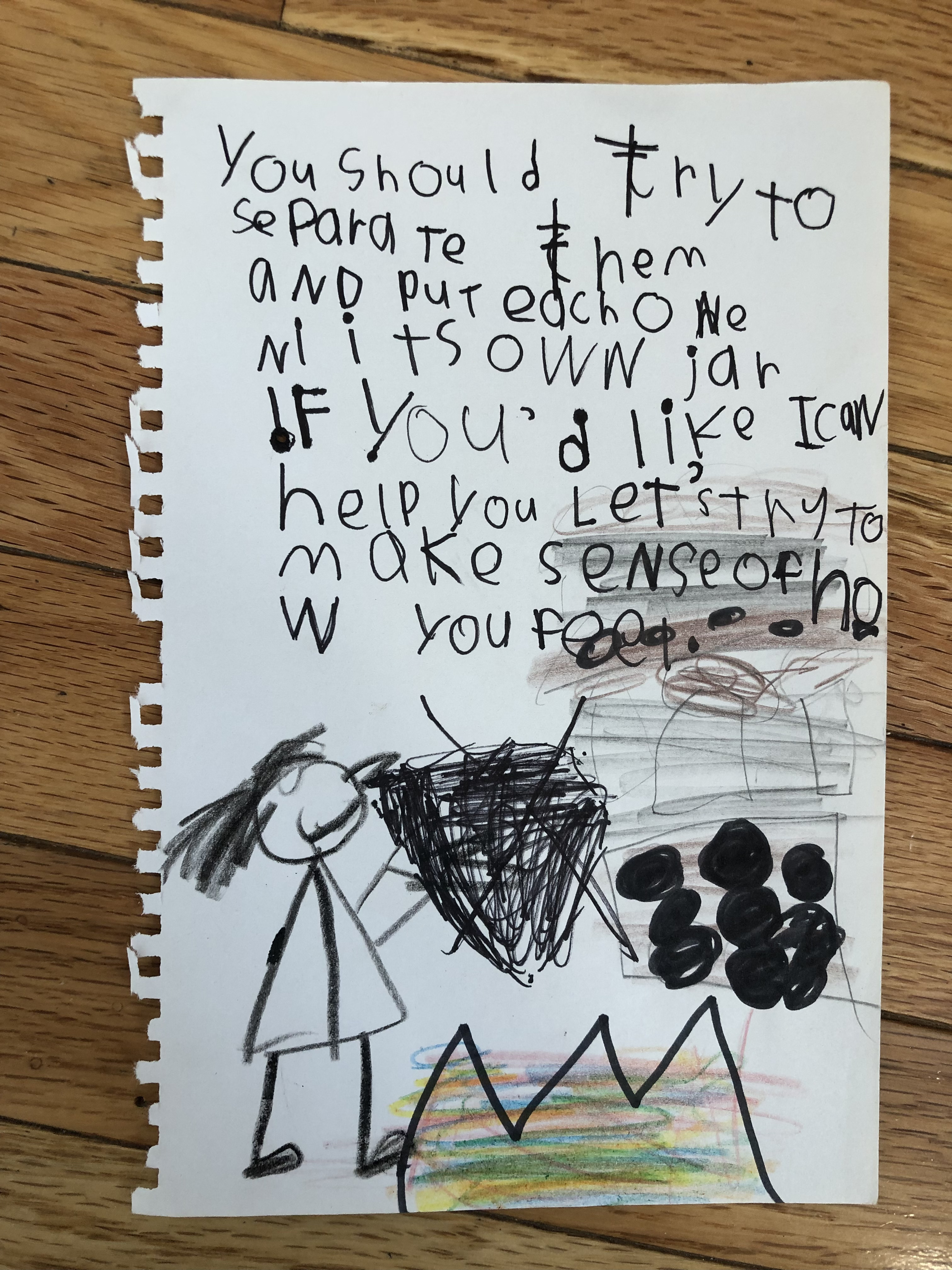
“You should try to separate them and put each one in its own jar. If you’d like, I can help you. Let’s try to make sense of how you feel.”

Page 5.

This is the final page of the story, and the Color Monster’s friend looks happy here, if a bit optically vacant, and the Color Monster himself seems decidedly less upset, so I’m thinking the therapeutic process was helpful for him. He does appear to be a bit concerned about the hole in the paper up there, however.

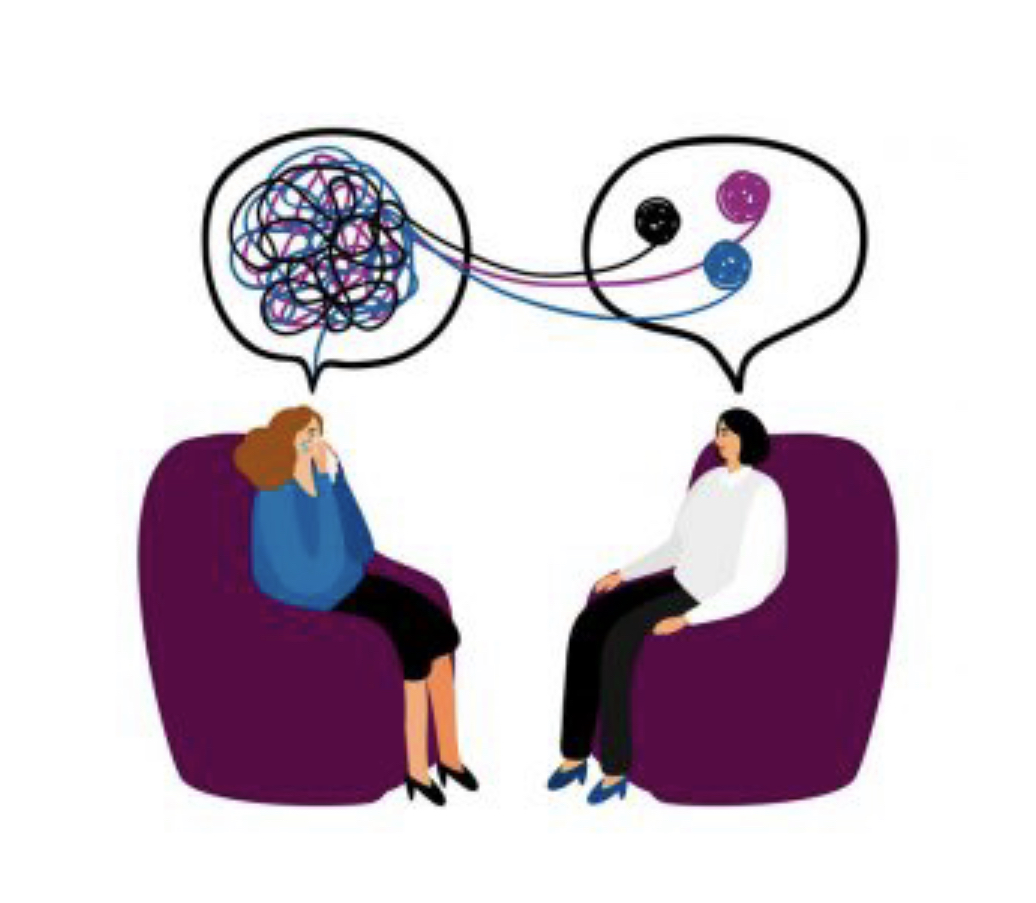
Anyway, I sent these photos to Ellen, who is trained as a therapist, and she replied that it reminded her of a graphic representing the process of talk therapy. After some research, we found it:

Woolgathering.

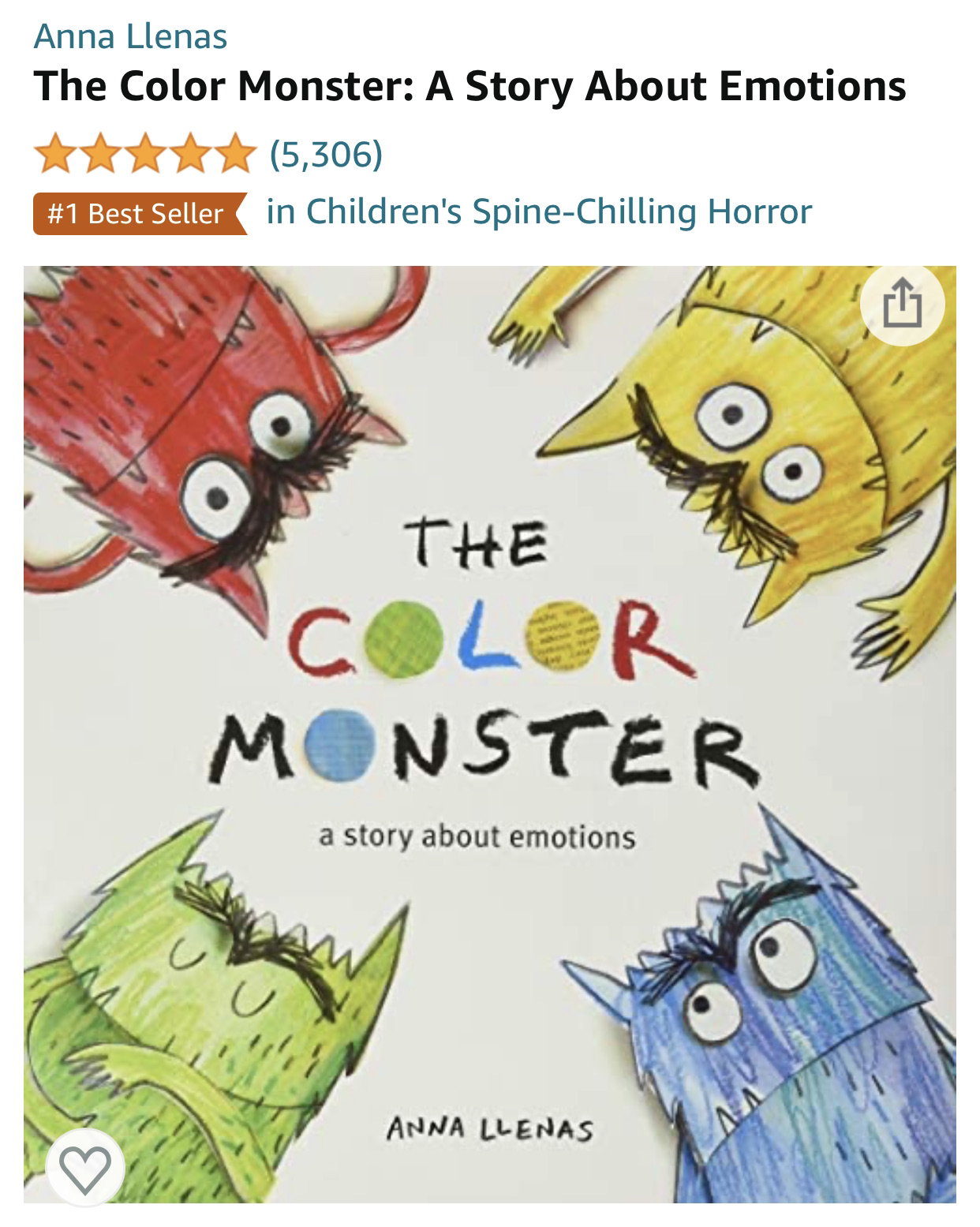
Well, this seemed like either a wild coincidence or proof that my child’s EQ is off the charts. I inspected her book further and started to become suspicious; the detective impulse in my mind began cataloguing aspects of it that seemed somehow out of line with authenticity. First, there was the rather precocious concept. Then there was the narrative style, a distinct departure from anything she’d produced heretofore. Add to that the fact that she’d used the words “emotions” and “jumbled” and the phrase “make sense of”, which seemed unlikely turns of phrase considering my child’s parlance and patterns of speech. And then the final red flag finally waved wildly: the spelling was almost all completely correct in this slim volume of sagacity, and, knowing my daughter and her history with spelling, that in and of itself was enough to warrant a quick jaunt onto the worldwide web. Here’s what turned up:

#1 Bestseller.

So the bit of brilliance I’d uncovered in a spiral notebook was still a surprise and a delight, but the fact that it was the work of a copycat did diminish the effect a bit. I mean, even the illustrations were borrowed heavily from the original text. Obviously I ordered a copy of the book straightaway, as it clearly had made quite the impression on my child, and I silently applauded the fact that she’d chosen such quality content in her plagiaristic pursuits. The only question that remains is twofold: first of all, I can’t quite understand why this book is categorized by Amazon.com as belonging to the genre of “Children’s Spine-Chilling Horror”. The second, and arguably more perplexing, facet of this discovery is the conundrum of why that genre exists at all. I wonder if someone in the children’s literature department at Amazon needs to have a sit-down with the Color Monster’s friend and start, shall we say, unraveling some tightly-spooled balls of multicolored yarn that might have begun the process of entanglement during, probably, childhood.

Mornings can be fun

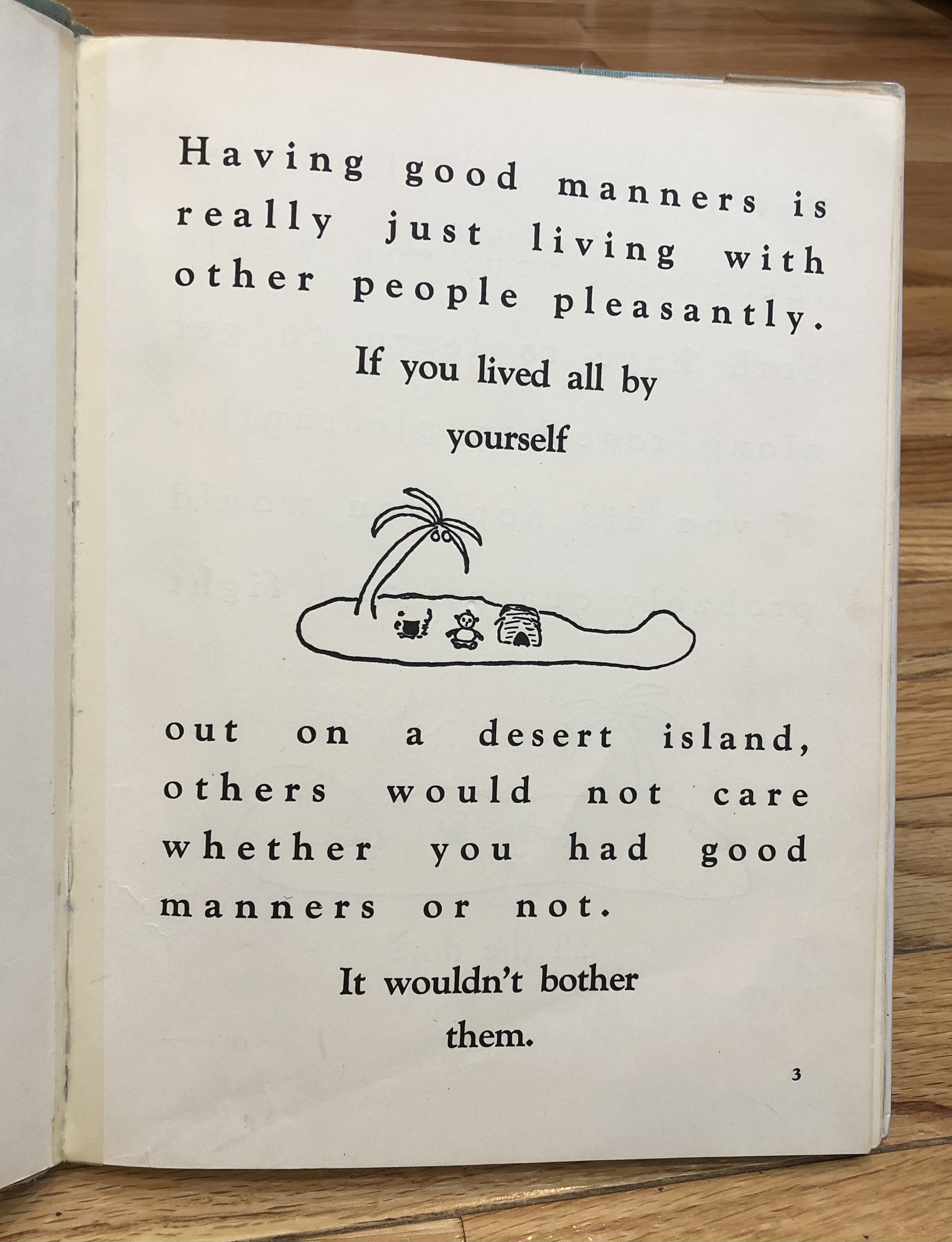
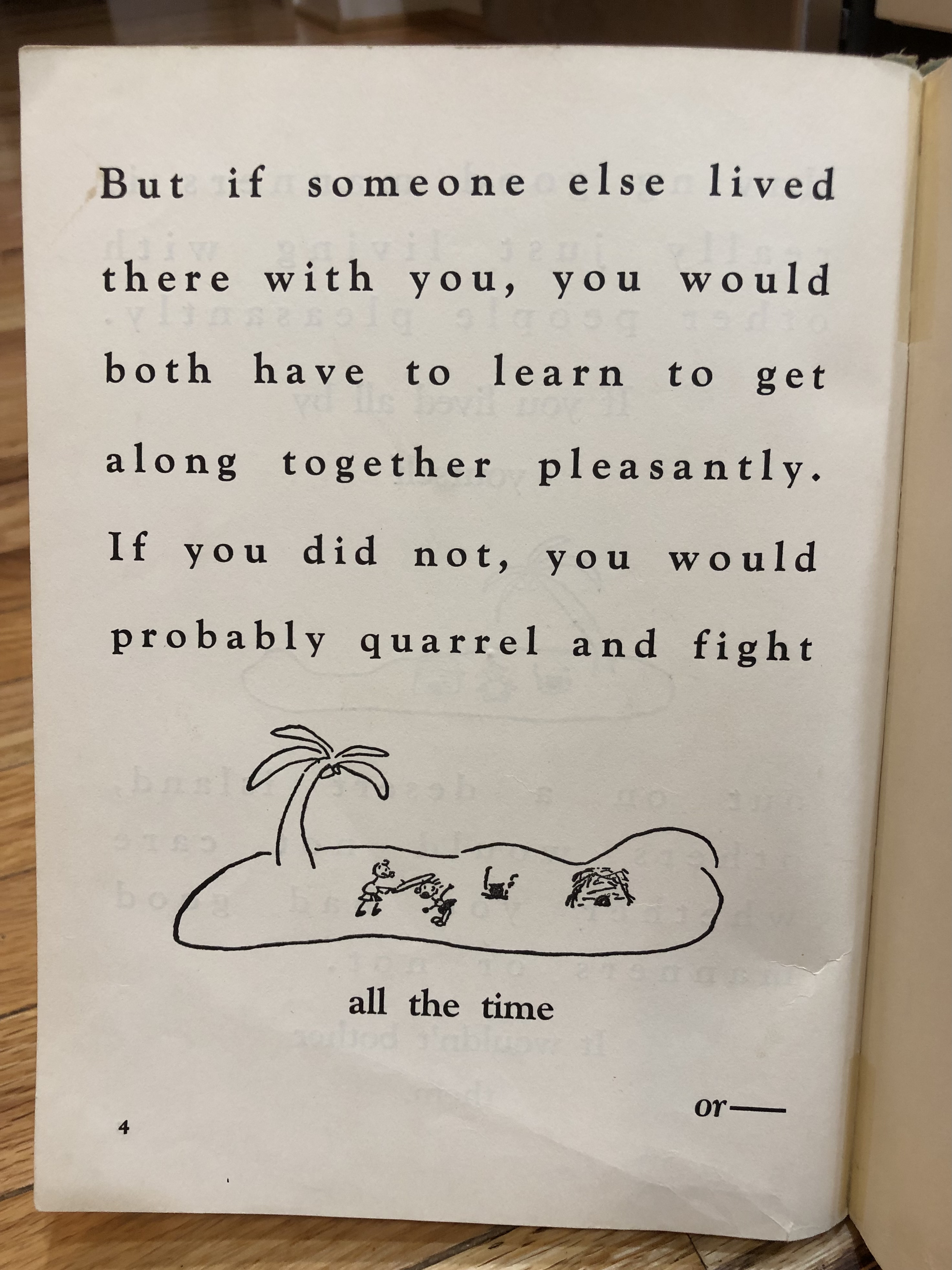
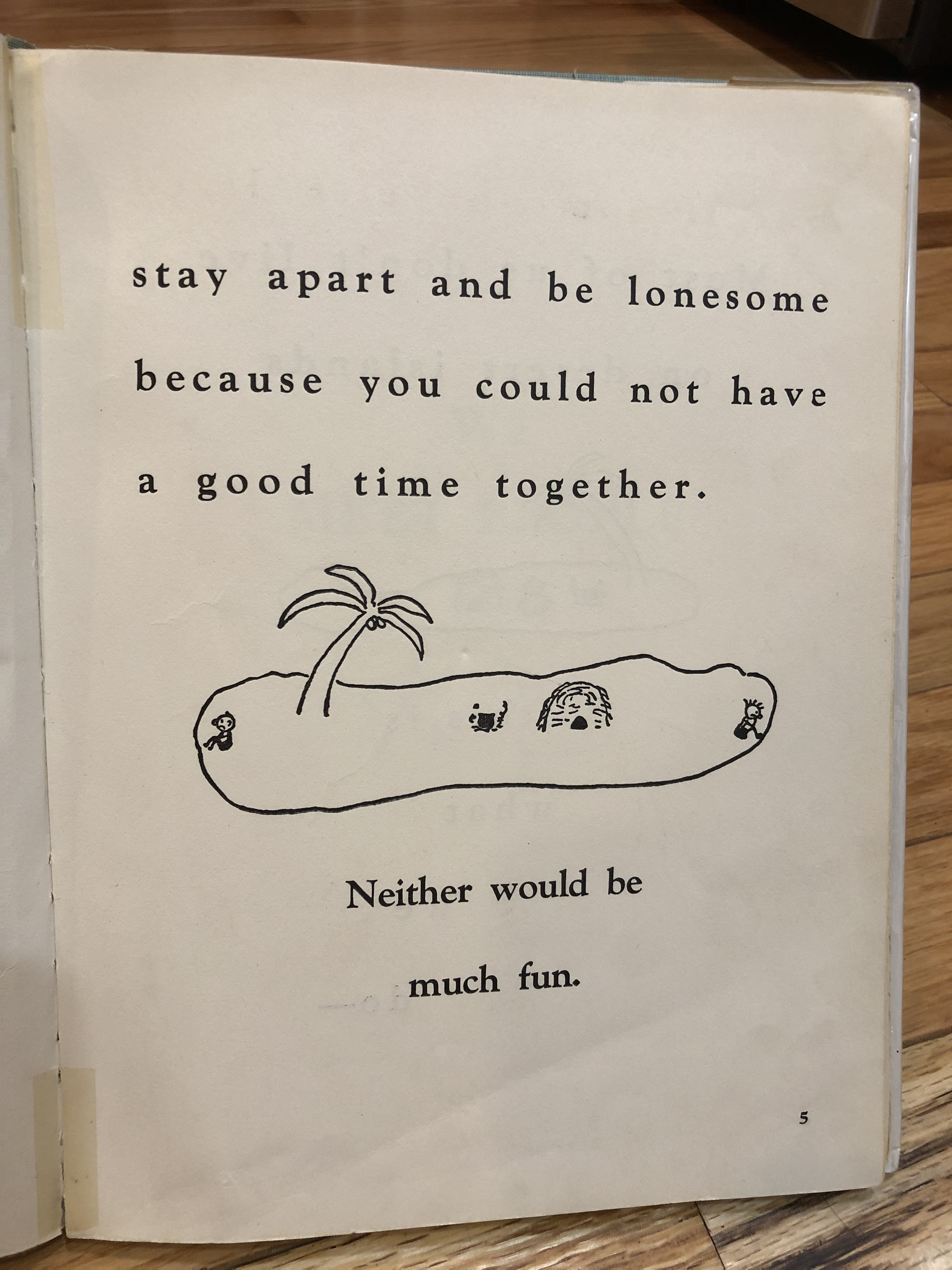
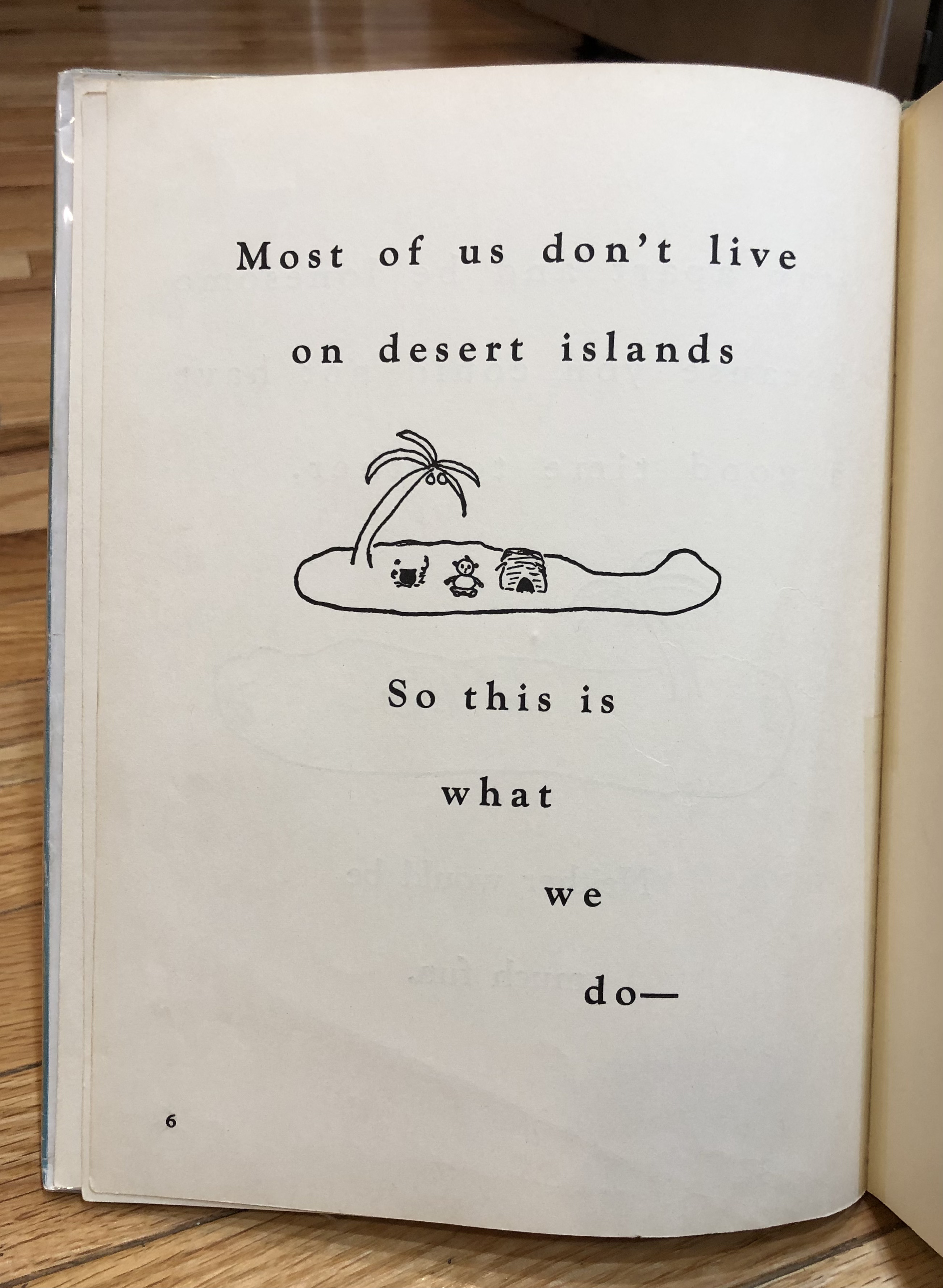
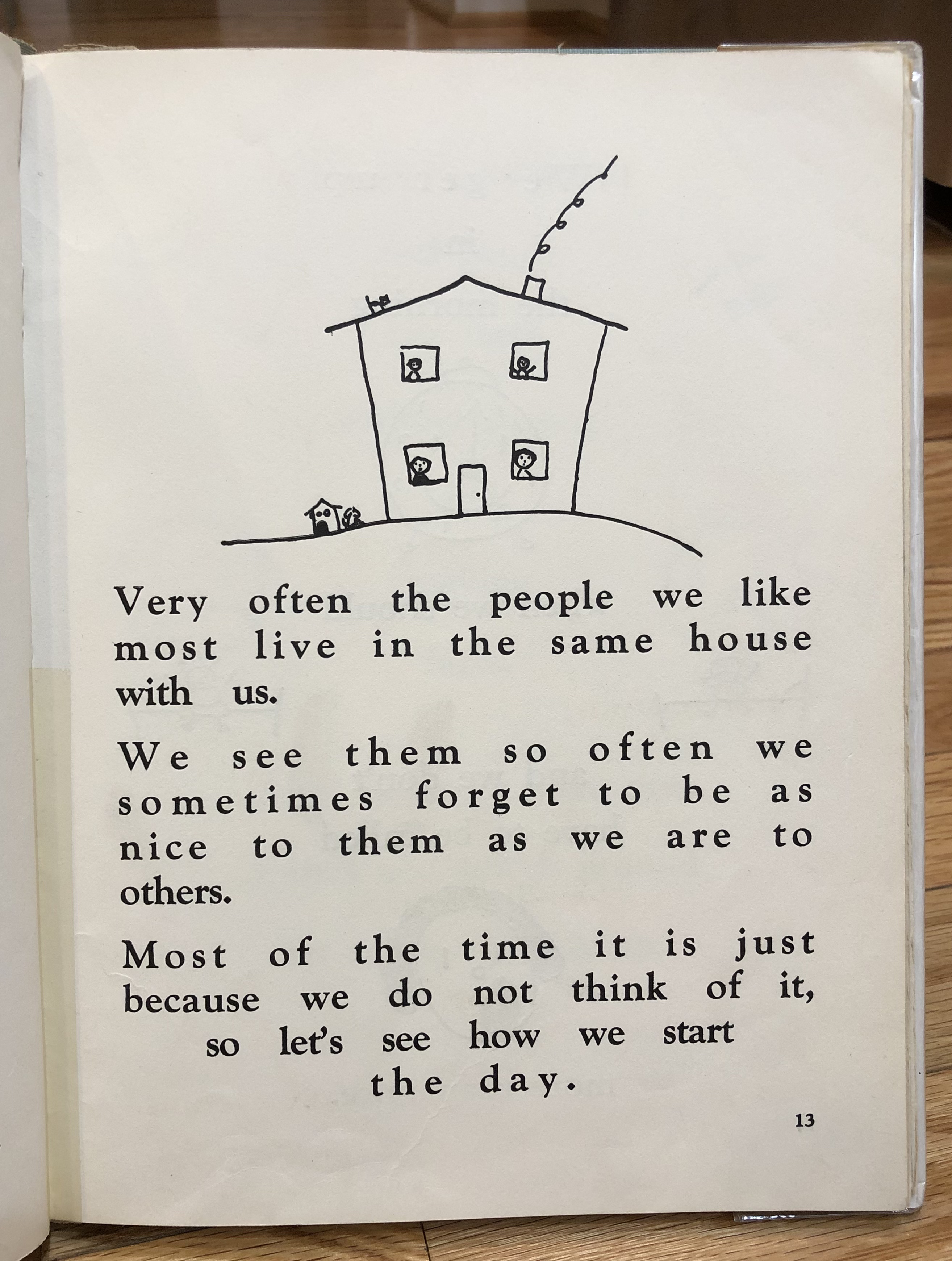
As frequently happens when I’m looking for a book in this house, I come across several others that catch my attention; either they’re titles I’d forgotten, early childhood readers that this brood has outgrown, or volumes that might appeal to their current reading preferences. Recently I was curating a mini-unit “theme offering” to leave out for the kids consisting of books focusing on the motif of “the unlikely garden” as a stepping-stone segment in our examination of the topic of civilization. The intention of this group of books was to investigate the idea of cultivation, what it really means and entails as a practice, and how it’s an important component of the creation and maintenance of civilization. In the journey from bookshelf to bookshelf, my sights landed upon the spine of a book I vaguely remembered as having belonged to my mother. It’s called Manners Can Be Fun by Munro Leaf, the man most famous for having written The Story of Ferdinand (incidentally, I discovered that Ferdinand, too, was a sacrificial lamb on the pyre of censorship; it had been banned in Spain and burned as pacifist propaganda in Nazi Germany, and any book that was burned in Nazi Germany is pretty much a book I want in my house).

I discovered that Mr. Leaf also wrote a book called How to Behave and Why, which obviously piqued my interest enough to read some reviews on Amazon, the most entertaining of which probably was submitted by someone named Suzan G from the United States, who wrote on March 23, 2017, “I sent it to the President. Will see if there are tweets” and accompanied this succinct bit of her own social commentary with a five-star rating. Anyway, I flipped through Manners Can Be Fun to find approximately what I’d expect from a children’s book from 1958 about manners, but a few pages felt as relevant today as ever. Here they are, in case people in your home could use these reminders as much as my group does:

So if your child was in tears this morning like mine was, crying, “Why do I have the worst family ever?” because you asked him what he’d like for breakfast, remember: it’s because he likes you the most.

Fantasy with a side of social commentary

I finished reading a middle-grade book recently, which was a delightful departure from most of the material I’ve cycled through this past year (unfortunately, that amount wasn’t much). The book was a gift to my kids from my mom, but even though they aren’t interested quite yet, I was, and it turned out to be great fun to travel to the island of Skuldark–and far beyond–with a protagonist named Gertie Milk (she thinks). It’s a story lodged soundly in an otherworldly setting, and I’d forgotten how refreshing it can be to explore a storyscape in a thoroughly imaginary environment. Reading can provide a haven of escape, but when the pages are populated by fantastical creatures and concepts, the added dimension of invention provides another degree of separation between the reader and his or her present reality. Practicing that willing suspension of disbelief can feel almost therapeutic, particularly when the rest of our waking hours are spent in the troubling, uncertain, difficult, unfortunate, and very real climate of the current day. So there I was, romping through space and time in this deliberately fictional world, when I came upon a paragraph bridging page 136 and 137 that rang jarringly applicable to current events.

It’s right after Gertie has come across something that her companion identifies as a “knowledge license”, or, more informally, a “brain card”. When she asks what its purpose was, he answers, “After the Information War, it was decided that you could only share information if it was factual, or based on firsthand experience–this was to stop opinions and feelings being passed off as facts, which caused chaos, especially in the medical field. Anyone posting false or misleading information would lose their brain card and be limited to ‘live speech’ for two years.” I paused to reread that paragraph a few times and consider this idea. What if this were a real-life mandate, as if it could even be enforced? What if anyone who subjected others to subjective material as if it were objective would lose their freedom to communicate or broadcast in any modality or format other than their very own speaking voice for two entire years?

I had to check the book’s publication date then, curious about what was happening in the world when the author was having this idea, thinking that if it had been published within the past year or so that this was surely an oblique nod to the turmoil resulting from trust issues involving science and government during the pandemic. But no…the copyright was issued in 2017, which does make sense on the heels of the 2016 election. But the notion still felt prophetic when applied to the these past many months, particularly for people so young as to still be ineligible for a vaccine, for the parents of those people, and for people exposed routinely to the harm and hardships dealt by the virus. I’m talking about about those lionhearted luminaries working in pediatrics and those venerable souls logging hours during emergency room shifts, among so many others.

The epigraph in this book is “Welcome to your life. There’s no turning back…” –Tears for Fears. I pulled up the lyrics for this song, “Everybody Wants to Rule the World” from 1985, only to find that they, too, seemed eerily prescient. Upon a bit more research, I learned that this song was banned from being broadcast by the BBC five years later for the duration of the Gulf War based on the presumption of its bearing anti-war undertones. How strange and unsettling it was, I thought, that the imaginary concept of revoking one’s “knowledge license”, which essentially severely limits the breadth and scope of his audience for a set amount of time, seems like an impossibility, and yet we live in a world where such censorship as banning books and songs is a very real thing?

As you can see, my journey with Gertie Milk took an abrupt detour out of her surrealistic dreamland of a story and hit hard on the ground of the equally bizarre human condition. Now if you’ll excuse me, I’ll tuck my nose back into the sequel of her adventure, full of inventions like Johnny the Guard Worm, Slug Lamps, the Time Cat, and Robot Rabbit Boy, because no matter what intrigue lies within those pages, it might make just as much sense as reality.

Artificial intelligence

On nights when it’s my turn to read to the kids, we’ve been enjoying a short installment of the Mini Mysteries series published by the American Girl dynasty followed by a segment of a chapter book. I’ve read Glim the Glorious, Melisande, The Enchanted Forest, The Last of the Really Great Whangdoodles, and a few Chinese fairy tales from a book I loved as a child. Recently we discovered The Wild Robot, and we all fell in love with Roz, the story’s protagonist.

The first half of the book is truly brilliant. If I didn’t know it was written by Peter Brown, I’d guess that Isaac Asimov and Rudyard Kipling had collaborated to produce this middle-grade volume (Asimov would have been a teenager during Kipling’s final years, so this theory could hold up). Following Roz on her journey of learning as she’s introduced to her new world is delightful, and the discussions it prompts are fascinating (aside from the countless ones we’ve had in which Liam reminds me that my robot voice is a far cry from his teacher’s, who apparently has had professional training in Robot as a Second Language, a course of study that, until now, I’d thought was only an elective). I started to feel a personal connection with our robot around page 67 when, having witnessed an opossum playing dead to avoid being eaten by a badger, Roz has a minor epiphany expressed by the sentence “Performing could be a survival strategy!”. The opossum gives Roz her first acting lesson, explaining, “You can start by imagining the character you’d like to be. How do they move and speak? What are their hopes and fears? How do others react to them? Only when you truly understand a character can you become that character…” Go on, opossum, I thought. Roz and I are listening.

My connection with Roz deepened during Chapter 28 when she encounters Loudwing, an old goose who makes her realize that she is the unlikely adoptive mother to an orphaned gosling, the death of whose parents was precipitated by an accident that Roz had unwittingly caused. The old goose gives her some unsolicited parenting advice that, unlike almost all unsolicited parenting advice, both she and I really appreciated: “Well, you’ll have to act like his mother if you want him to survive.” This is the page that follows:

Even before I met Roz and Loudwing, I knew I wasn’t alone in the feeling that parenting requires quite the theatrical effort. Am I feeling patient? No. Am I acting patient? As best I can. Do I want to play this same game for the hundredth time? Certainly not. Am I acting like I’m having a grand old time? I’m trying. Do I enjoy personalizing dinner preparation just enough so that everyone will eat something even if it doesn’t taste like marshmallows? I really don’t. Am I acting like it’s my job? You bet I am!

My advice for other parents (only when solicited, under normal circumstances) is to try a method I adopted when my kids were much younger: when things get challenging, pretend that you’re being filmed. Pretend that whatever scenario in which you’re ensconced is being recorded and broadcast live on the big screen to a room filled with all of the people you respect most in the world. They are watching how you are going to handle this. Act like you’d want them to see you act. Put on the patience. Wear the forbearance. Summon the semblance of composure even if you privately feel like losing your cool completely. When your kids test you to the point that you feel at odds, act even.

No mother has a complete playbook in her pocket. We all have tools and coping mechanisms, and we all learn from outside sources (each other, science, specialists, news and media) to assemble our own assortment of mental and emotional equipment that will help us as we walk (and trudge through, traipse across, stagger down) these paths, some well tread and some we need to forge anew. Roz, my first robot friend, can attest to that. And she’s given me a new catch phrase that I’ve been conjuring during some tough parenting moments recently, a statement she makes to her hungry hatchling on page 82 that runs through my brain in the best robot voice I can manage: “I am trying to act like a good mother.” Same here, Roz. Same here.

Hey, Biscotti and Twice-Baked Potatoes, there’s a new kid in town

Every year I tell myself, after I boil way too many eggs in preparation for Easter dyeing, that I’ll cut back next time. And then spring rolls back around and I think, “Maybe this is the year they’ll get really into it, so I’ll just cook up a cool dozen to be safe,” and by this I mean a dozen cartons. So after we dyed about twenty eggs and sent home three dozen with our pod family, we were left with a superfluous amount of cheap, white, hardboiled eggs. Part of me saw this coming, and that part thought: egg salad! Eggs in lunch boxes! Surely there are lots of things we can do with the leftovers!

As it turns out, there really aren’t that many ways to eat hardboiled eggs unless you have a household full of adventuresome palates. Since that isn’t the case in my home, I racked my brain to think of how to utilize them in such as way as to result in consumption prior to decomposition. I know, such a romantic culinary incentive! I also happened to have about half of a quart of liquid egg whites that was approaching its “best by” date, so I concocted a wild idea: what if I mashed up a bunch of the boiled eggs, added the liquid whites and some milk and cheese and salt and pepper, and baked it up into a quiche?

Well, it worked. Next time I’d add some bacon or ham to variegate the texture, and some caramelized onion and spinach would be welcome additions as well. Here I give you:

Double-Cookery Quiche

(serves 8-12)

Ingredients:
12 hardboiled eggs, mashed with fork
1 pint liquid egg whites (or ~six whole eggs, beaten)
1/2 cup whole milk
1 cup shredded cheese (a mixture of cheddar and swiss would work well)
2 prepared pie shells (or make your own if that’s how you do things)
salt & pepper
Optional additions: small onion, slivered and caramelized in butter, sautéed or fresh spinach, crumbled cooked bacon, ham, or other cured meat cut into small pieces, or any number of other options!

Directions:
Preheat oven to 400 degrees. Line two pie plates with the crusts. Combine all ingredients and divide the mixture evenly between the two pie dishes. Bake for about twenty minutes or until top is dry and just beginning to think about browning. Allow to cool for a few minutes (it’s good cold, too, though I prefer it warm but not piping hot). Serve with sliced tomatoes, a bowl of soup (gazpacho, anyone?), or a salad. Perfect for a summer picnic!