Which fish to fry

Of the more than ten jobs I’ve held, the one that shaped me most as a person was working as a server at an upscale restaurant downtown that shuttered a few years after I’d moved to New England and become a teacher. The name of the restaurant was OXO, and it was owned by a husband/wife power duo named John and Alice. John was the cutthroat chef de cuisine, and Alice, whom I revered, ran the front of the house as if it were a military unit. I could write pages upon pages about my years in their employ (actually, I already have, including lots of poetry, and no doubt I’ll write more on the subject), but suffice it to say that the influence of those years on my life even today, half a lifetime later, is substantial. Sometimes I wonder if one of the reasons I wanted to name my child “Arlo” is that OXO, where my adult self took shape, was in many ways Alice’s restaurant.

As a lead server, I had the experience of interfacing with many interesting people, some of whom happened to be famous. One night, there was a large VIP booking in the back dining room, a section of the restaurant assigned to one of my server friends for the evening, and it turned out that the reservation was for Michael J. Fox, his wife, and about eight other people. It was a busy night, and my friend had gotten double-seated twice in thirty minutes, so she was in the weeds and told me while we were picking up cocktails that she was worried about making the VIP table wait to order dinner. I had a rare to medium rare spare minute and a whole lot of fangirl feelings, so I offered to take their order and bring it to the line.

Michael was sitting near Tracy Pollan, his stunning spouse, and they were both as lovely and blithely urbane in real life as they were onscreen. When I asked him what he’d like for an entrée, he responded with what sounded like “snapper” but could have just as easily been “salmon”. His speech was only mildly affected by Parkinson’s, but that one word got a little lost among the others, the final syllable swallowed up in the rest of the sentence. I cursed our menu for containing two fish options beginning with “s” and possessing the short “a” sound, but I made up my mind in the moment that there was absolutely no way I was going to ask him to repeat it. The man was so dignified, so elegant, so self-assured, and I refused to let that little hitch in his speech claim any power over the situation. So I left that space blank while I took the rest of the order and decided what to do.

Time was of the essence, and I knew that the kitchen would have my head if I were responsible for serving this icon the wrong dinner, but I just couldn’t bring myself to go back and ask him again. This man deserved to go out to a nice restaurant and order his own meal and not be misheard, Parkinson’s notwithstanding. As far as I was concerned, no diagnosis was going to mess with his right to feel successful as a communicator, at least on that night in that single exchange. I was in control here, and it somehow felt critical to me that he have the moment of ordering his dinner be just that–simple, effortless, uncomplicated. So little else is, particularly for people with a lifelong disease.

I decided to make a guess and suffer the consequences in the event that I’d chosen the wrong fish. I’d take the impassioned, scathing insults from the chefs, the chagrin from my fellow servers, the disappointment from Alice, the possible annoyance from Michael himself, the embarrassment I’d surely feel: I’d take it all. I steeled myself for a long second and then wrote “snapper” on my order ticket, hoping hard that our signature entrée, that delicate pan-seared filet enrobed in a potato crêpe and served with roasted pearl onions, lardons of bacon, and sautéed baby spinach, topped with a nest of ribboned fennel salad and dressed with lemon Mosto oil and 100-year old balsamic vinegar, was the one that he’d intended to order.

I suffered through the drink and appetizer hour, helping to clear their plates and then firing the entrées, waiting on my own tables by masquerading as myself while my stomach knotted to the point that I had to ask for a “white coffee” from my bartender friend, Karen (“white coffee”, for a reason I don’t remember, was code for a shot of Jägermeister in a coffee cup). When it was finally time to deliver dinner to the VIPs, I made sure that I was the one to carry the snapper; if it were wrong, I knew I’d be the one who’d need to fire an extra salmon on the fly, pay for the snapper out of my tips for the night, and face the fire that was sure to follow. After the women at the table had been served, I approached Michael, held out his plate and said, “the snapper for you, sir”, to which he nodded and said, “Yes, thank you.” I almost passed out with relief.

Anyone who has worked in fine dining will agree that the processes involved in delivering a plate of food to a guest are much more complicated and intricately interconnected than they might appear. Nothing is as simple as it seems to a guest who is always a guest, and frequently what guests don’t encounter (clumps in the sugar bowl, crumbs on the banquettes, water marks on the flatware, creases in the menu, empty water glasses, inconsistencies with the food, servers who don’t know answers to every question they might be asked, for example) take an enormous amount of effort with respect to observation, preparation, and maintenance. But more important, perhaps, are the unseen efforts involved in the interactions between guests and those whose job it is not only to meet their needs but to exceed expectations. The pressure is immense, and I feel very fortunate that I didn’t have to face the music by serving the wrong sea animal to a star of the silver screen. I’m not sure why it felt like a point of integrity for me to take that chance in an effort to avoid drawing attention to a moment when Parkinson’s tried to interrupt the one and only conversation I’d ever have with Michael J. Fox, but it felt like a chance I had to take. I very much doubt that he remembers his meal that night, but I’ll never forget the most memorable plate of snapper I ever set down, an emblem of the private risk involved in a person’s choice to preserve a moment for the sake of another who would never even know that the choice had existed. There is so much beauty in the world that we never even know about, and sometimes the fact that it bypasses perception renders it all the more beautiful. We must remember that.

It’s complicated

It was bedtime, and Arlo was tired and being difficult. He’s the youngest, which is a hard place to fall in the family sometimes, and typically the fallout happens in the hour before he heads to bed. We used to let the kids watch two episodes of a show in the evenings, but I’ve felt uncomfortable about that for a while, so recently we changed the routine to incorporate a family game in place of one of the episodes. The older kids are happy with this because they really enjoy the games and are usually great about losing, but Arlo has a tougher time with it when he’s tired. He’d lost both hands of Uno that night and was disappointed not to be able to watch two episodes of “Octonauts”, and then upstairs he said he was bored of the Magic Tree House book Brian was reading to them even though he had been told that he could pick out a short book to read as well. If Arlo didn’t have older siblings, we most likely would be reading exclusively picture books, but because we have to appeal to a wider audience, he is asked to abide a lot of exposure to content that is more appropriate for kids of advanced age. It’s just easier for the older kids to enjoy a picture book than it is for Arlo to enjoy a chapter book, so understandably he protests.

Brian feels strongly that all of the kids should read together at bedtime, so he asked Arlo to go over and just sit with them for the duration of the book, but the child was complaining and adamant that he would not move from his position, which was lying on the bed in the master bedroom. We tried all sorts of things to get him to cooperate, but it just wasn’t working. Once we’d exhausted every avenue of “what to say to a five-year old to get him to give into the request we are making of him”, I had a thought: What would I say to him if he were the adult in the situation, and it was a child asking him to read books with him? It couldn’t hurt, so I tried, “Arlo, it’s not about the book. Daddy didn’t get home until almost 6:00. He just wants to spend some time with you.” I still had to carry him over to the sofa to deposit him, but he stopped resisting.

While I put away some clothing and tidied up, I half-listened to the chapter of the Magic Tree House book, in which the protagonist children, Jack and Annie, conclude their 22nd Merlin Mission, and caught these words: “‘Yep, but first we have to write down our new secret of greatness,’ said Annie. Jack pulled out a pencil and picked up the paper that was still lying on the floor. And under the word HUMILITY, he wrote: HARD WORK. ‘Hard work,’ said Annie. ‘That’s so simple.'”

Well, Jack and Annie, I agree that humility and hard work contribute to greatness. And I know that you are children, so you can’t appreciate this yet, but let me tell you something: it’s not so simple. And it sure isn’t easy. Greatness isn’t an endpoint, either; it’s not a destination at which one arrives, drops his bags, and sinks down into an easy chair. Greatness happens in moments, and it’s always a work in progress, evolving to meet each new instance, rifling around in the toolkit for what would best suit each given situation, and sometimes finding that new tools need to be created. This is humility and hard work, yes, but it’s also a process imbued with complexity. Let’s circle back to this discussion when you have kids. In the meantime, get back to that tree house, please, because there’s a 23rd Merlin Mission and someone has just got to save Florence Nightingale.

Allegory of the raspberry lollipop

One day after I picked the kids up from school, we went through the drive-through at the bank on the way home so I could make a quick transaction. The teller at the window asked if we’d like lollipops, and I said, “Yes–thank you! We’d like three, please!” She came back to the window brandishing three red Tootsie Pops instead of the usual little Dum-Dums we’d been expecting. Because we’ve programmed ourselves to set our expectations at absolute zero these days and considering the fact that my children all adore Tootsie Pops, this felt like a holy moment. I thanked the woman profusely and reached into the metal drawer to find that there were, in fact, three red lollipops there, but they weren’t all the same flavor. Two wore bright cherry-red wrappers while the third boasted a magenta cloak of raspberry. I knew immediately that this presented the potential to elicit discord, or at the very least consternation, unless the unlikelihood that two children wanting cherry and one child wanting raspberry could exist.

Liam didn’t seem to have a strong preference, so it came down to the younger two, who of course both wanted the raspberry. I’m on edge during the hours between school pickup and bedtime because that’s frequently when the moods can shift quickly, often making interactions difficult or complicated, so the thought crossed my mind that it would have been so much easier if the woman at the bank had just given me three of the same flavor. I thought, ‘How hard would it have been to pick three cherry lollipops and thereby negate the necessity of the negotiations I’m about to have to navigate with these people?’ As soon as that notion took shape in my mind, I heard in it the echo of past generations and realized my error. I had absolutely no right to teach these kids that life always hands everyone the same flavor of lollipop, that everyday events are meted out by a hand of circumstance that is at all egalitarian. How dare I even desire to alter reality by presenting the idea that fairness isn’t the exception to the rule? Sure, it would be easier for me in the moment if I could have said, “Oh, look, kids! Three cherry lollipops, one for each of you!” but it might not have made life easier for the kids, or therefore for me, in the long run. Maybe it’s the accumulation of microcosmic unfairnesses that contributes to a well-adjusted human, one who is pleasantly surprised when things work out in ways that please everyone equally but who certainly doesn’t expect it.

As it turns out, I didn’t have to moderate a dramatic disagreement. After about thirty seconds, Arlo said, “It’s okay; Summerly can have it,” and once everyone had agreed that the next time there is only one preferred treat coveted by both, it would go to Arlo, the Tootsie Pops were distributed without further ado. I spent the rest of the car ride wondering: is Arlo’s flexibility a byproduct of being the third child, inured to the constancy of inequality endemic to never having existed without siblings? Is he just magnanimous beyond the paucity of his years? Did he really not care that much and see no reason to make an issue? Is he (as I’ve suspected for a while but would never say to him, at least until he’s grown) a child genius who already grasps the benefits of playing the long game? Or is he a brilliant manipulator who didn’t want the raspberry at all but thought this would give him the edge next time when there may be something even better in the offing? If I ever know the answers to these questions, I’ll let you know.

What I do know is that sometimes it makes the most sense to hand everyone the same flavor of lollipop. At times it’s a good idea to read the room and recognize that the energy abounding suggests that another iron in the fire might lead to an unproductive conflagration that would suck the oxygen out of the situation and smelt nothing but seeds of dissent. And at other times, though it might feel counterintuitive, it’s a worthwhile decision to choose to allow for the opportunity to practice “working things out” because that’s what people spend most of their lives doing. If we give every kid the piece of cake with the sugar rose on top every time, why wouldn’t they expect the same with each cake to come? If we prepare them for reality in a world where sugar roses are few and far between, we’re doing them a service and saving everyone a lot of frustration and chagrin, or worse, later on. Is this easy for parents? No. Is it usually exhausting? Completely. Is the dividend worth the investment? Absolutely. Is life like a box of chocolates and you never know which one you’ll get? Maybe, at least sometimes, life is knowing exactly which chocolate in the box is which and that you might not get the one you want. But maybe a sibling will give it to you anyway, which is even sweeter.

Off-key

A week or so before Christmas, I was finishing an email to a far-flung family member who is usually in town for the holidays but, for obvious reasons, didn’t travel this year. I was signing it “xox” while also also talking to one of my children (which frequently affects my typing accuracy) so instead of the “x” key, my finger landed on the “s”. Instead of “xox”, I’d written “sos”. Instead of hugs and kisses, the message had become a cry for help. Isn’t that just 2020 in a nutshell?

The Twelve Months of Covid

Sing it with me! When you get to an ellipsis, you know what to do 😉

In the first month of Covid, the virus gave to me
constant high anxiety
In the second month of Covid, the virus gave to me
too many hard decisions…
In the third month of Covid, the virus gave to me
fear of public places…
In the fourth month of Covid, the virus gave to me
Zoom-induced exhaustion…
In the fifth month of Covid, the virus gave to me
NO TIME ALONE…
In the sixth month of Covid, the virus gave to me
six new panic triggers…
In the seventh month of Covid, the virus gave to me
word retrieval issues…
In the eighth month of Covid, the virus gave to me
vague memories of weekends…
In the ninth month of Covid, the virus gave to me
perhaps a drinking problem…
In the tenth month of Covid, the virus gave to me
ten gray hairs each hour…
In the eleventh month of Covid, the virus gave to me
self-diagnosed disorders…
In the twelfth month of Covid, the virus gave to me
I wish I could remember…


The gift of gab

It’s been almost a year since Summerly was able to attend gymnastics class, thanks to a certain pandemic, but she still practices all manner of calisthenics and prefers to cartwheel across the house rather than walk. For months she worked on learning how to do a handstand bridge kickover, and she finally mastered it this fall, much to her delight and sense of accomplishment. A few weeks later, while she waited for her brothers to finish in the bathroom so we could read books before bed, she was practicing her new skill in our bedroom and realized that she suddenly wasn’t able to do the kickover part anymore. As usually happens at this time of the evening, little issues threaten to turn into big deals because kids are tired and desperate for just that last bit of attention they can wring out of their equally tired parents. On this particular day, all the kids had been home for five of the past six days because Arlo hadn’t been feeling well, so we were waiting for his test results to come back before everyone else could return to school. I had exactly three scraps of patience and parental energy left at this point, but because bedtime can be a cruel and unusual few hours, the disappointed child got extremely upset. “I can’t do it anymore! Why can’t I do it? I’m never going to be able to do it again! I’m not flexible anymore!”, etc. etc. I ran through the usual, “Your body is probably tired. Remember when this happened before with your backbend? We’ll practice tomorrow and you’ll get it back just like last time,” but she wouldn’t be assuaged, responding with a litany of “I’m not flexible anymore!” on repeat.

I tried to catalog all of the advice I’d gotten and techniques I’ve tried to recenter kids when they go off the rails, but I came up completely blank. So I decided to change the subject, suggesting, “Your friends are going to be so excited to see you back at school tomorrow.” Her response was, “But I don’t have PE tomorrow! I missed PE today. And the only time I can see Julie and Elka (her new friends who are in a different homeroom and therefore only allowed to interact infrequently and at a distance) is at PE! So I won’t get to see them until next week. I was really sad about that today.”

AHA! Breakthrough! “I get that that makes you feel sad,” I said. “I’m sorry. This is hard. Can you imagine how much harder it would be if you couldn’t go to school at all, like most kids these days? I know it’s really upsetting to miss out on time with friends, but at least you’ll most likely get to see them in person on Monday. In the meantime, maybe you could write them notes and ask Ms. Scott to give them to their teacher tomorrow, or we can take pictures of the notes and email them to their parents.” I don’t remember if she said anything in response, but what I do know is that she stood up, put her hands above her head, did a handstand into a bridge and then, miraculously, a kickover.

A month or so later, we had another tough evening in which Summerly reacted poorly to Brian speaking strongly to her. She recovered, he recovered, and the rest of the evening was arduous but everyone held it together for the most part. After Liam had gone to his room to play and Arlo was winding down on the third floor with Brian, Summerly came downstairs while I futzed about the kitchen, unable to relax ’til they were all dispatched for the night. Totally unprompted, she lay down on the hardwood floor and said, “You know another reason I didn’t act so well tonight? Today at school Molly said that Julie is rude, but I don’t think she is. I think Molly was upset because she was feeling left out. And I’m also jealous that Arlo got to go on a field trip today.” We talked it through and she went to bed feeling noticeably lighter.

Moments like these–when I watch my daughter name her feelings, express them openly, earnestly, unabashedly, and I witness the effect this process has on her–are stunning. She’s eight and a half years old, and she’s not only self-aware and insightful about her own emotions (usually), but also able to verbalize them as a therapeutic exercise, and I can actually see her body and her brain react in positive ways. One minute she can’t do a kickover, but after unburdening her mind, her body can cooperate again, as if her core is actually strengthened by sharing the source of her sadness. When she’s struggling with confusion or worry or envy, she’ll lock into a parent’s tone of displeasure and spiral into recalcitrance or obstinacy, but once she speaks these feelings out into the air between her and another person who receives them with compassion, she is free. I hope with every atom of my being that she won’t lose this coping mechanism, that she won’t ever keep the turmoil inside. I realize that there may come a day when I am no longer her confidante, but in that case my greatest wish for her is that she has someone to whom she feels safe enough to speak her grievances. This is a gift she is practicing. She has a gift, one she knows how to give herself, a gift so many of us don’t know how to give or have no one to help us learn to give it.

Wise men, keep your gold and frankincense. Bury your myrrh for all it’s worth. No gift is greater than the one people can give unto themselves, and may we all find ways to give it, and give it, and give it.

I’m not always right

Recently I was reading a book to the kids in which a child’s parents inform him that his grandparents wouldn’t be able to visit for the holidays. The child protests, saying, “But Grandma and Grandpa always come,” to which his parents explain that they have to do things differently this year and that that doesn’t mean it won’t be a great holiday. I thought, ‘Excellent! A perfect book to read during a pandemic! An illustration of a family adapting their traditions by necessity and making the best of it! An example of how wonderful it can be to create new traditions, or to abandon tradition altogether to make space for new ways! A story form of this life we’ve been handed, a model of how we can still enjoy all of these dozens upon dozens of annual occurrences that must be conducted in unusual fashion! So I jumped right in with, “See, you guys, there really is no such thing as ‘always,’ at least as far as we know. ‘Always’ is actually a really ambiguous adverb. Think about times that you use the word, and you’ll find that there’s a more specific, more informative way to say what you mean. ‘Always’, when we’re talking about relativity of time, is as abstract as ‘infinity’ when we’re talking about numbers.”

I hoped Liam was listening, as we repeatedly have discussed his resistance to flexing routines. For example, a few days earlier when he’d gone to do his math homework on the iPad only to realize that it was completely out of juice and needed to be charged for a while before there was any hope of it lasting through the session, I suggested that he practice violin while it was plugged in. His response was, “But I always do violin AFTER iPad!” I was hopeful that we could make a shift in both his vocabulary and his rigidity because recently we’d made progress with another disambiguation: the words “need” and “want”. I’d been impressed a few days earlier to hear him self-identify that, considering his bureau drawer full of clean underwear, he didn’t actually need the days-of-the-week underwear that were in the laundry; rather, he wanted them.

We continued our discussion about “always” as a concept rather than a concrete quantity and went on to read the rest of the story (which, as it turned out, was in fact NOT the perfect book to represent the pandemic-life paradigm, and it actually demonstrated a family that, despite being well intentioned and surprisingly adaptable, displayed severely dysfunctional interpersonal communication skills). Later that night, I noticed that the light was on in the hallway bathroom, and the door was open. In our home at this time of day, these facts clearly indicate that Liam was in the bathroom and that he’d probably be there for a while longer. I sighed and walked over to close the door and remind him yet again that he needs to close the bathroom door at times such as these. As I said this, I watched him use a piece of toilet paper and throw it in the trash can next to him. “Liam,” I said, “toilet paper always goes in the toilet. Baby wipes always go in the trash. I repeat: baby wipes go in the trash; we do not flush them. But toilet paper, after you use it, always goes in the toilet.” He responded, “Okay. But there’s no such thing as ‘always.'”

Well played, my son. You have kicked the soapbox clean out from beneath me. I shall submit my resignation letter in the morning.

The antidote

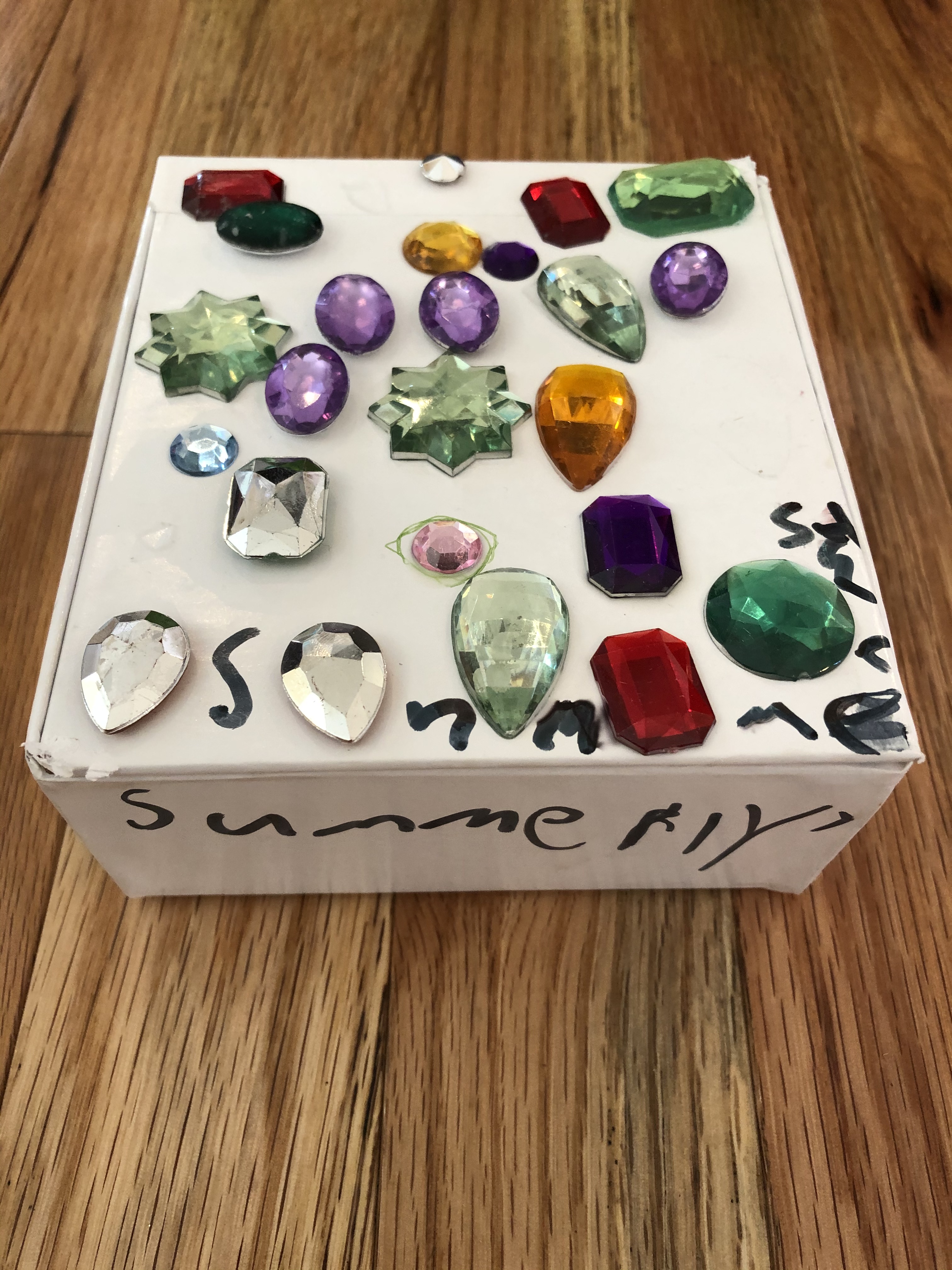
It was Greek Day at school one day last week, and at pickup Summerly climbed into the car and handed me this:

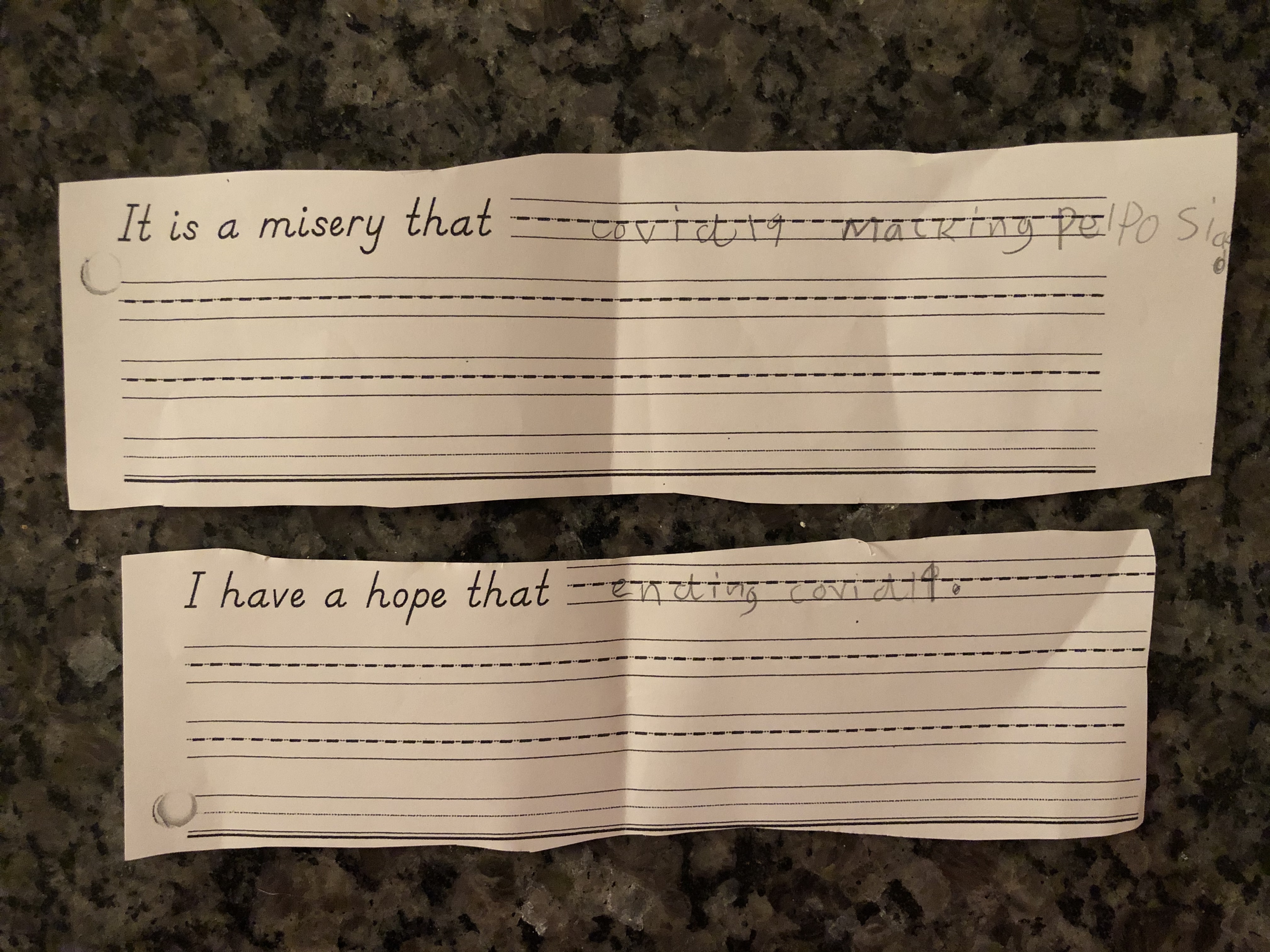
It’s her very own Pandora’s Box, embellished with rhinestones and decorated in her characteristic style (I like to describe it as “slapdash with panache”). “There’s something inside it,” she said. When we got home, much like the eponymous box’s original owner, I couldn’t resist investigating its contents. What I found within was a set of folded strips of paper, each but one inscribed with a “misery” of our world, and a single shred of hope tucked among them. Look at this:

Her “misery” is that Covid-19 is making people sick, and her hope is an end to Covid-19. This rendering of the current human mindset is simultaneously simplistic and profound, and for some reason it flooded me with feelings. Who ever dreamed that our second graders would live in a reality where this dichotomy even exists?

Pandora’s name means “the one who bears all gifts” and she was created as a punishment to mankind because they had been given fire by Prometheus, the Titan who’d stolen it from the gods. The Greek Pantheon is fascinating, not least due to the petty, puerile, punitive, conniving, deceitful, hypocritical way they interact with each other and humans, according to myth. The Pandora story provides a perfect example: Prometheus committed an act of thievery against Mount Olympus. He gave the filched fire to humankind. And the gods punished humankind. Despite the faulty logic involved here, there are two alternate endings to the Pandora story; in one, she lets loose all of the evils to wreak havoc on humanity for all eternity and, horrified at what she’s done, slams the lid back just in time to trap one last item inside: hope. The less cynical version of the tale allows hope to fly from the box, swirling around as the one extant power to counterpose the evils, giving humanity a weapon to combat a defeatist mindset that assumes the inevitability of doomsday and threatens the potential for people to ever be delivered from a life of oppressing suffering.

I’m going to hang these two strips of paper somewhere, probably in my closet, where I can see them frequently but not constantly, as an affirmation of that second version of the myth. We must refuse to believe in a world without the heartbeat of hope. If hope is “the thing with feathers” as Emily Dickinson says, may it not beat its wings to bits inside a box. May it take to the air, the very air we breathe, and make it safe to breathe again.

My eight year-old has a hope for the end of Covid-19. Your words to Zeus’s ears, my child. And may this punishment leave behind all the gifts it brought to bear.