Dónde está?

I’ve found that there’s a significant learning curve involved with helping a middle schooler manage the world according to homework, and the first couple of weeks required quite a bit of guidance on my part. One afternoon, my fifth grader enumerated his assignments to me after pickup, which included a page of math in his workbook, a round of math fact fluency practice via an app, and a word search for Spanish. We identified that he wouldn’t have time for all of it before our scheduled nightly reading, so he suggested he save the word search for after his siblings went upstairs to do their pre-bedtime preparations because it was the easiest. While he worked on the word search later that night, I went through the motions of putting the kitchen to bed, shaking ants off the figs I’d picked and brought in after an afternoon of downpours, switching out the masks the kids had worn that day and snapping clean ones onto their lanyards, supplying the insect habitat with some fresh food (a few leaves, wet with rain), and making sure everything was in order for the next morning.

Every couple of minutes or so, he’d give me a progress report, commenting that he’d found “lunes”, then “domingo”, then “martes” and “sábado.” “Only three left,” he said, then “two to go,” followed by a few more quiet minutes. When I hadn’t heard anything for a while, I checked in for an update, hoping to hear that he was finishing up and ready to head to bed, but he replied that he was having trouble finding the final word, “jueves”. Though I love crosswords puzzles and games like “Boggle”, I’ve always thoroughly despised word searches, but in the name of expediency I offered to have a look after making him spell the word and translate it for me until I was confident that the objective of the exercise had been met, despite the fact that he hadn’t completed the assignment per se. I sat down next to him and laser focused on every single “j” on the grid, certain that I could have this task accomplished in under a minute. The minute passed, and I did a second inspection, this time trying the method he’d been using, which was to find the letter sequence “eve”. No luck. I explained that he’d learned the spelling and meaning of the word, which was ultimately more important than finding it on this piece of paper, and it was late, and he’d given it plenty of time and effort, so we’d have another look in the morning.

Halfway through my second cup of coffee the next day, “jueves” still hadn’t made itself any more accessible to either his or my eyesight, though I swear I must have gone over every single glyph on that photocopy twelve times. We decided enough energy had been spent on this, and he packed it up ready to ask his teacher to solve the mystery of the missing Thursday when he got to school. I said, “What’s funny is that we decided to save that assignment for last because we thought it would be the easiest, but it turned out to be a lot harder than we expected.” At this point, his sister chimed in to remind us of something she’d said the evening after the first day of school. Liam had been telling her all about the new homework regimen he’d have for fifth grade, and I just happened to pass by in the hallway in time to overhear her response, which was , “Wow, Liam. Middle school is harsh.” We’d all found this uproarious at the time and now had another good laugh at the memory, remarking on the appropriate reapplication of the comment to this situation as everyone filed out the door.

But, seriously, she really got it right with that assessment. And as it turns out, homework for middle schoolers can be every bit as harsh for their parents as it is for them. Here, you have a go:
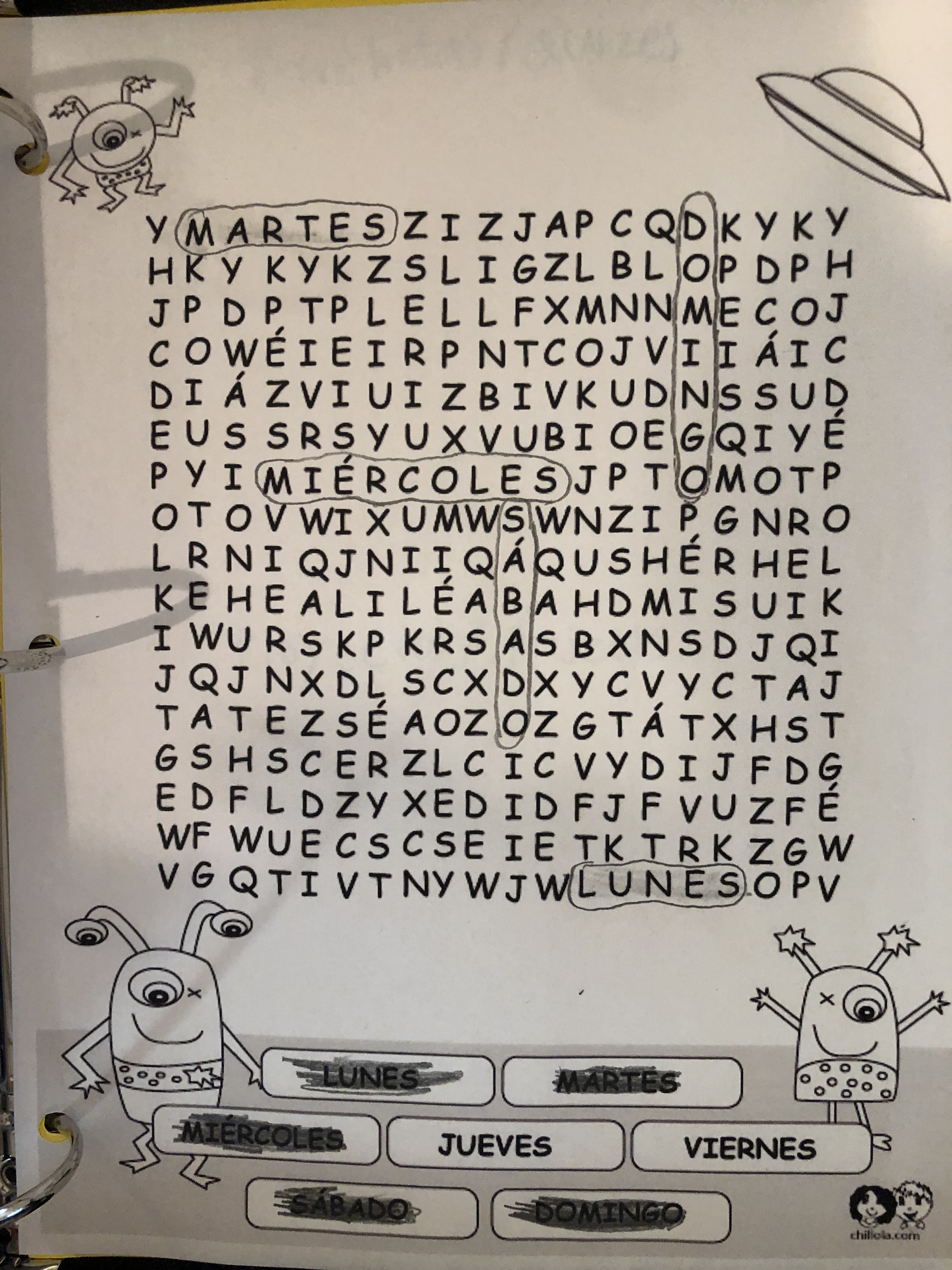
In search of Thursday

So much of life feels like this: we’re told the world is one way, that the answers are there in black and white, and all we have to do is find them. But too frequently we can turn what’s obvious inside out and still fail to see through to some kind of clarity, to find meaning in a scrambled situation. Sometimes, as in math, the answer to a problem is actually “no solution”, which feels like an ultimately anticlimactic way to fill in a blank, but in reality it’s the right response. What we ended up doing that morning was close the binder and go on with the day, which is often the only way to move forth through time when faced with a task that’s unreasonable or unrealistic. And even if we didn’t fulfill an expectation as it was presented despite making every effort to complete what was asked of us, it’s enough to know that even if we’ve failed to meet the letter of the law, so to speak, we’ve done our best. And that knowledge, though true, sure is harsh.

P.S. The next night he had another word search for Spanish, this time for the months of the year, and I’m happy to report that all twelve were accounted for this time. Whether or not the weeks in those months contained Thursdays in any language, however, has yet to be determined.

A mortarboard moment

During the first week of fifth grade, my newly-minted middle schooler learned how to use email. His social studies teacher set each student up with an account linked to gmail through the school, and she showed them the basics of how to manage the technology, encouraging parents to send their kids a message using this platform. Eager to take advantage of the opportunity to communicate to one of my children via email for the first time, I carefully modeled a format that I’ve spent a long time considering, wondering if he’d use mine as a sort of boilerplate and respond in kind or whether he’d develop his own interpretation of salutation, closing, content, and tone. When I opened my email that evening to discover his response, what I found was easily the single most magnificent email I think I’ve ever received.

I love it so much that I even resisted the urge to point out the homophonic misapplication in that last line, instead reveling in the fact that he hadn’t copied my style but had borrowed from it what features he preferred, combined with his very own approach to punctuation, syntax, layout, and structure. It is truly a thing of beauty to behold this very concrete evidence of a young person’s growth and personal progress, to see his voice take on its own individual dimension, to witness the manifestation of so many efforts in the production of a single message, to see it spelled out in black and white but with a countless catalogue of elemental color hidden there between the lines.

And what’s more is the postscript that occurred in our house that night: my middle-school son followed through with the laundry, and the next morning he even took it out of the dryer, put it into a laundry basket with the mesh bags of clean masks on top of the pile, and brought it downstairs for folding. The kids may still be in their first full week of the school year, but I feel like I just graduated.

Bottoms up

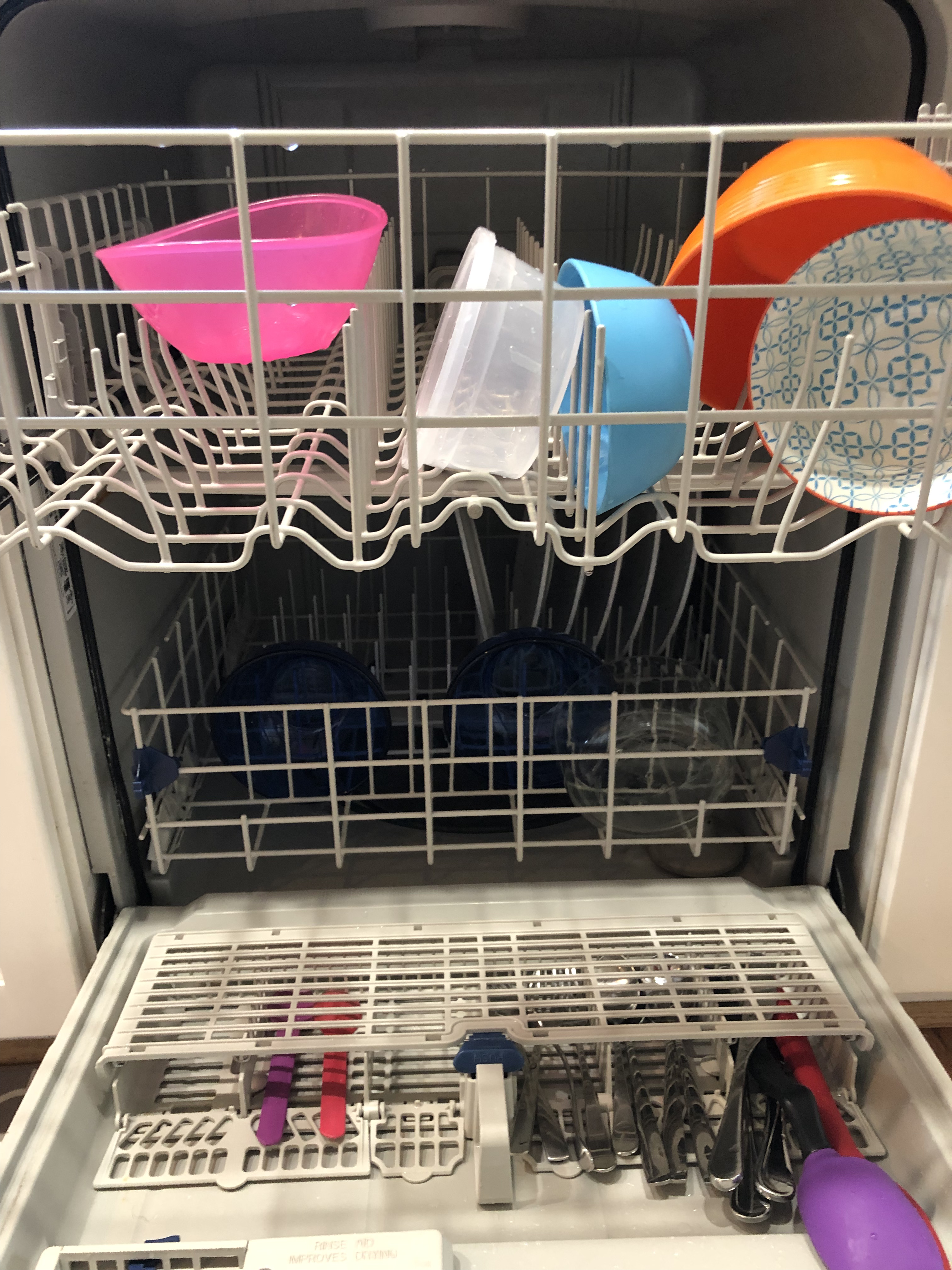
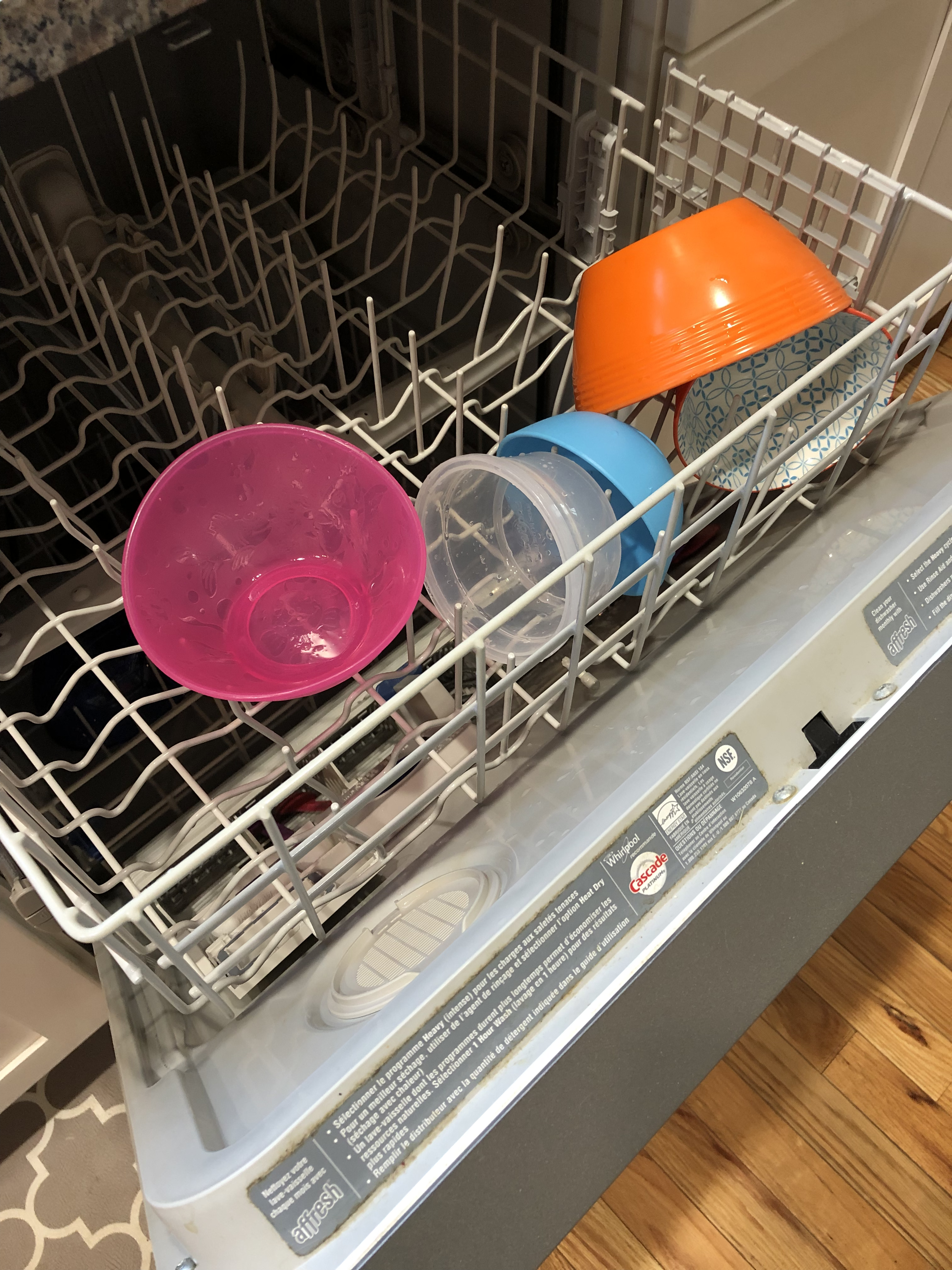
Most evenings after dinner, the kids retire to the playroom for their nightly show, each with a bowl of sliced fruit and their choice of a small chocolate treat. They use those small plastic bowls we’ve had for probably a decade, the ones that are nearly indestructible, easy to rinse or toss onto the top rack of the dishwasher, and color-coded so each child knows which bowl is intended for whom. After the show concludes, the kids have been instructed to bring their bowls to the kitchen, and at some point we upgraded this responsibility for the older kids to not only bring in their bowls, but to also rinse them and put them in the dishwasher. On one of the first nights after the upgrade, my daughter followed through, and I was happy to lay eyes on her pink bowl in the dishwasher. At first I thought how interesting it was that she had placed it with the concavity facing the rear of the appliance, while it’s my habit to nestle bowls with their bottoms to the back. For a moment I wondered at how similarly and differently our two brains operate, hers and mine, and then I bent over and looked in the dishwasher again, only to realize that what I’d thought I was seeing at first was actually an optical illusion. Here’s the scene from the original angle:

Upside down and backwards?

If you imagine that you’re looking at the bottom of that pink bowl, it appears to be placed with its outer rim facing the darkness back there. But upon investigation, this is the situation I was actually beholding:

When right side up is wrong

She’d put the bowl right there on the top rack, just as I’d requested, obviously lacking the knowledge of how dishwashers function. I mean, the bowl is stored upright in the cabinet. It’s served with the convex surface facing the table. In the sink, it’s rinsed and soaked with inside up. It’s not hard to guess why she’d think to follow suit here. As a parent, there are countless instances when you realize how unintuitive life can be, how so much isn’t abundantly obvious and needs to be taught or learned. The experience of parenthood is a lot like this: how could one know that that bowl would end up filled with water and the silt of foodstuffs if it went through a cycle in that orientation unless one either understood the physics of dishwashers or had been given articulate instruction regarding the bowl’s position to favor the desired outcome?

I thought for a few minutes about how to approach sharing this information with her when I realized I’d gone about the responsibility upgrade in the wrong direction. Rather than ask kids to load the dishwasher before they’ve ever unloaded one, perhaps a more productive way to go about it would be to have them unload a clean dishwasher first; that way, they’d understand how the water remains in any crack or crevice that has no method of downward egress. That way they’d know to take the tupperware out and shake it in the sink before putting it in the dish drainer, face up this time, so the water caught in the downturned lips of its edges can evaporate. That way they’d know that when one of the small bowls gets flipped by the upward spray of water while the cycle in running so that it rests with its base facing down, it will collect water in its rounded basin and fail to cooperate with the “dry” portion of the cycle.

Sometimes we have to start at the endpoint and retrace our steps, work backwards through a process, in order to understand how to begin again. Sometimes learning best practices is most effective retroactively, when the ends actually do justify the means, when we have a clear idea about what steps to take to favor fortune. For most aspects of life, of course, this isn’t possible; we can’t get a do-over when it comes to the intractability of time, and our little pink bowls will again and again end up brimming with dishwater, potholes on the road to progress. But in some small ways–like learning to use an appliance–it’s nice to know that you can start at the end to inform the next beginning, to use the understanding of the endgame at the outset. And when things aren’t obvious, when we don’t know which side of a situation is up, sometimes it takes sense to make sense, and the only way forward is back.

Keep calm and…

For Mother’s Day this year at my gentle behest, my husband booked me a massage. It was my first massage in years, and the experience was so much more relaxing than I’d expected, right up until the point that the massage therapist held up the blanket that was covering me so I could flip over. Perhaps it was the monumental peculiarity involved in the fact that the only scrap of cloth on my body was covering my mouth and nose (that sensation–of wearing a mask and nothing else–was a brand-new one), but I was suddenly self-conscious despite the fact that she was looking away, and the blanket was mere inches off my skin so she wouldn’t have been able to glimpse anything below my neck regardless. It was a strange feeling because I’m not overly modest, nor am I ashamed of my shape, so I was surprised to even encounter that unfamiliar twinge of cringe, yet it only lasted for a second because my mind immediately went to a time when I was in a much more exposed situation.

The day was June 4th, 2015, the day I went to the hospital to deliver my third child. The obstetrics practice overseeing my pregnancy consisted of about eight different doctors, one of whom had recently joined rank after moving back to town. This doctor happened to be the one on duty that day, and she also happened to be an acquaintance of mine; she’d been a year ahead of me in school from elementary days all the way through until her graduation, one year before mine. She and I hadn’t been friends in school; in fact, we’d been rather tepid to one another throughout the years. Back then, she was always one of the smartest kids in her grade, and she was also beautiful and ultra-athletic and popular among both girls and boys, so she was basically one of those “full package” kind of kids that others sometimes secretly (or not-so-secretly) resent for being so uncommonly stacked in favorable attributes that it seems just a bit unfair.

Of course, I had prepared myself for this possibility (I mean, there was a “one in eight” chance that this would happen, so it probably would), rationalizing over my initial resistance with the knowledge that, until recently, she and I hadn’t seen each other for twenty years and were practically different people now than we were as kids in school. I also reminded myself of how smart she is (a much sought-after quality in a doctor) and that she was a professional, so this was just another day at the office for her. I’d also seen her for a routine appointment a few months earlier, so I knew that her bedside manner was canny enough that she wouldn’t start asking after my siblings or something while I was mid-contraction. She was also a woman and a mother herself, and having had my first two children delivered by men, it might be nice to have two x-chromosomes at the helm this time since, well, it takes one to know one in some basic biological ways. So what if the guy I’d been casually seeing during my junior year, who I fully expected would take me to his senior prom, had asked her instead of me? I got over that years ago (almost completely)!

Anyway, you know you’re really grown up when you come to terms with having a woman who used to be the girl who hung on the arm of guy who’d publicly snubbed you in high school (he did apologize, I should add, though it was much later) deliver your baby. Though childbirth is miraculous in so many ways, there are aspects of the process that can also feel pretty darn undignified while they’re happening, as I knew from experience. I won’t go into any details, but lying there on that massage table, I remembered all of them, pulling out each one like photographs from an album, moments captured as snapshots and filed away unbidden until some reminder pulls the book off the shelf. As my mind paged through those memories of having babies, I suddenly remembered that I was mid-massage and almost laughed at the irony: there I was, ostensibly enjoying my Mother’s Day gift while my brain was humming with some of the least relaxing thoughts possible, including angsty high school social drama and labor and delivery.

Next year maybe I’ll ask for something equally as rejuvenating as a massage but without all of that unoccupied mental time devoted to a rabbit hole of childbirth stories. To that end, I’m going to take a screenshot of that hand vacuum for the car I’ve been eyeing and text it to my husband on May 1st. I know he’ll understand.

Add to my favorites

During the final week of his kindergarten year, a few weeks before his sixth birthday, Arlo’s teacher (the famous Ms. Ashley) called to share that he’d been having a hard time with his “memories” book that each student was compiling as a culminating project for the school year. The kids were given several prompts, such as “favorite unit of investigation” and “favorite game to play” and “favorite piece of playground equipment”. Immediately I understood why Arlo might be having a hard time with this assignment; sometimes asking kids to pick a “favorite” is an overwhelming request. Unless clear, obvious choices exist in their minds, choosing from what, at times, is a number of options unconfined to finitude can feel daunting, particularly because many of the items within each category are apples and oranges to each other. Add to this the fact that Arlo, like many kids, derives such great enjoyment from almost every engagement he makes in the social setting that school provides that he’d be hard-pressed to narrow the options down to a single front-runner. There was yet a third reason that this exercise would prove challenging for him: he’s not a simply concrete thinker, and his insightful interpretation of the world frequently surprises us with its explicative perspicacity. He doesn’t just “think outside the box”, to use a hackneyed idiom; he breaks the box down and puts it out with the recycling so there is no longer any box that could possibly contain his thoughts.

When I asked Ms. Ashley for more details, she recommended that we do some summer work with writing so that his confidence increases. She explained that he’d really had a hard time with one question in particular: “Where is your favorite place to be at school?” because his answer was so long that he’d stalled out in trying to write it all. I asked her what his answer was and she said, “He said his favorite place to be at school was in other people’s minds because that means they’re thinking about him.”

I have a hard time with favorites, too, but I can definitely say that that answer to that question is hands-down my favorite favorite.

Soloist

It amazes me that our neighborhood, despite the hundreds of houses with barely any breathing room in between them, plus incessant construction clamor and commotion accompanied by all manner of vehicular machinery from dawn til dusk at least six days a week, is home to whole host of birdlife. In our yard alone, every year we enjoy the sights and songs of goldfinches, bluebirds, cardinals, and hummingbirds (one year we had a group of nine tiny fliers who frequented our honeysuckle plants!), as well as sparrows and wrens and finches and thrushes and robins. I’ve seen one solitary blue jay, also, and once in a while a mourning dove or two. I swear there was a flock of actual pigeons one day, including an elegant albino, hanging out in the stand of trees in our traffic circle, and Canada geese storm the streets most years, notoriously feasting on the grass seed put down in the park across the street one spring. Of course, we have the crows, and hawks circle from time to time, but the main character of this vignette is the mockingbird.

As late spring unfurled into summer this year, a mockingbird of considerable stature decided to spend most of his time perched on the topmost ridge on the eastern corner of our house’s gable roof, and from there he produced a stream of song that rarely abated. I named him Pavarotti, and he sang all season in loud, long strains, the clarified timbre of his notes tripping along to produce an almost aggressive music. His range and repertoire, marked by the unmistakeable sound of self-assuredness, as if he were convinced that his voice was the greatest gift to all who could hear, were impressive. And his stamina for spilling forth copious song goes unprecedented in my memory of mockingbirds past. He was animated, too: a true performer, constantly turning his head to regale all audience within range, long tail feathers moving with seemingly impassioned rhythm and expression.

Pavarotti rose with the sun those May days, chirping up my final quiet mornings of the kids’ school year while I sat inside at the computer almost directly below his shingled pulpit, punctuating my typing with his sampling of song that cycled through what must have been about a dozen different birdcalls. At first, I marveled at his tenacious audacity, his presumptuousness at consuming earshot by singing over all other birds, not to mention barreling cement mixers or the thunder of Monday morning garbage pickup. Then I felt just a twinge of perturbation at his utter disregard for my proclivity towards peace and quiet, his strident messages being delivered over and over in a broken record of languages I could appreciate but didn’t understand. And then it occurred to me that there was something sad about this too: the mockingbird’s song is only his as much as he can perfect the songs of other birds. I did some reading on the subject and learned that, though a mockingbird parrots verses of songs belonging to other species’, often with even more refined technique and style, perfect pitch and tone, never would another bird mistake his song for one of their own. It would be like Whitney Houston doing a cover of a Paris Hilton number: same notes, same words, but of a different quality completely.

Despite Pavarotti’s melodic prowess and ability to broadcast, despite his expertise at the craft of mimicry, he was only the author of his song insomuch as he could control the arrangement, the pattern of others’ songs. The only originality belonging to his music was the order in which he strung the strains of other songs together: an avian version of a mixtape, a mashup of borrowed art. I wondered if his bombastic bluster of sound and fury emanated from a place of creative frustration, that his only harmonic occupation was the polished, finely-tuned recapitulation of ancient refrains written in the nucleotides of other feathered friends. I thought of a pastor whose only recourse was reciting scripture to his congregation, a parent who spoke to her child in aphorism only, a writer who couldn’t think to begin and end a story with anything other than “once upon a time” and “happily ever after.” Sure, there’s something to be said for taking the old and making it new, but what if the thwarted artist wanted nothing more than authorship of something purely his own? What if the mockingbird yearned for the ability to sing an original song but had no language of his own, no tune of his own, to conjure one?

I know, I know. He’s a bird, not a human, and there’s every reason to believe he’s blithely happy to do the incontrovertible bidding of his instinct, which is to repeat what he hears, just a town crier proud to make his report. These are purely human projections; surely no mockingbird has ever bemoaned his inability to compose. But just in case, I cranked a crack in the kitchen window so Pavarotti’s display of virtuosity would be better audible, a small, mostly emblematic way to say to him and all others who crave listeners for their voices: I hear you.

A snack that inspires

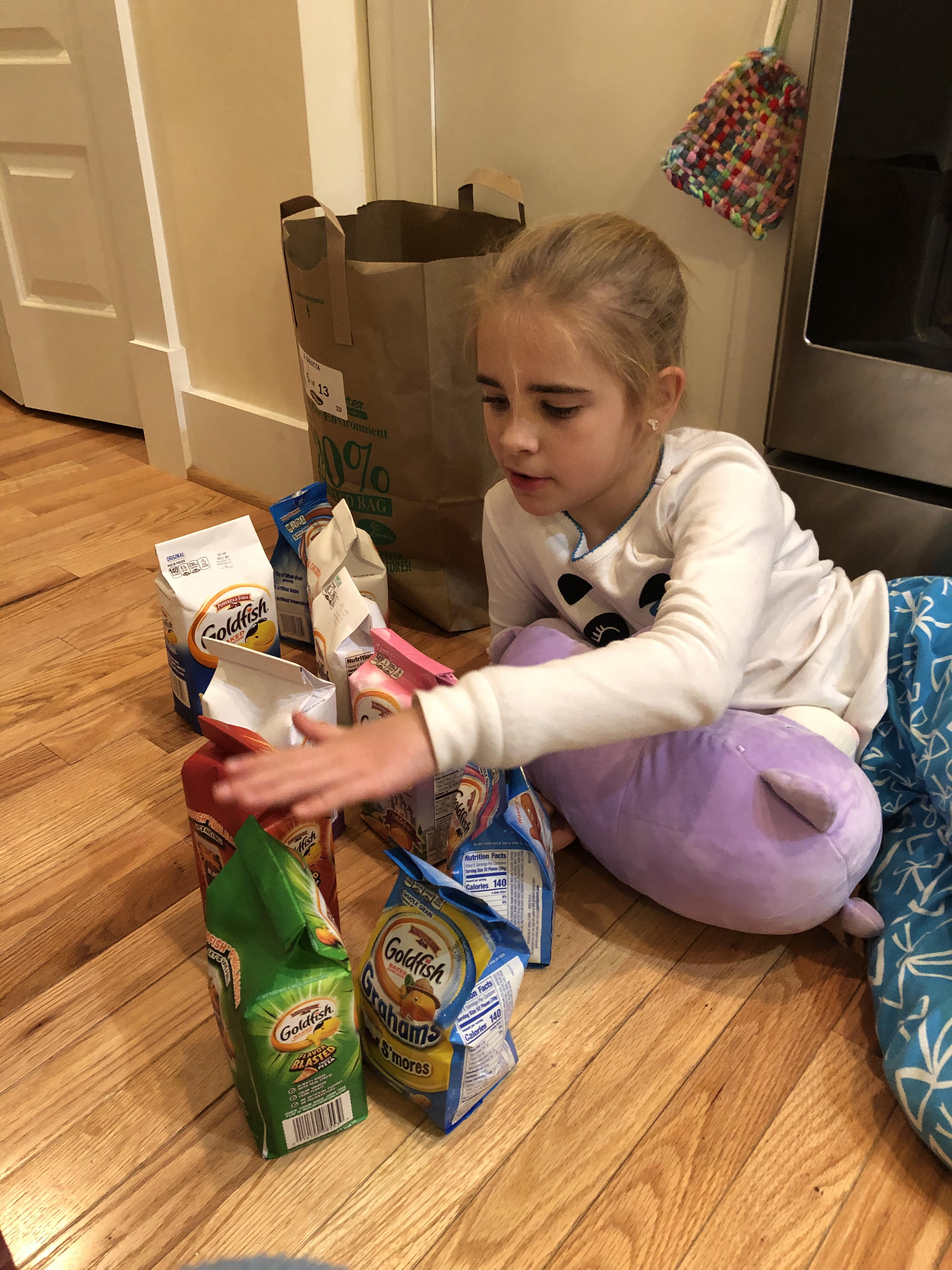
Some kids play with dolls. Others ignore the thousand toys we have because who needs action figures when you have groceries?

(Goldfish were on sale, in case you couldn’t tell. And the princess goldfish bag was the princess, as one might imagine, though I’m still trying to figure out why the pizza-flavored goldfish bags were the servants. Thankfully, they seemed to be treated exceptionally well by the royal family, even the royal dog who, naturally, was called Cupcake.)

Firstborn son

Liam discovered a YouTube channel with a seemingly endless series of videos starring Star Wars Lego minifigures (specifically combat sequences featuring clone troopers versus battle droids). The videos are surprisingly well done, with interesting plotlines and camera angles and set design, so I gave him the go-ahead after we previewed one together while discussing the dangers of YouTube and the importance of his not clicking beyond the content published on this channel. We agreed that he would let me know if anything he encountered, advertisement-related or otherwise, left him with questions or made him doubt the appropriateness of what he was seeing. After he’d seen a few episodes, I checked in to take the pulse, and he said that it was all fine aside from the fact that they use the phrase “what the hell” and the word “crap”. I told him that didn’t worry me because I knew he could handle it as long as it didn’t make him feel too uncomfortable and because those words were very mild as far as profanity goes, and we decided that if any other oaths cropped up that gave him pause, he’d let me know. I also noted that I’d prefer that his first experiences with more mature material be within the context of our family so that he’s accurately informed, as a way to avoid misconceptions should he be exposed to the content elsewhere (like, ahem, hearing it from other kids). As he took a step toward the living room, he hesitated, then said, “Mommy? Do you remember when I said “damn it” that time when we lived in our old house?”

I had to think for a few seconds, as this event had to have taken place about six years ago, and then a vague memory swam to the surface. I had a hazy image of Liam coming down the stairs while uttering those words, and then a feeling that was at once nebulous and visceral flooded my mind. “I do remember that, sort of,” I said. “I got mad at you, didn’t I?” He confirmed this, and I felt terrible. “I’m sorry, Liam,” I said. “I don’t know if I’ve apologized for that yet, but I shouldn’t have been angry at you. That certainly was not your fault; in fact, it was probably mine because you were most likely parroting what you’d heard me say at some point. I must have been worried that you’d repeat it at school or something and felt like I needed to impress upon you the importance of NOT saying things like that because you were really too young to be using those words. When you’re that little, you aren’t ready to practice the kind of discernment necessary to understand how and when words like those can fit into dialect, and you need to fill that language acquisition space in your brain with more useful vocabulary to help you express specific ideas. Not until you’ve achieved the kind of fluency that will allow you to say exactly what you’re trying to say in almost all situations does it make sense to add those unnecessary words into the mix. That being said, I really wish I hadn’t acted angry at you that day because you certainly didn’t understand any of this, and you had no frame of reference to inform the moment you said those words. I should have behaved in an opposite way, and I wish I could go back and do it differently.”

I gave him a hug, and he happily retreated to the other room with his iPad peopled with animated Lego versions of automatons from a galaxy far, far away, leaving me to ruminate while applying a dry rub to some pork chops. As a firstborn myself, I know the challenges implicit in leading the pack into life, and I also appreciate the learning curve that new parents have to undertake in their first experience of guiding a new human through his tenderest years. I feel compassion for those parents as well as for my former self, even in that misguided moment at the bottom of the stairs when I reacted with ire instead of grace, when I didn’t have the clarity of experience to impart a healthier method of expression to my consciousness.

In trying the flip the script, I’m seeing this retrospective reconsideration of the “damn it” moment as a kind of gift of redemption. It gave me the experience of admitting to my child that I had made a mistake and apologizing for it, of recognizing that I know things now that I wasn’t aware of at the time. It gave me the opportunity to explain that I lacked understanding and acted poorly as a result, to look my son in the eyes and say “mea culpa” with dignity, to make it clear to him that because he was our first child, we’ve had to figure out a lot throughout his decade of life. I pointed out that, though I was in the wrong that day, I possessed neither the education nor the insight necessary to inform my behavior and so I deserve no self-flagellation. Ignorance isn’t bliss, but it sometimes can confer a kind of innocence.

The burden of the firstborn is real: you are on the front lines of your generation. You are the one blazing the trail of childhood, igniting your parents’ trial by fire that lights their pathway through parenthood. You are, in many cultures, the primary inheritor, be it of title or reputation or responsibility. You are the prototype, the guinea pig, the culture in a petri dish representing the object of examination in the motherhood experiment. You are the teacher of your parents, the one who has to hold their hands while they cross the street between being a person and being a person who is also a mother or a father. The mantle across your shoulders is a weighty one, and though you must be strong to support it, it also imbues you with strength of character. You are born into a leadership role, whether you like it or not, and the power of your influence is both a diamond diadem and crown of thorns. It’s a wand you carry and cross you bear.

I’m really not worried about Liam picking up a swearing habit, partly because he already has a cursing canon of his very own. He’s on the record for exclaiming, “What in the name of Thor!” while shaking his fist on several occasions. He’s uttered “Ka-SHINGA!” and “Moo-SAka!” (homophone of “moussaka” but with emphasis on the second syllable, unlike the Greek pronunciation), which are original coinages, more than a few times. And frequently, as an expression of frustration, he drops the hot phrase “chicken nuggets” despite repeated requests that this annoying epithet be excised from his lexicon aside from when he’s discussing actual pieces of breaded poultry. This is a child who actively resists negative influences, who travels the straight and narrow by choice because it makes him feel safe. Whether this is due to birth order or personality, or both, I don’t know, but I’m glad that he’s the one who came first. If his younger brother had been the older brother, who knows what things would be like over here. This is why, when “chicken nuggets” is interjected into my airspace roughly once every waking hour of my life when Liam is home, I don’t even give a damn.

Windfall

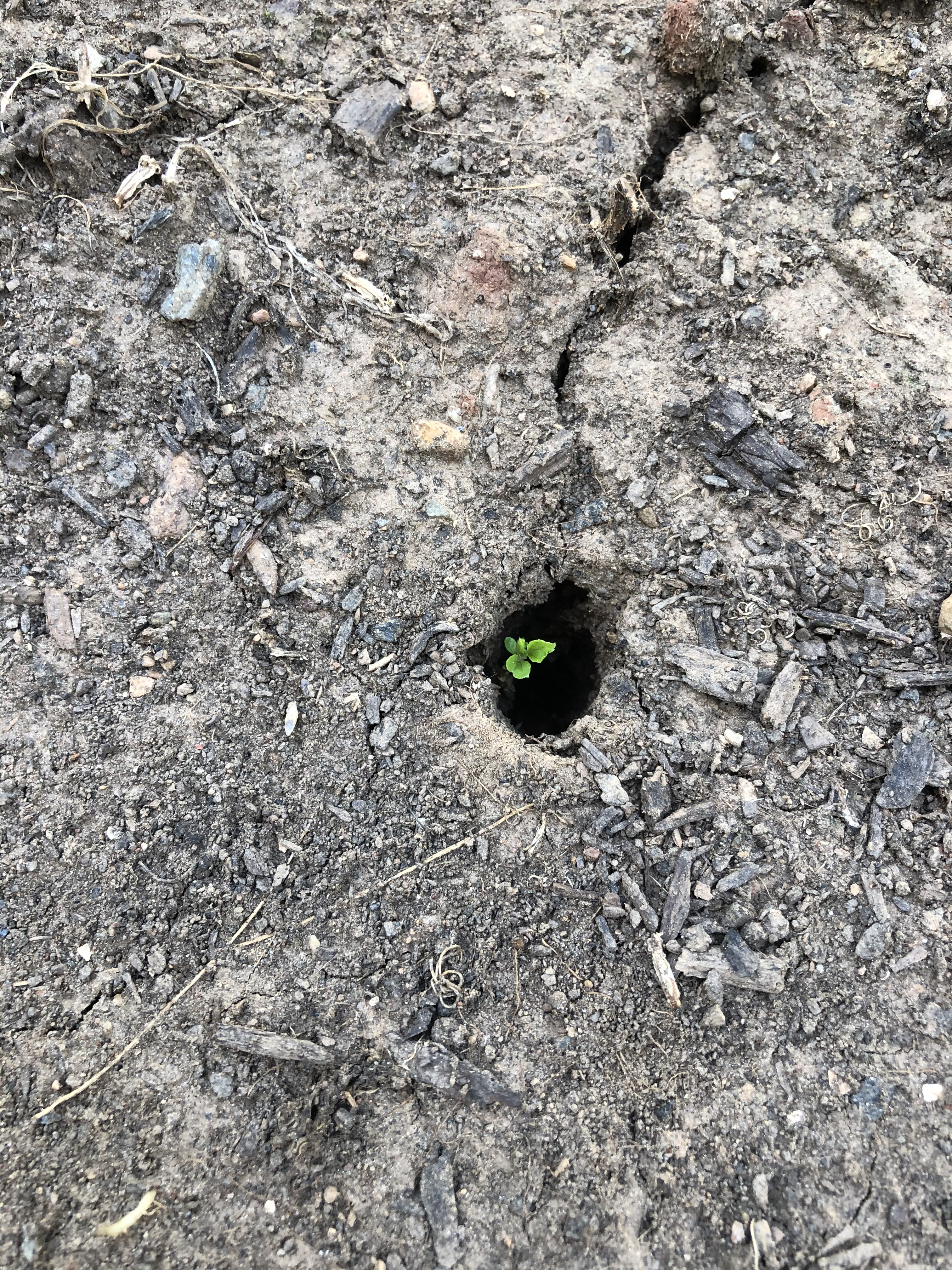
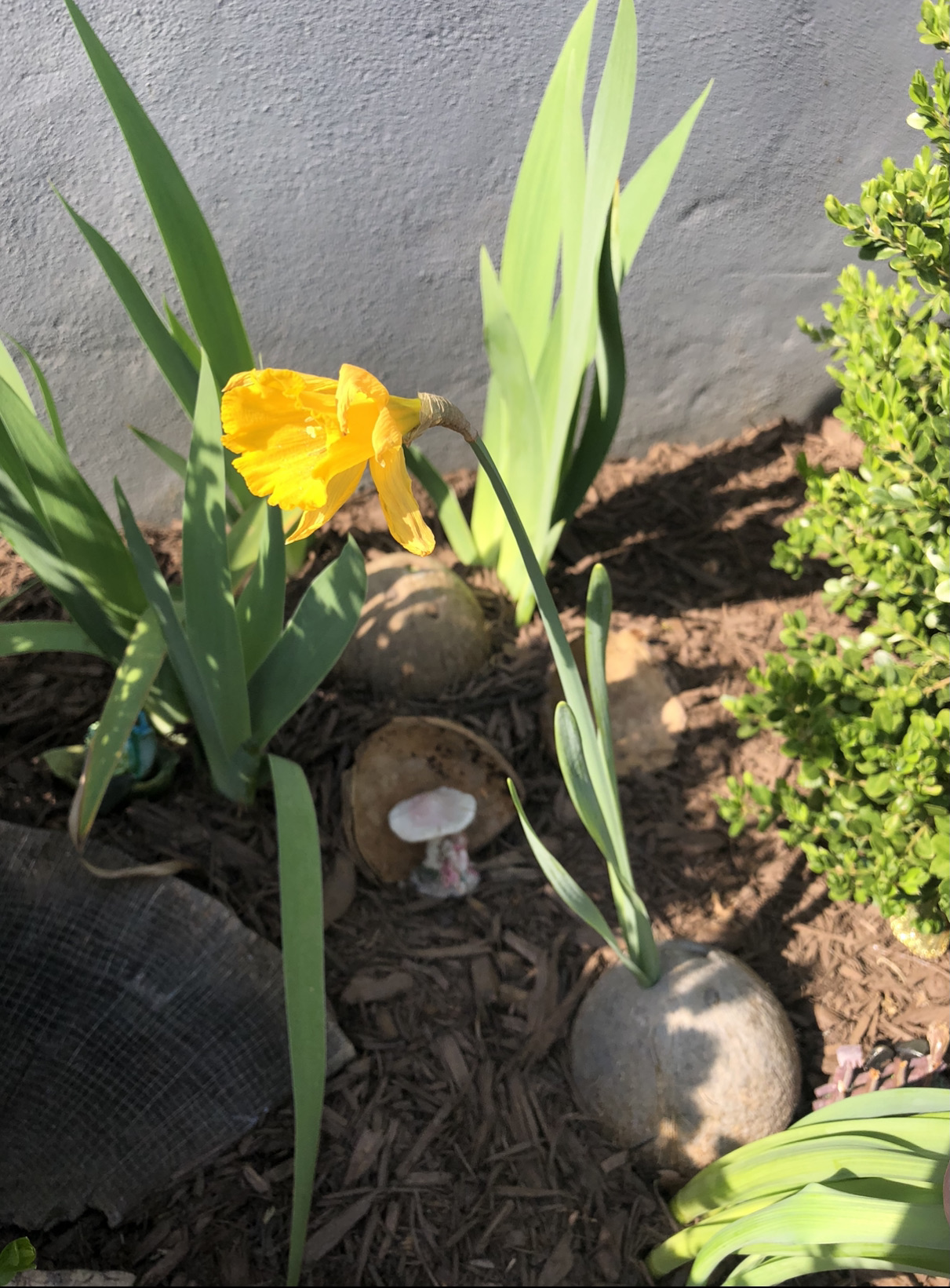
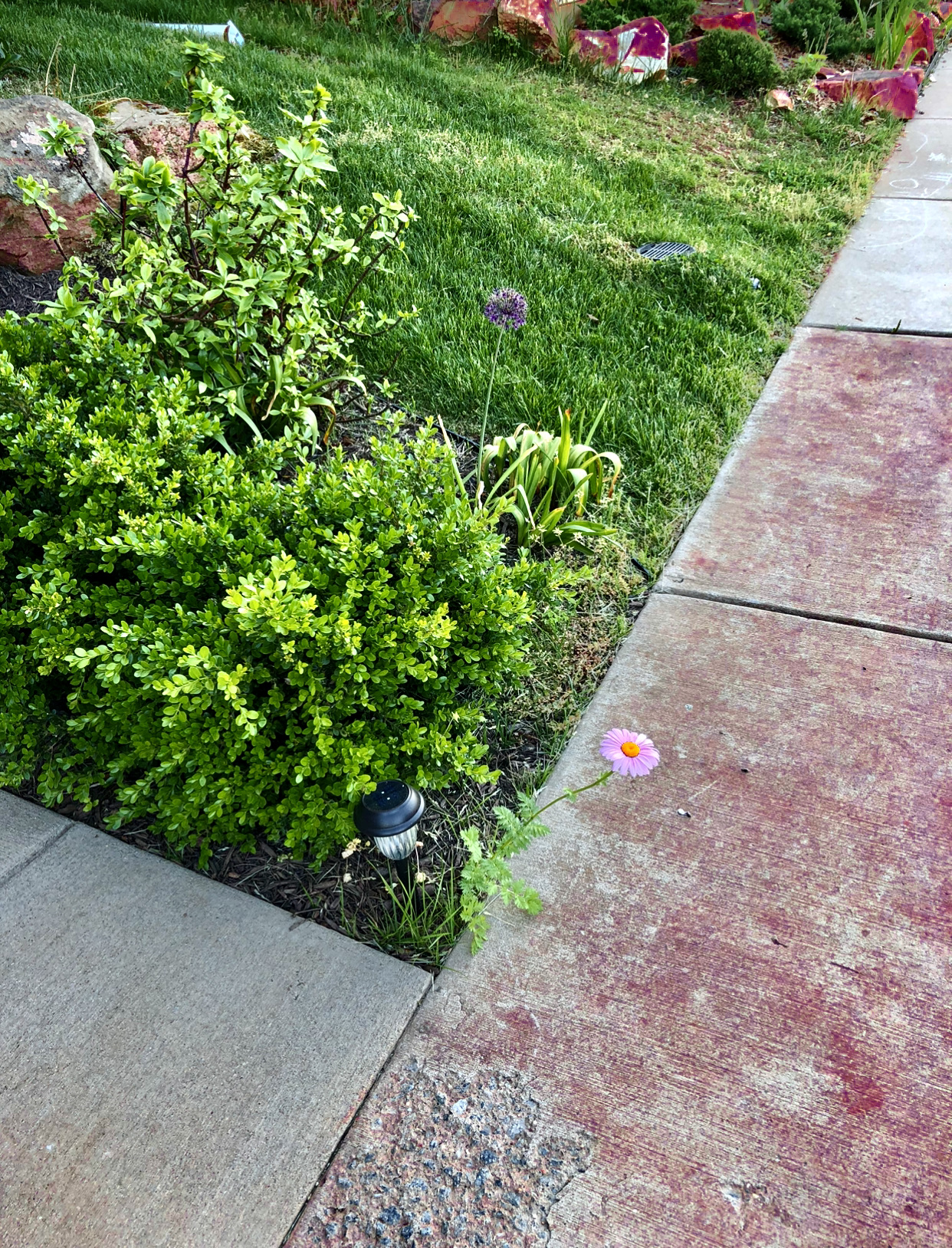
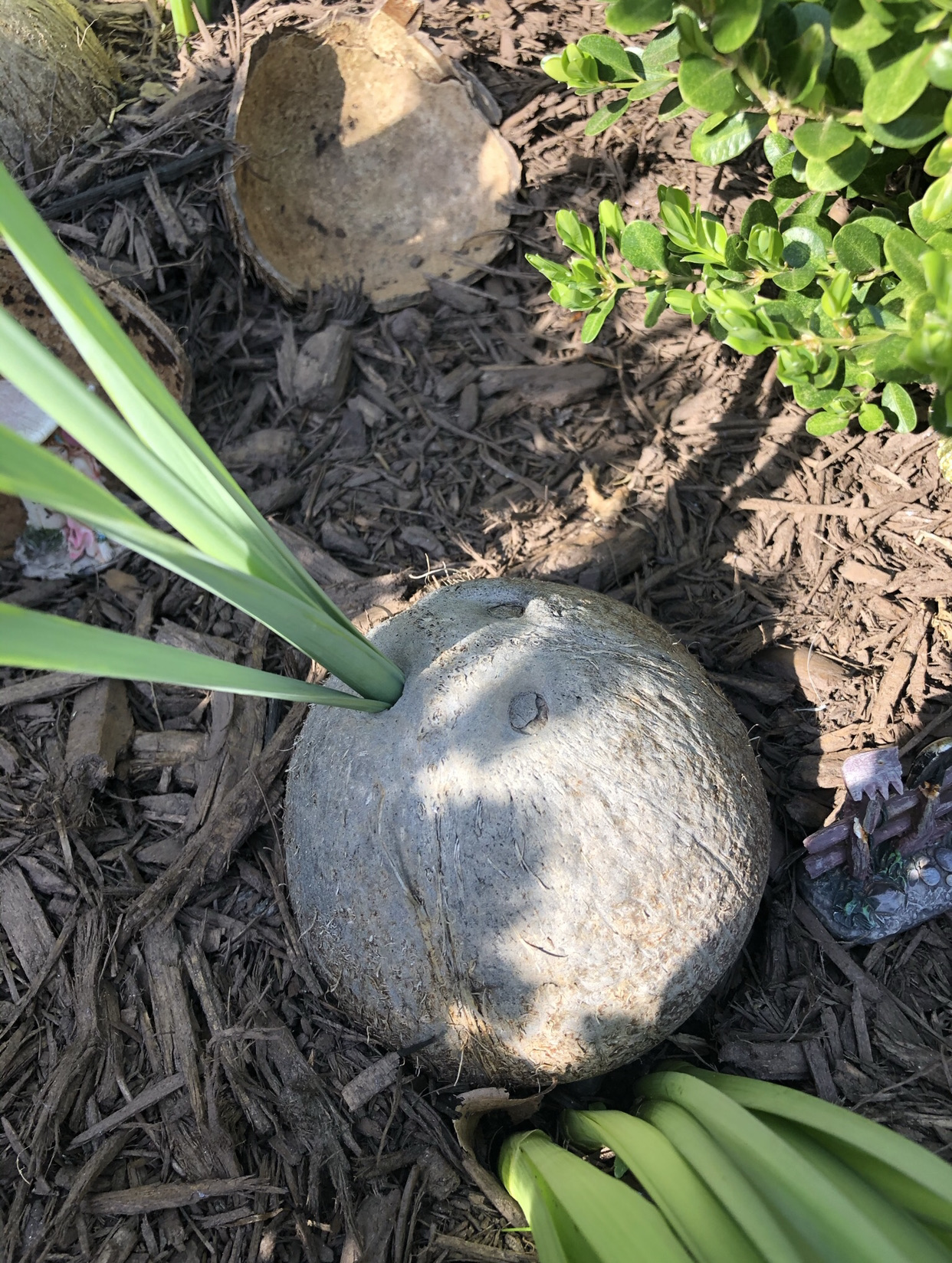
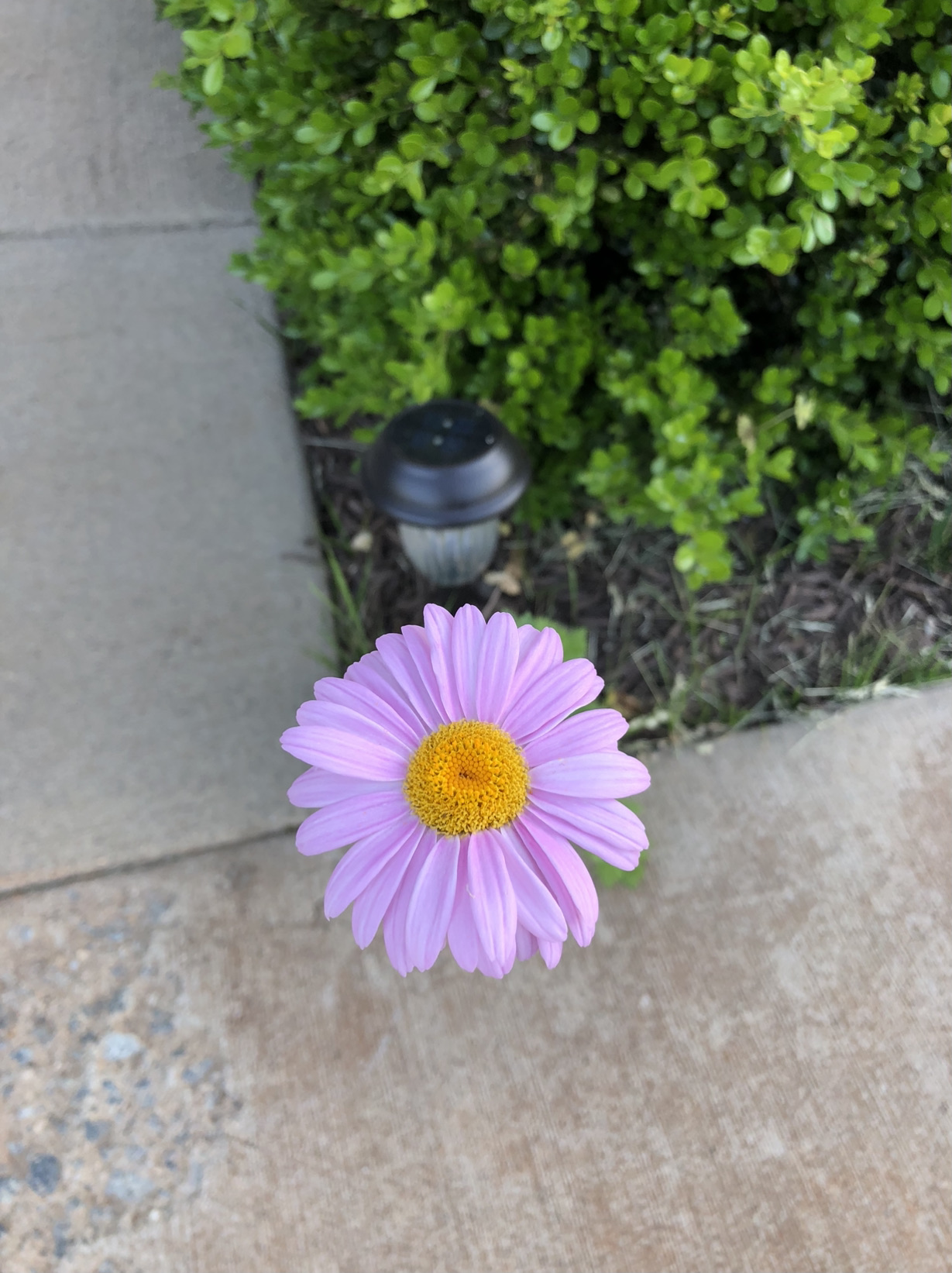
For years I’ve been collecting photos of nature being brave, which I keep as a source of inspiration. It’s that “grass in a crack of the sidewalk” conundrum, a reminder that growth often happens in unlikely places despite unfavorable circumstances. These are my botanical role models: the volunteer tomato, grown from last year’s seed after a burst fruit dropped in a transplant pot, sprouting in a spot so shady it grows at a forty-five degree angle to access the sun; a tongue of catmint, its origins unknown, licking up from the untold depths of a toad hole; a daffodil that grew underneath a coconut shell in our fairy garden and proved most resourceful in finding its way to the light; this very special daisy sprung from an overblown parent plant I’d grown in a porch pot the summer before, its face somehow impossibly pink in spite of the white-as-milk blooms its ancestry wore.

Here are their headshots in the playbill for “You Can Do It Too: A Garden Production of Fortitude and Joie de Vivre as the Antidotes to Hardship and Inauspicious Beginnings”:

Limited resources can still yield sweet fruit.
Once again, light finds its way into dark spaces.
Growth potential knows no confinement.
So what if they were white! Be pink.

And a couple of closeups for clarity:

I named her Gloria Gaynor. No glass remains in that coconut ceiling.
If only I could get Darwin and Fibonacci in the same room to discuss this!

What’s in a name

When we were preparing for our oldest child to enter middle school, we had to choose which language he would take. The obvious choice in my opinion is Latin, but unfortunately that wasn’t an option, so it was either French or Spanish. I’ve held a suspicion for a while that Liam might have a future as a culinary school student (I also was certain that my daughter would be born a redhead (she’s blonde as a daisy) and my third child would be a girl (he is most definitely a boy from top to bottom), so it’s possible that I’m wrong about this, too). Harboring that speculation, however, did make the decision a bit more complex. I posited that French would be most helpful in pursuing a culinary education, but for working in an actual restaurant, at least in the US, Spanish is the obvious choice.

Assuming that I’m probably incorrect in thinking that he has a future in gastronomy, and because Spanish seems a practical language for young Americans to learn in general, that’s eventually what we chose, though I did feel wistful about the idea of Liam walking into his first day of an internship at Le Cordon Bleu with a brain full of fluent French. Not that he couldn’t learn it later on, of course, but there certainly is something romantic about a little boy speaking en français in a little boy voice. And though it’s quite possible that I’m just projecting about the idea of him as a future chef, the child sure does share my delight in Julia Child’s “The Way to Cook” collection from the eighties, and if I ever want someone to binge-watch every episode of “The Great British Baking Show” (again), he’d be my pick. He also has interesting sentiments about food, and his palate is remarkable.

For example, one morning he took his first bite of a bowl of cereal, and a look of disgust immediately colored his face as he declared that the milk had soured. I sipped my coffee, full of milk from that same half-gallon, and disagreed. His sister, who was also eating cereal, agreed with me; the milk was fine. Well, what do you know, but the next morning when I poured some in my coffee: curds. Damn, I thought, that boy was right (again). A few weeks later I used some cheese in his baked potato that was pushing its expiration date, but it tasted fine and was only beginning to smell a tad on the ripe side, but he pushed it away. “There’s something wrong with the cheese,” he diagnosed, having merely smelled the fork. Meanwhile, his siblings found no fault in the aging cheddar, but I started to think: this kid knows flavor. He frequently comments on aspects of balance and texture, and he’s always been especially sensitive to the temperature of food. He also likes to experiment with making combinations, like putting avocado on a hotdog or sautéed clover on pizza. This isn’t to say that he’s particularly adventuresome when it comes to eating; in fact, he’s pretty picky. But he often has interesting ideas for recipes, including adding bacon to a quesadilla or making what we call burgerritos.

He suggested that we make cheeseburgers and wrap them, with some guacamole, in flour tortillas, and I’m obviously a sucker for a portmanteau opportunity, so the “burgerrito” was born. I’d picked up some organic wagyu ground beef that was on sale and suggested that we mold the patties into an oblong shape with the cheese pocketed inside. That way, the baking time would be short because the layer of meat would be thin, and the cheese would melt at the end of the cooking process due to convection. Then we could wrap these in warmed tortillas and serve with guacamole for dipping (or ketchup as an alternative). It was a great success, and everyone raved about the beef. I said, “It’s wagyu, so it’s really rich. I’ll have to see if it’s still on sale.” Liam reacted to this with a fit of giggles, and we all looked at him quizzically. “Wagyu!” he said. “So it’s tail meat?! You know, ‘wag you’??” and commenced his hilarity.

Maybe I should have him take Japanese instead.