Author Archives: alisongulotta

You’ll C Y

A conversation between mother and son:

Son: “What’s the first word in ‘yuck’?”
Mother: “You mean what’s the first letter in the word ‘yuck’?”
Son: “Oh, yeah.”
Mother: “Y…”
Son: “Because I want to write ‘yuck’.”
Mother: “Oh! Haha, I know! I was saying ‘y’ the letter, not ‘why’ the word!”
Son: “Oh, okay!” (starts writing)
Mother: “But also why ARE you writing ‘yuck’?”
Son: “You’ll see why.”
Mother: “Oh, really?”
Son: “Uh-huh. Right now.” (holds up paper with a “y” written on it) “See ‘y’?”

This probably would have been more entertaining had it not occurred so soon after he’d rejected all of the several dinner options that were literally on the table, but at least he’s journaling about it.

Her majesty’s secret service

Just when I thought the growing pains in my relationship with Alexa could be considered history, a new pattern began to develop. In the years before the age of assistive technology, we’d been alerted to the arrival of an Amazon order when a package would show up on the doorstep or in the mailbox. I’d been able to open the box or bag privately and disseminate its contents according to the identity of the items therein. If the delivery contained a bottle of vitamins, for example, I’d just whip it out and put it in the cabinet behind the one nearing emptiness. If it were a birthday present for a friend’s upcoming party, onto the shelf in the hall closet it would go until the time came to wrap things up. And if it were a gift for one of the kids living here, I’d quietly squirrel it away into one of my hiding spots in anticipation of the next occasion warranting gifting. However, now that Alexa is a fixture in our living space, we have the luxury of being audibly alerted when a package from Amazon has been delivered. Sweet feature, right?!

Wrong. Well, I suppose in theory it’s helpful, but that’s the thing about Alexa; she uses this guise of helpfulness to worm her way into a position of power, just like many masters of manipulation. Here’s what she does: say I’ve ordered Scotch tape, hamster food, printer ink, rubber gloves, popcorn, and a black widow spider preserved in resin. That spider was expensive, but it was right there at the top of my youngest child’s Christmas list. When the package was delivered, Alexa flashed yellow to let us know that we had a notification. Early on she’d trained us to know that if we said, “Alexa, what’s the notification?” she’d tell us what was on her version of a mind. When we do this after a package is delivered, she says, “You have one new notification. From Amazon shopping, a shipment has arrived,” which is all well and good, but she doesn’t stop there, adding the word “including…” followed by the name of one of the items in the delivery. For instance, when that particular order arrived, she could have said, “including Scotch tape multipack” or “including Orville Redenbacher popcorn” or “including Epson Series 340 replacement ink cartridges.” But no, she chose the one item in the group that was intended to be a kept quiet for the time being, spilling the beans by saying, “including black widow in resin,” loud and clear for all to hear. It’s like this every single time. No matter what the contents of the order are, without fail she selects for enumeration whichever item is a gift for a child living in this home.

My kids thought this was hilarious, of course, and delighted in the spoilers, deriving great satisfaction from noticing before I did that the yellow ring of light was winking at them, compelling them to take the bait and ask her for notifications themselves. Obviously I should have disabled this feature before I finally did, but I kept thinking it wouldn’t happen next time; next time, surely, she’ll call out one of the several things I’ve ordered that doesn’t happen to be a surprise for a child. And yet the next time, when a box containing sneaker deodorizers, mouthwash, caperberries, the newest graphic novel in the hit series the kids were devouring, and a hairbrush was dropped off on our front porch, which of those items did she choose to articulate in her haltingly haughty computerese? That book, of course, the full title just rolling off her virtual tongue.

The last time this happened, she gave away the fact that I’d ordered a doll hairbrush as a gift for Summerly in hopes that we’d avoid another American Girl head being wrested from a body due to brushing a tangled ponytail with an implement intended for human hair. Summerly, of course, was sitting right there at the counter at the time. After the big reveal, Alexa taunted me with, “Was that helpful?” but before I could tell her just how unhelpful it actually was, my daughter chirped, “Yes! Thank you!” Then she looked at me with a naughty glitter in her gaze and said in that quippy way she has, “Alexa’s my bodyguard for gifts.”

Just a friendly reminder to shop locally this holiday season, folks.

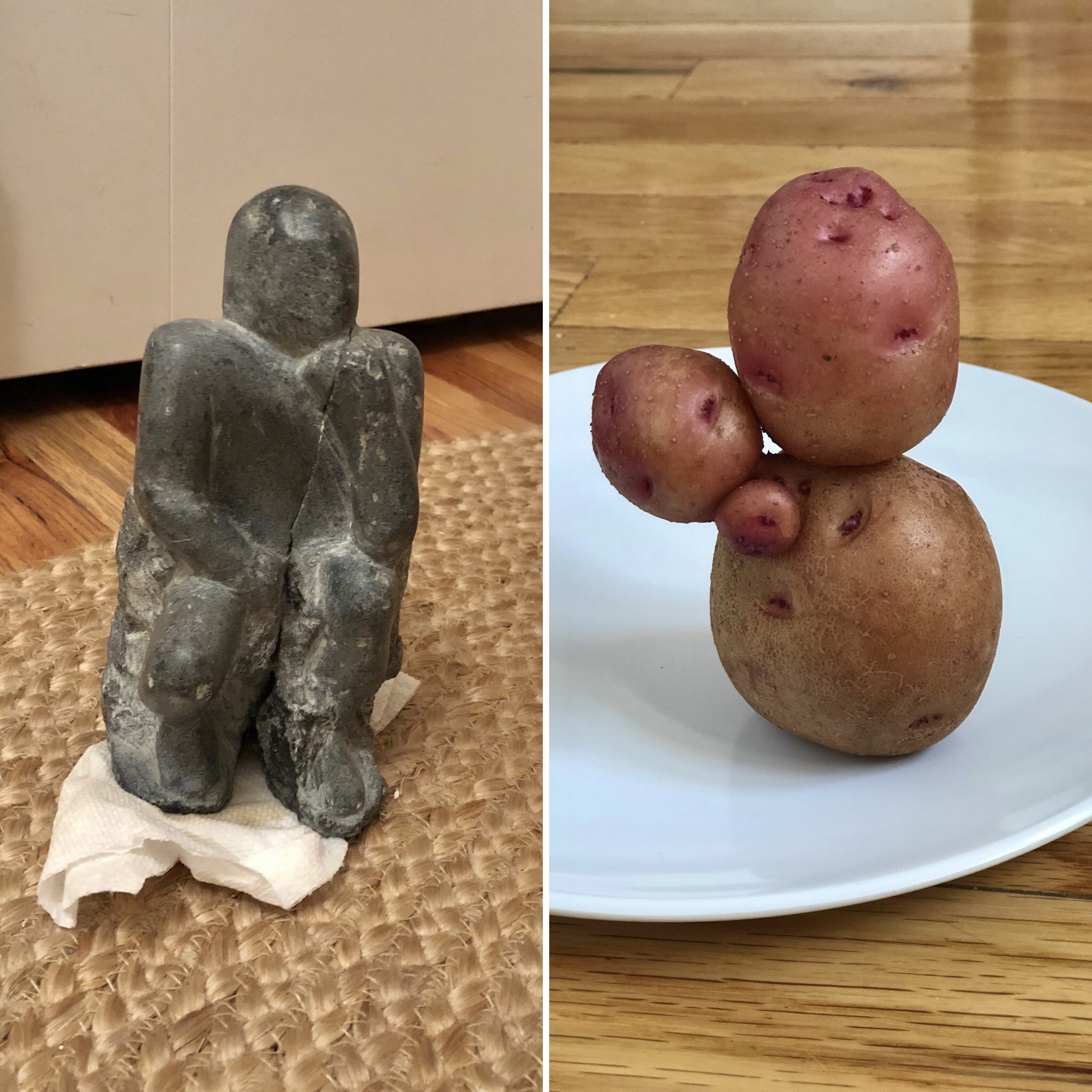
Photo feature

Pictured on left: unfinished soapstone carving of a left-handed version of Rodin’s “The Thinker”, abandoned in my high school art studio and adopted by me to become a favorite paperweight, seen here helping to put pressure on the paper towel absorbing the water I used to clean the spot on the jute rug that the rabbits stubbornly mistake for a litterbox. Artist unknown.

Pictured on right: conglomerate-shaped Red Pontiac grown in container from a group of seed potatoes given to me by my friend Ellen, unearthed early in the fall in this exact configuration.

Art is everywhere.

Lobsters for science

Everyone has tells. You know, like in poker: when Lenny’s holding a trump card, his nose begins to twitch. Or when Slim’s about to bluff, he starts tapping his foot ever so slightly. When my kids are feeling things, I can tell by the signs: when one of them is hungry and doesn’t even know it, I can literally see it in her face. When one of them is worried and stressed, his voice gets quiet and his mouth tugs down at the corners when he talks. And when the complicated person who is my third child is triggered, he exemplifies a wide assortment of mannerisms and behaviors, some more telltale than others. Recently, his process of learning to read has leveled up in a significant way, and the difficulties he has with attention and focus have become exacerbated by all of the words in the world that surrounds him. During his piano lesson this week, he couldn’t listen to his teacher’s questions because he was sounding out the syllables of the words on the pages of his music book. Halfway through undressing at bedtime, he’ll get derailed for minutes on end by the spines of the books on his shelves. It’s both a beautiful thing to witness and a frustrating stage of life; on one hand, I’m amazed by his impressive language decoding skills, but on the other, it’s a struggle to summon the amounts of patience required by the constant interruptions of executive functioning presented by this process. I know it will get easier once his reading fluency increases, but this middle place is as much magical as it is exhausting.

Now that he’s begun to read, a new trigger-tell has emerged for him, and it’s one that both delights and troubles me because I recognize it in myself. Part of parenting this child that is heartbreaking is how frequently I see my genetic responsibility come to bear in how his mind works, and I know how hard that can make life feel. Our similarities are as striking as our differences, but not a day passes that I’m not taken aback by feeling the uncommon kind of kinship that can only be found in such a like mind. I can only imagine how this will develop as he ages, considering that the boy is only six, and I hope the onus of possessing this kind of hive of a mind serves to help instead of hinder him. This new trigger-tell, the one that’s mine too, is that when he’s feeling anxious or overwhelmed, he takes a word into his brain and reverses the letters. In the car on the way home from school the first day after the holiday week off, he announced, seemingly out of the blue, that “Gulotta” (his last name) spelled backwards is “Attolug”. Everyone in the car found this hilarious, myself included, but it also raised that scarlet flag to full mast for me because I do this too. When things are out of balance within, my brain will go to this same place, imposing a sense of control by creating new meaning out of what’s already there, just turning it inside out. I don’t do it purposefully, but I realize that when it happens it’s because I’m feeling disordered, and perhaps focusing on metathesizing the letters in words is a way my brain self-regulates as a kind of coping mechanism.

I’ve never shared this with anyone because it’s never seemed relevant, but when a person becomes a parent, apparently, so much becomes relevant that wasn’t before. The kids know I frequently spell words backwards, just as Arlo is beginning to do, but we haven’t discussed my suspicions about why I do this. Once in a while I’ll share with them a particularly interesting or funny backwards spelling, and the most family-famous example of this happened while we were waiting for the kids to get their first Covid vaccine last month. Arlo, being a very sensory-special kid, was extremely anxious and had been preoccupied by the anticipation of this experience for as long as he’d known it was happening. I’d managed to get him and the other two kids into the pharmacy without event, but as the minutes drew closer and closer to that needle, Arlo became more and more upset. Of course, the effect this had on his mother was an uptick in anxiety, a feeling we all know even though sometimes we don’t know we’re feeling it. There we were in Walgreen’s, waiting for the kids’ turn to head into the room while Arlo tried to tie his body in knots around the arm of the red chair he was occupying, and my brain went to the place of walking backwards through words. “Hey, guys,” I said, thinking it might lighten the mood, “You know what ‘Walgreen’s’ spelled backwards is?” They all just kind of looked at me. “What?” asked my middle child, the one who’d be least likely to play alphabet games to quell uncomfortable feelings. “S’neerglaw!” I said in my most ominously witchy voice. “Wouldn’t that make a great name for a supervillain? Like, ‘Beware the clutches of evil S’neerglaw, a threat to the universe, whose power grows with every hour!'”

All three laughed, even though one of them had both arms and legs now fully entwined in the chair. Then the pharmacist called “Gulotta”, and it was time for me to channel all the force of a supervillain to wrest my child out of that chair and into the hotseat. Now that I think about it, “Attolug” would be a great name for one of S’neerglaw’s henchman. This, no doubt, will be the topic of discussion this afternoon while they wait for their second dose of science, after which we’ll head to Wegman’s to pick up lobsters as a reward for Arlo (his interest is anatomical rather than gustatory, but it feels like the right idea for a special-occasion-such-as-this dinner). While we’re there, will I mention that “S’namgew” is the reverse of “Wegman’s? Only if no one else does first.

Twenty things I never thought I’d say

  1. “Please stop clapping while I’m flossing your teeth.”
  2. “It just took you forty minutes to eat that bowl of cereal.”
  3. “Oh, all right. You can bring home the three-footed hamster. But let me be the one to tell Daddy.”
  4. “Wait, you wore underwear today? Wow. That’s cool.”
  5. “Maybe you could bring a container to school to put the spiders in it. That way you wouldn’t put them directly into your backpack..”
  6. “Thank you for asking him so nicely to shoot that zombie!”
  7. “You know, I am aware that you try to drink soy sauce every time I turn my back.”
  8. “Do NOT touch the television with your face.”
  9. “It’s not that I don’t think it’s cool that you can blow bubbles with your spit. It’s just that you’ve shown me enough times and I don’t really want to look at them anymore.”
  10. “Yes, honey. Naming grubs IS hard.”
  11. “Please don’t call me ‘ladyservant.'”
  12. “Earbuds are not for cleaning your ears.”
  13. “I love being able to see the floor in your room!”
  14. “Yes, I know you mean the mouthwash tastes like grape vomit, and I know you mean the kind of vomit that would come out of a grape, not human vomit full of grapes.”
  15. “What you’re really asking is for me to micromanage you. And I won’t do it. “
  16. “No, I didn’t say that I weaponized Snape. I said that I recognized Nate.”
  17. “Those grapes are for the fruit flies so we’ll have larvae to feed your spiders this winter.”
  18. “Let’s not have the scenario where you blow a bubble with your gum while wearing a mask during your piano lesson again this week, ok?”
  19. “Please don’t sit down on my bed while I’m in the process of making it.”
  20. “Oh, you said you have pee in your pants? Phew. I thought you said you had three million ants.”

Soup’s on

As much as I wax poetic about the alchemical value of using reserved pasta water to add starchy body and enhance the textural properties of sauces, there is something to be said for cooking pasta without using the basic “boil it in water” method. Frequently I develop recipes out of necessity or the desire to make use of something comestible in our possession that isn’t being consumed in a timely fashion, but this one was borne simply out of the spirit of invention. Not that this idea is original, I’m sure, but it was new to me and felt like a worthwhile experiment to pursue.

My daughter was in a week of Ancient Greece camp run by the former-teacher mother of a friend of mine, and I’d offered to bring lunch for the group, so she suggested I bring the meal for the final day. Did I want to bring something that everyone would eat, remaining faithful to the theme of Greek week? Well, of course I did, but the slight hiccup in this initiative was that they’d already had spanakopita, hummus with pita, crudités with tzatziki, and pizza that week, plus plenty of Greek-inspired snacks, and the family hosting the camp were vegetarian. Having been to Greece and sampled the cuisine myself, I suspected that the girls’ palates might be averse to some of the menu options under consideration, so it felt like a challenge to produce something that would be nutritious, vegetarian, at least semi-Greek, and actually enjoyable for the audience to whom it would be offered.

I finally settled on two main options, one of which was a batch of my dad’s famous lentil du puy, cooked with carrots and celery and bay leaves, which I knew my daughter would eat. I also had the idea to make a pasta and cheese dish, opting for halloumi over feta because I happened to have a block of that delightfully squeaky, salty stuff already in the freezer. Also on hand was a quart container of tomato soup that hadn’t found its way into a meal yet, so it seemed like a good idea to try using it in place of water to cook the pasta. That way, I theorized, it would serve to hydrate and infuse the noodles with flavor while retaining that precious wheat starch released during the cooking process, with the result being a pasta cooked in its own sauce. Orzo seemed like a good choice, as it cooks quickly enough that the soup wouldn’t reduce too much before delivering that desired al dente density, and the decidedly Mediterranean association of that particular pasta shape clinched the decision. The results of this experiment proved successful, and whenever a recipe that calls for fewer than five ingredients turns out well, it always feels like another leaf added to that laurel wreath we food-providers wear.

Tomato Soup Orzotto

(serves 4-6 depending on accompaniments)

1/2 lb. dried orzo
~4 cups tomato soup
salt and pepper

Add two cups of soup to a saucepan over medium heat. Once it’s about to boil, add the orzo and cook, stirring constantly as you would a risotto and adding more soup until orzo is al dente and the sauce is of a, well, saucy consistency. Constant stirring is important to prevent pasta from sticking to the bottom of the pan. Season with salt and pepper to taste. This can be served in any way you choose, but some halloumi sliced into pieces a half-inch thick and fried in a dry, nonstick pan ’til brown on both sides is a good way to go. If your people won’t go the halloumi route (I’m the only one in this house who’s a fan), some little balls of mozzarella di bufala stirred into the mix works well as an alternative. And if you’re not a vegetarian, a nice meatball never hurt anyone. (Please don’t say that to your children, however, unless you want them to consider it a challenge they can’t help but accept.)

And to all a good nightcap

One evening as summer melted into fall, after an hour spent preparing our six year-old for bedtime and having gotten so far as to have half-closed his door for what I’d hoped was the final time that night, he said, “Mommy? I just have one question.” Although that seemed highly unlikely, as his questions tend to create a multiplicative causation, I waited for it, expecting him to ask something like “When is it the weekend?” or “Can I have a playdate with Tripp tomorrow?” or “Are there viruses in outer space?” Instead, he hit me with, “Are you Santa?”

All parents of young children who believe in Santa Claus prepare themselves for this moment, and most of us have read at least one viral account of a way to answer the question gently but honestly while still preserving the spirit of enchantment and tradition. I read one or two of those years ago, back when I thought having some tips and tricks in my back pocket might come in handy with our oldest child, but of course it had been so long since then that I couldn’t remember any of the turns of phrase or model of delivery I’d expected to sample when the need arose. And of course my child had chosen this exact time of day, as the clock was striking half-past goodnight, when I was just about to snug the door against its jamb with a sound much like punching out a time card on the way to happy hour. “Not so fast,” the boss says, “There’s still work to do here. Time to clock back in and tidy things up.”

So I lay beside the boy and did my best to recall some of the strategies I’d read those years ago, coupled with some improvisation on my own part, and here’s the basic gist of how it went. “No, buddy. I’m not Santa! One person couldn’t be Santa on his or her own. Santa isn’t even a person at all. Santa’s made up of so many people and so many feelings and ideas that it’s hard to explain, but everyone who loves to give, and gives out of love, has a little bit of Santa in them. If you could take all of those people, all of that love, and put them together into one being, that might amount to Santa, but you can’t do that exactly. That’s where the magic part gets involved. Only magic could create a single entity to represent the combined spirit of benevolent generosity in the world for as long as it’s existed, so that’s where the idea of Santa came from. Every person has a Santa spark inside, and that’s a kind of magic too. If you believe in using that spark to bring happiness to other people, then you believe in Santa because you are part of what makes him real. And when you let your own Santa spark shine, more magic can happen because saying and doing things that bring joy to other people…that’s a kind of gift you can give too. Just because you can’t necessarily open a gift and hold it in your hands doesn’t mean it isn’t something special you can keep. And if you believe that, it means you don’t just believe in the magic spark; it means you also believe in what I think is one of the most impressive superpowers: the power to give beautiful gifts to others that they can feel but not see. What do you think?”

He yawned in the adorable way they do, with that singsong whistle-catch of breath at the back of the throat, and rolled over. “Yeah, okay. Goodnight, Mommy,” he said and snuggled under his blanket. Now I’m not sure if he was just ready for me to stop talking and let him fall asleep at that point, or if I’d just told the most successfully boring bedtime story of my life, but it felt like the boss had just handed me his credit card, pushed me out of the office, and said the first round’s on him.

From the sublime to the ridiculous

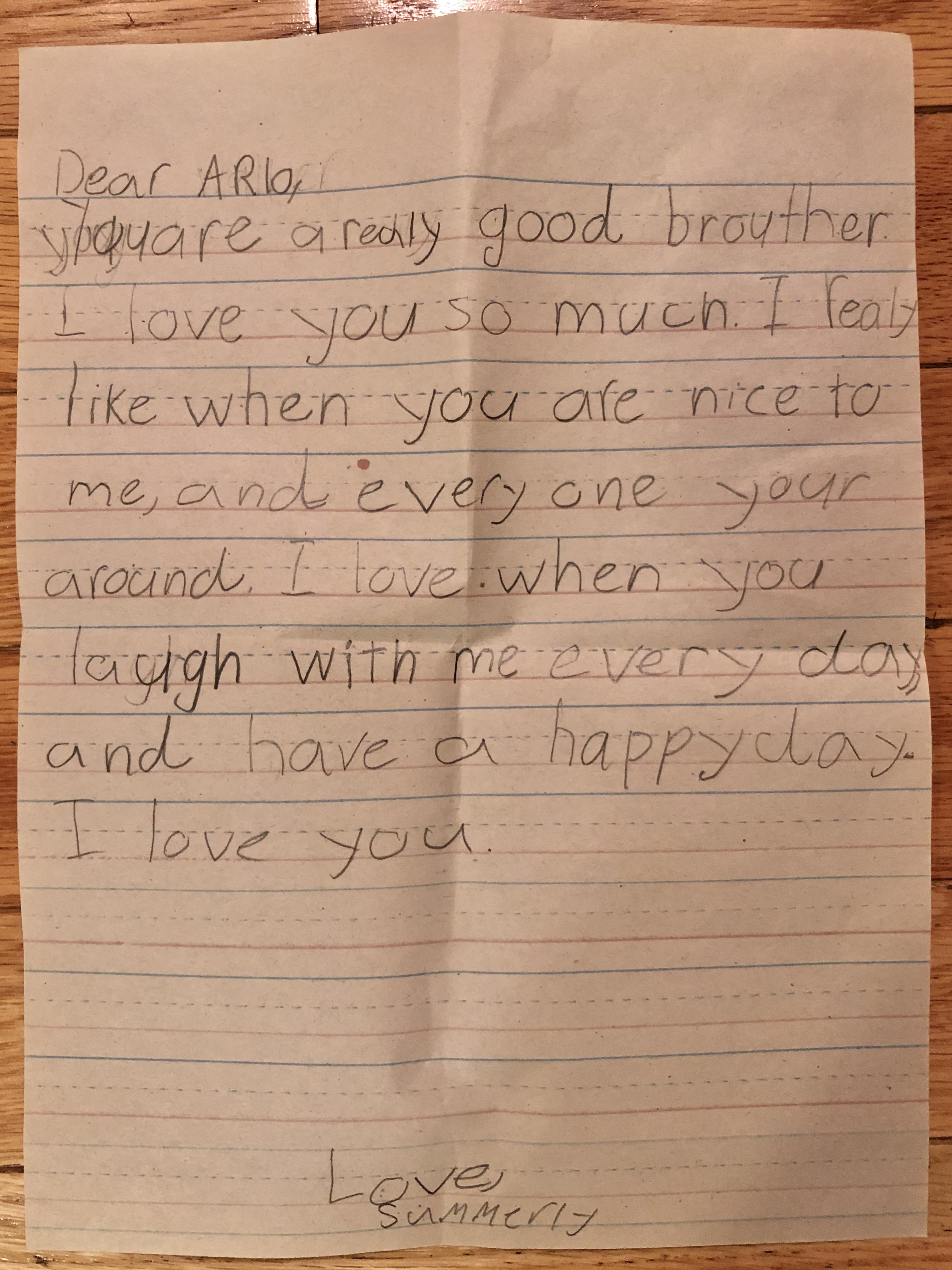
One night after a particularly trying evening, I went to put a snack in my first-grader’s backpack for the next day. Along with several rocks, sticks, and other assorted nature-treasures, I found a piece of folded paper. I opened it to find this:

At pickup, Arlo had said that Summerly had brought him a note as part of her Thankful Thursday routine in third grade that day, but I’d forgotten to follow up and ask him if I could see it. If ever there were a child who needed a note like this on a day like that, it was the recipient of this love letter. It took my breath away to the point that I almost fainted dead away, and I thought, “If I fell over right now, at least my day would end on a happy note,” then took those words literally and laughed uproariously at my own joke.

And then it dawned on me

There aren’t many things all people can agree upon, but one semi-axiomatic testament I think is pretty watertight is this: everyone loves a good drinking vessel. For some, that might mean a double-walled, insulated hiking flask; for others, a hand-blown wine goblet might be a favorite. My friend Jason prefers to take his beverages in glass jars, and I know a few people who might not be recognizable without a Tervis tumbler in their hands. Our oldest child, for his part, bears a stalwart adherence to his fleet of Thermos Funtainers (perhaps that marketing-driven moniker bears some responsibility for his allegiance). The newest addition to his collection of these flip-top aluminum bottles with straw attachments is one decorated with a depiction of the amazing Spider-Man in action, and recently I’d noticed that the silicone straw component for it looked a little grubby and was in need of a thorough scrubbing.

To prepare for this, and because I frankly didn’t feel like getting out the tiny straw brush to work on it in that moment, I put the piece in a bowl in the sink and sprayed its entire surface area with my sink’s companion, the Dawn Powerwash, to let those scum-scouring agents work their surfactant sorcery, or, as my husband puts it, “let it soak”. The next morning I’d finally summoned the energy to attack the thing with a wire brush, successfully removing all traces of discoloration and stuffing it onto one of the pegs in the top rack of the dishwasher for a final cleanse.

A couple of weeks later, my son came home from school saying that his water tasted like perfume all day, and I silently scoffed at his sensitivity but disassembled the whole Spider-Man Funtainer, put it back in the dishwasher, and thought nothing else of it. However, the next time he used that bottle, the same complaint ensued. I challenged him on it, thinking perhaps there was a psychosomatic element at play here, but he adamantly averred, “No, Mommy, it really does taste like your perfume!” Wait a second, I thought. MY perfume?! I haven’t worn perfume since the moment he was born, cringing prudishly when anyone wafting eau-de-anything wanted to hold my children as infants and bemoaning to everyone who would listen that Johnson & Johnson baby products were full of fragrance. Hell, I don’t even use dryer sheets. “Liam,” I said, “I don’t wear perfume. I haven’t worn perfume in years,” to which he responded with certainty, “Yes, you do! I smell it on you a lot!”

Well, that was a real head-scratcher. Our detergent is free and clear, and I don’t use fragranced skin or hair products, so I had no idea what he could be thinking. At any rate, it was time to see what all of the fuss was about, so I finally took the time to sniff the silicone straw apparatus and, lo and behold, the kid wasn’t wrong about it bearing a scent reminiscent of the second-grade teacher at my school, Mrs. Burchett, whose classroom famously reeked of her perfume to the point that I could barely pass by the open door without gagging (luckily my homeroom that year was with the sweetly unscented Mrs. Holden). So Operation Scent Removal began, which included an overnight white vinegar bath, a sterilizing session in a rolling boil of water in a saucepan, and a full day of full sun in hopes of achieving deodorization. I’m pleased to say that this reverse-spa treatment worked fairly well in eliminating almost all of whatever bouquet had infected the strawpiece, so I called the situation salvaged and case closed. Spider-Man could now safely get back to his work of eradicating street crime and hydrating middle schoolers.

The plot thickened and quickly thinned out a week or so later, when I went to say goodnight to Liam one evening. I reached over to give him a hug, then fluffed his hair and mentioned that it was almost haircut weekend again. “There it is!” he said, sitting suddenly straight up in bed. “That’s it! Your perfume! I smelled it on your hands just now!” I checked to see what he meant and discovered that there was, in fact, a residual odor on my hands. It was the distinct aroma of the blue Dawn I’d used to finish up the dishes moments before coming upstairs. Immediately upon making this realization, we were able to surmise that leaving the silicone to “soak” in the Dawn Powerwash (erroneously labeled as imparting a “Fresh Scent”) had had the opposite effect of what was intended.

That was the moment when I recognized that my child might very well enter into adulthood with an olfactory association between his mother and the smell of distinctly blue dish soap. And all I can say about this is that if you could bottle up the feeling of accomplishment, not even Coco Chanel could put a price tag on it.

A matter of taste

It’s fascinating to consider the dissimilar approaches that different children take to the topic of food. Our oldest son mostly eats meals, rarely asking for a snack unless a sweet treat is offered. His lunchbox is routinely empty when I unpack it in the afternoon, and when I ask him if he’s hungry between meals, his answer is usually, “Not really.” Our youngest son prefers to graze, rarely finishing even half of a sandwich in a sitting, and I frequently put a bowl upside-down over his partially-eaten plate of food, to which he’ll return throughout the day, upend the makeshift cloche, and have a few bites here and there. Trying to get him to eat a decent amount at one time is a pursuit that, considering how densely-sown the minefield we’re navigating with him is, we’re choosing not to undertake for now.

Our daughter, who was so tiny as a baby and toddler that she didn’t even measure “on the charts” until she turned two, is the most fun to feed (well, she has been since she stopped nursing every hour of every day at the age of 8 months and deigned to finally avail herself of solid foods, all of which she’d rejected up until that point). The first thing she was interested in eating was a slice of orange, and after she passed through that sweet citrus gateway, there was no stopping her. She ate smoked salmon, prosciutto, pickled ginger, tuna, seaweed, cottage cheese, raw tomatoes, bacon, zoodles, refried beans, potstickers, mustard, pumpkin pie, edamame, pesto, potato latkes, and her favorite of all, avocado maki. And it wasn’t just the interesting range of foods that was impressive, but also the size of the portions she could consume. And these portion sizes grew as she did. Three cream cheese bagel halves for breakfast? Sure thing. Twelve Bagel Bite pizzas for lunch? No problem. Five hotdogs for dinner? It’s happened before. Twenty pieces of avocado roll for any meal, with as much soy sauce as I’ll let her have? That’ll do, and some miso soup, please.

Even more remarkable is that, despite her petiteness, she is often ready for another meal a couple of hours after one is over. She can easily eat a second full breakfast most days; a recent example of her choice for second breakfast was a whole can of drained black beans with grated cheddar melted into it. Another favorite is an entire 10-oz. packet of Indian Madras Lentils. We all know and admire her gustatory gifts and metabolic means, particularly because she’s taken an interest in nutrition recently (when asked what she’d like to eat, she famously answers, “Protein!”). So I don’t know why I’m surprised when, for example, I asked her after her first breakfast of waffles one day if she’d like anything else and her response was, “Yeah, maybe just a little something. Like five sausages.” Or when she says she’d like a snack, so I send her to pick something out and she comes back with a family-size can of chicken noodle soup.

However, if you’re reading this and thinking, ‘Wow! What a lucky mom! I can’t get my kids to eat anything besides cheese quesadillas, peanut butter, mozzarella sticks, and raisins,’ don’t worry. Practically all children have an “I won’t touch it” list, and those items are all on hers. She’s also averse to things as seemingly innocuous as croissants and whipped cream, but show her a bag of salt-and-vinegar potato chips, and that girl will be all over it. Feeding children is an endeavor involving equal parts dullness and intrigue, drudgery and excitement, sameness and surprise. So much of it is unpredictable and variable, from child to child and day to day. Sometimes kids like things you’d expect them to enjoy, and other times they refuse what others generally consider to be delectations. I mean, my daughter’s never met a dill pickle she didn’t like, but she’ll shudder with revulsion if you so much as offer her a chocolate chip cookie or–god forbid–a brownie. Her relationship with desserts, pretty much across the board, can be considered “it’s complicated”, which is why she patently rejects the nuance of idioms like “a cherry on top” and “the icing on the cake”. She also questions the use of “honey” as a term of endearment. So, friends, I give you three savory neologisms: “a meatball on top”, “the salt on the pretzel”, and this affectionate nickname: “Pringle”.