Social experiment #1 (BoGoC): Complete

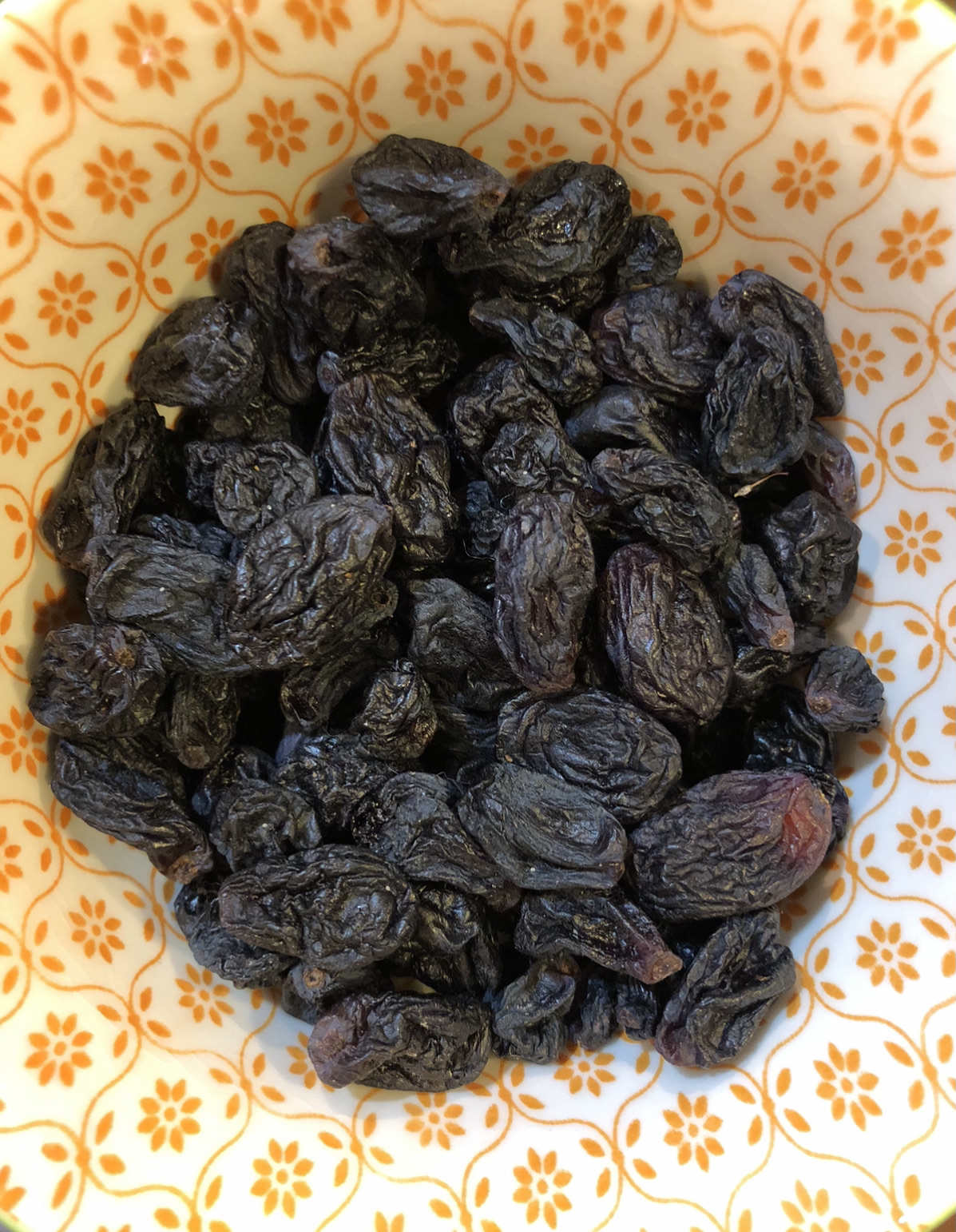
It took longer than a couple of weeks, but results from the experiment are in, and they aren’t what I’d expected. My hypothesis was that the grapes would sit there on the counter, untouched, as they progressed through one phase of decay into the next, our very own compost pile right there in the kitchen. I prepared to be annoyed that apparently no one else would notice this or seem to care that there was a bowl of moldy produce right under their noses, and I resolved not to buy grapes in bulk at Costco henceforth. I was ready to consider this a matter of “grapes wasted and nobody cares: case closed”, but, lo and behold, those grapes absolutely refused to rot, resisting demise with some kind of transcendental life force perhaps supplied to them in infancy by their mother vine. What happened instead was that they shriveled into honest-to-god raisins, their supple skin folding in on itself in rippled wrinkles, internal sugars concentrating and intensifying, little ovoid chrysalises that were both the vessel for transformation as well as the result of the metamorphosis occurring therein. Here I will try to record as close to verbatim as I can recall the conversation that occurred after this process had arrived at completion, as a record kept in faith to the scientific process:

Brian: (eats one) “These are good!”
Alison: “I know! I can’t believe it. I’m going to make oatmeal raisin cookies with actual homemade raisins! Gives a new meaning to ‘table grapes’, doesn’t it?”
Brian: “No way are you using those in cookies. You can use other raisins for that, not these perfect, delicious, succulent, way-too-good-for-baking raisins. Keep these away from the oven. They’re for eating just like this.”

Well, there you have it. As it turns out, sometimes just leaving things alone yields decidedly sweet results. But I don’t think I’m going to get in the habit of putting neglected fruit in a bowl on the counter and hoping it undergoes transformational self-improvement the way these raisins did. It really would be unrealistic to hold such grape expectations.

Fig. 2

Like peanut butter and jelly

No one experiences high school in exactly the same way as anyone else, but all of my schoolmates agreed on a solitary data point: there was one kid who surpassed all others in popularity. It was just one of those things everybody understood. And for good reason, because this boy was the full package: magnetically sociable, smart, exceptionally good-looking, and far and away the most superior athlete our school had maybe even seen. For all four years, he was hallway royalty, revered by the boys and admired by every girl, whether they would admit it or not. Everyone wanted to be like him and be liked by him. He was emulated and imitated by his coterie of adoring friends, and I’d be shocked if anyone outside of his circle would have rejected his attention. He was in a league of his own, a golden boy atop a pedestal only wide enough for one set of swift feet, a star almost too bright for bare eyes.

Many kids with this kind of power might have used it for ill, and he certainly could have done a lot of damage had he wielded his prestige as a weapon rather than a beacon, but he didn’t: he had impeccable manners and went through the motions of his days with a blithe deftness, a fluidity of purpose, a natural ease. He was so secure in himself that he felt no inclination to be mean to anyone, and this in and of itself rarefied his reputation to an even greater extent. He wore his popularity like a comfortable rucksack, not a pistol in a hip holster. By all accounts, this boy was beyond reproach. The teachers loved him, too, and I suspect his coaches even envied him a bit. His success just seemed so effortless, his talents so innate, that it was hard to believe that he wasn’t a fictional hero boy magically animated and placed amongst us as a reminder that perfection can, in fact, exist. Even his name felt famous.

Years later, I read in an alumni magazine that he’d gotten married and had a baby girl named Sally, a darling child whose photo in the glossy publication bore a resemblance to her dad. I remember wondering about this baby’s mom, the woman who had caught the heart of that boy-turned-man. Because he could have had his pick among basically any of the girls in school, I assumed this situation had followed him to college and beyond, so the woman he’d married must be something special. Her very existence felt intimidating.

A couple of years after that, I was at a toddler gymnastics class with my daughter and there was a beautiful woman with lustrous, chin-length hair and a kind countenance accompanying a little girl named Sally. I just knew this Sally was HIS Sally–the age and face tracked–and I deduced that the woman with her was her grandmother, her mother’s mother. I kept my curious eye on Sally and her grandmother during the class, thinking that between these two generations was another female married to the high school legend, and I noted the woman’s gentle attentiveness and obvious adoration of this bonny little girl, who seemed as sweet as her name and for whom obvious effort had gone into everything from her hairstyle to her adorable outfit to her personalized backpack.

A year or so passed, and at preschool pickup one winter day, I saw him–the grownup version–with someone who had to be his wife, ostensibly touring the school as a prospective family. I only got a glimpse of her, but it was hard not to notice that her hair was cut so straight across, her coat was tied just right, her shoes were up-to-the-minute on trend, and her beauty was, well, conspicuous. Wow, I thought.

The summer after that, I went to a park for a preschool gathering to welcome new families, and guess who was there? This unicorn of a woman with her unicorn of a daughter, and as we were introduced, I tried to act calm even though my tongue was experiencing a strange paralysis. She asked me for ideas about packing lunches for Sally since her current go-to was a peanut butter sandwich, but our school is a nut-free facility. I don’t remember what I said, but I do know that I picked up some Sun Butter the next time I went to the grocery store so I could give it to her and have an excuse to start another conversation. It was our first gift.

Six years after that, I’m delighted that this woman no longer scares me silly. Our daughters became best friends in preschool (I swear I had nothing to do with this), which brought us together, and as soon as my tongue had recovered its regular range of motion, it was obvious that I was correct about one thing: the wife of that boy from high school IS a unicorn of a woman, and now she’s my unicorn of a friend. We’ve been in daily contact for years, and I can’t imagine what my life would be like without her. She’s an incredible mother and an incredible person. She’s whip-smart with a razor wit. She’s a benchmark and a benison. And, maybe luckiest of all, she knows everything about me and loves me anyway.

I’m writing this on February 25th, which is her 38th birthday. I know that right now she’s wearing a pink tennis skirt with a new white shirt and tennis shoes she joked about this morning because they’re touted as having orthopedic qualities. I know what time the FedEx truck arrived at her house yesterday. I know how her favorite shampoo/conditioner combination and that she likes flannel sheets in the winter (but not flannel pillowcases). I know what she put in her breakfast smoothie and what she had for dinner last night and what she found on sale last time she went to Costco. I’m so grateful.

And you know what’s funny? If I could go back in time and tell my high-school self that one day I’d be fast friends with the wife of the man who was in that moment the “it” boy paragon, I’d have laughed in my forty year-old face. Because back then, I didn’t believe in unicorns.

Good Humor

I read a book to the kids I remember from my childhood called “Do I Have to Say Hello?”, and though it’s dated and could afford a healthy revision, it was a lot of fun and generated a ton of laughter as well as some interesting discussions. The book is basically a satirical take on a multiple-choice quiz test on manners while incorporating a loose storyline, and though the illustrations are caricature-style bordering on grotesque, they provide an added dimension of absurdity. Here’s an example of one of the questions:

“After Aunt Delia washes off Sarah’s knee, she buys everyone a Good Humor bar. You and Katie ask for vanilla inside with chocolate outside. Sarah orders chocolate inside but you…
a) tell her she has to have vanilla because you say so because it’s your aunt who’s paying.
b) give her a bite of yours when she gives you one of hers.”

I would have added another option or two, and we discussed what those might be, but because at least one of my children has experienced another child saying something along the lines of option a), I couldn’t resist trying to imbue this example with a bit of edification. I said something like, “You know, you might hear kids say things like that, and it’s not ok. What’s happening there is one person trying to manipulate another person into doing something as a way of exerting control. When people do this, it’s because they’re feeling kind of helpless in some aspect in their lives, and they don’t know how to make themselves feel more powerful, so sometimes they do it in ways that don’t make sense and aren’t healthy. It’s not really about the ice cream flavor or the person whose money is buying it; it’s about one kid trying to dominate another kid because he has some kind of negative feelings that he doesn’t know how to heal, even if he isn’t consciously aware of them, so he tries to counteract those feelings by controlling others. Then he feels powerful, but it’s a false kind of power because it comes from treating people poorly and doing things for the wrong reasons.”

At this point, Arlo interrupted me, “Like Donald Trump?”

Kids, man. I’m telling you. They get it.

The kitchen sink takes the floor

A PSA from my kitchen sink to yours:

“Big news! I’ve recently begun a self-care routine that’s working wonders! I feel cleaner, fresher, and more independent than ever, and my family has been so impressed with my positive changes. These two new products I discovered have changed the game completely, and I think you’ll love them too! To get the glow, see below for all you need to know!*

“All it takes is the simple application of one product each month and a daily cleanse using the other that can be done literally in SECONDS. All you need is a box of Lysol ‘click gel’ toilet bowl cleaners (applicators are included with purchase!) and a bottle of Dawn Platinum Powerwash Dish Spray. Now, I know what you’re thinking: these products are for toilets and dishes. Not anymore! Here’s what to do: apply one of the Lysol ‘click gels’ to the inside of your basin farthest away from the drain, where the spray from the faucet can be directed but where it won’t come into contact with dirty dishes. Each time one of your humans finishes up with the washing, they can spray water from the faucet onto the gel tab, releasing some of the cleaning agent to be dispersed over your surface, with the added bonus of adding a punch of fragrance (I like the ‘mango & hibiscus’ scent, but try the ‘fresh’ scent if you prefer a more traditional clean aroma). When the click gel is dissolved (this takes about four to six weeks in my household), simply click on a replacement!

“You might be thinking, ‘What about the other sides of the basin? Won’t they feel grungy next to the side with the click gel and the bottom, both of which get a lovely sudsy final rinse? Aha–don’t worry! That’s where the Dawn Powerwash spray comes in. As a final step in the routine, your humans can spray the Dawn over the surfaces of the other basin walls, and then (here’s the part you have to see to believe) they can just LEAVE IT THERE! No need to rinse away! It’ll dissipate on its own while the active ingredients go to work on the surface, removing any residue that might still remain, and then next time someone does dishes, the Powerwash action will be reactivated when it comes into contact with the water! Amazing, right? As for the Dawn, I’m partial to the ‘green apple’ scent; this, in combination with the ‘mango & hibiscus’, is a truly tropical treat worthy of a Club Med spa day.

“Don’t wait–you’ll be so glad you tried this and thrilled with how easy it is to maintain the routine! That bottle of Barkeeper’s Friend will be banished to the bathroom where it belongs. Feel free to message me for more details or to share your success stories. Gleam on, my friends! Now’s the time to shine!”

*The Gulotta kitchen sink is in no way affiliated, associated, or connected to the Lysol or Dawn companies or product lines, nor it is directly authorized, endorsed, or in any way officially sponsored by them, and it stands to gain no income from advertising aside from the pure delight of sharing beauty and style tips with other likeminded sinks.

Buy Nothing

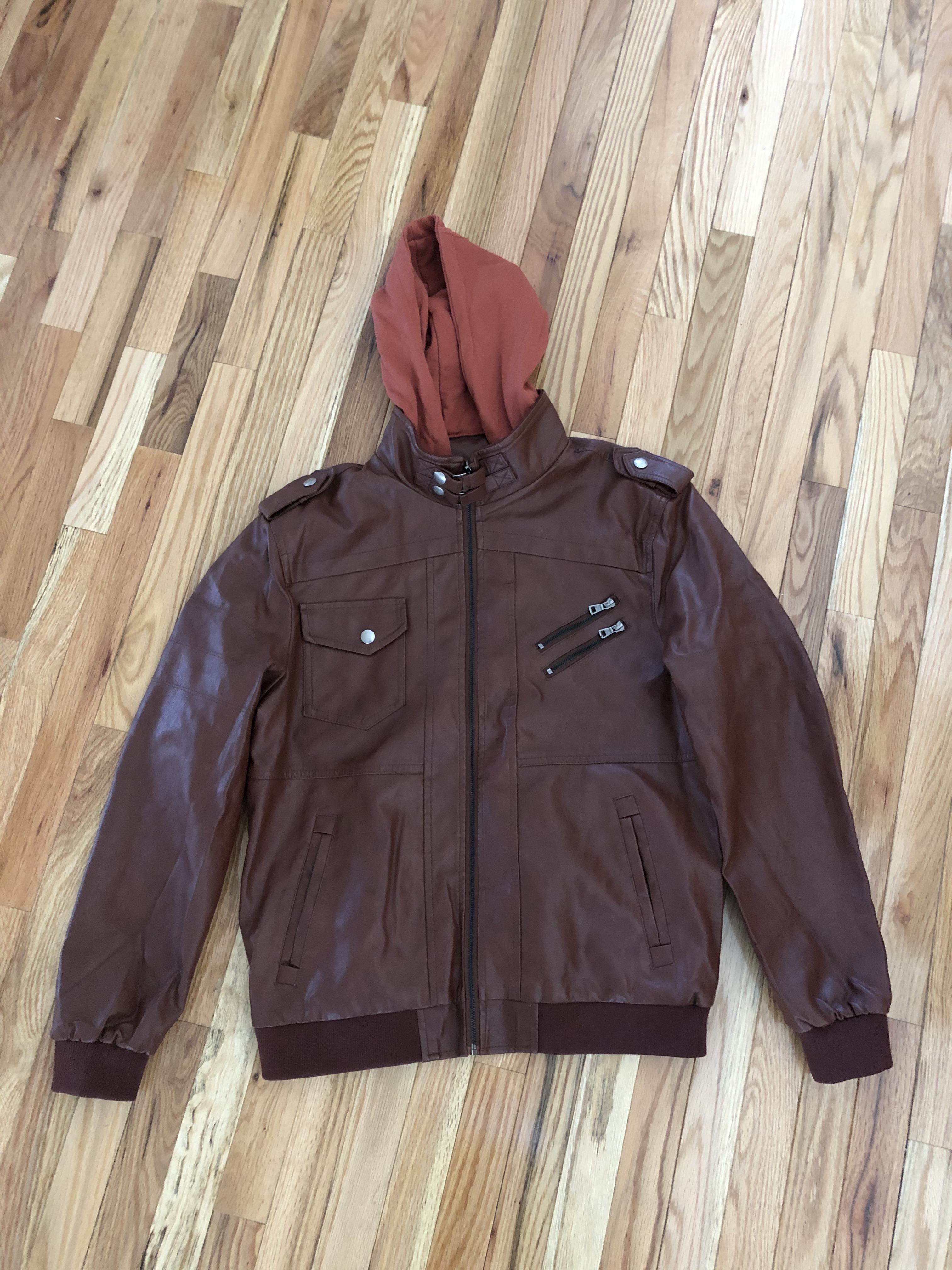
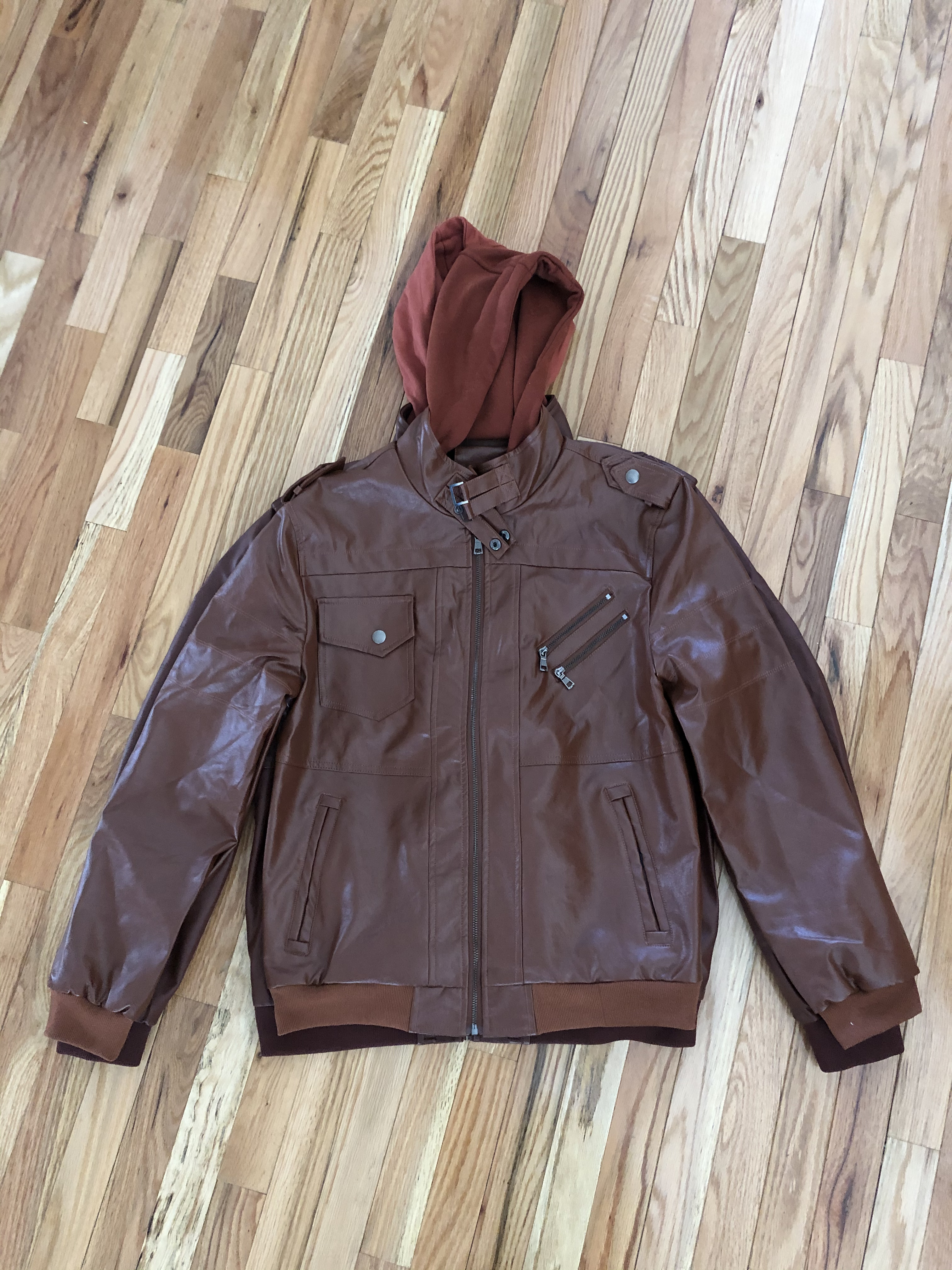
I posted the following on the local “Buy Nothing” Facebook group page with these two photos:

Short version: I have two of these jackets to gift. They both fit like a men’s size medium, though one is labeled a large, and are fully lined with a sweatshirt-style hood that can be unzipped around the collar for removal. The colors are slightly different, but they are very similar in cut and design with the exception that the slightly darker one appears to be real leather (I can’t conclusively confirm this), whereas the lighter one is definitely imitation, and the placket pockets zip in opposite directions. Both are brand new, never worn, without tags. Photo on left is the higher-quality, slightly larger one (tag says “M”), and photo on right is the lower-quality, slightly smaller one (tag says “L”) overlaid atop the other one.

Long version: My husband wanted this jacket (he’d found it on amazon.com for $149) for Christmas. Since I’d already spent more than I wanted to, he found it sold elsewhere online for $99 with product images that were absolutely identical to the listing on amazon, so I splurged (and had to add a pair of socks to the order to qualify for the free shipping, which didn’t kick in until the $100 mark, of course). It took two months to arrive, during which time I anxiously awaited because the other big gift I’d given him for Christmas was a luxe velvet forest green robe with the Slytherin crest embroidered on the chest (he always gets “Slytherin” when taking Harry Potter house quizzes). Well, in classic Slytherin fashion, he detested the robe on sight, so back it went to Pottery Barn (ok, it was Pottery Barn Teen, but I ordered the XL and teens are GIANT these days!).

Despite the fact that we’d taken very accurate measurements before deciding on the size medium jacket, it was definitely too small for my husband. The slip of paper that had come in the bag with it was printed in Chinese, so I had no way of knowing how to send it back, nor did I want to hassle with international shipping. I emailed the company to inquire, and they offered to send a replacement for $53, so I went ahead with it, thinking I could give the other jacket to someone (surely!). I should add that the email exchanges with the company’s customer service amounted to fifteen in number over the course of eight days, and these included sending screenshots of the proof of purchase and PayPal receipt as well as repeated clarification of preferred size and color.

The second jacket arrived about a month later this time, and guess what? Although the label indicated an “L” for “large”, this one was actually a smidge smaller than the medium, and the material was obviously inferior in quality. Now I was in possession of a knockoff bomber jacket and a knockoff of a knockoff bomber jacket, both useless to me despite the fact that I’d paid more to own them that I would have if I’d ordered the genuine jacket from amazon in the first place.

If this entire experience can benefit someone, I’ll call the debacle redeemed, so please, someone, get these jackets out of my house. Porch pickup off of Rio Road East.
***
Update: I am pleased to report that as of now there are currently zero knockoff bomber jackets in my possession. What a gift!

Organized crime

Back when La Croix had a corner on the designer-seltzer market, I became an avid devotee and we quickly dedicated a shelf of the refrigerator to my passion for sparkling hydration. Last summer during lockdown, the kids expressed an interest in trying it, and Summerly fell hard for the stuff. The boys liked it, too, so we began buying an assortment of different brands and flavors to see which we liked best (count this experiment among so many other ways we’ve all invented exciting enterprises during Covid).

One day Liam went to get a seltzer from the refrigerator, sat down at the counter, and opened it. Summerly, sitting next to him, without even looking away from her lunch, put her hand out, and Liam removed the tab from his can and gave it to her. She put it in a mason jar on the counter and continued eating her burrito. I asked what that was all about, and Liam said, “That’s how I pay her for seltzer.”

“You pay her for seltzer?” I asked. “Yes,” he said cheerfully, “She loves it the most, so she charges us for it. We pay her with those,” he said, pointing to the mason jar. “Wait,” I said, “Let me get this straight. You have to pay Summerly for the privilege of drinking seltzer by giving her your can tabs?” They all nodded as if this were the most usual thing in the world. I pointed out that I was the one who actually bought the seltzer, and they responded, “We know.” To this day, I’m still trying to figure out whether this arrangement more closely resembles entrepreneurship or racketeering.

I bring this up because the other day we were playing “Alibi”, a game where one person leaves the room and the others think up an imaginary crime, assign it a date and time, and invent for themselves each an alibi. They also choose one person to be the criminal, and when the detective reenters the room and asks each person to provide their alibis, the criminal changes one detail of his or her alibi on the second round of questioning. On our first round, Liam was the detective, and when he asked Summerly what she was doing at eight o’clock on the night of September 30th, her response was “Drinking out of my wine glass and thinking about money.”

Here she is, my darling middle child, the daughter I so desperately wanted and who was so eager to get here she didn’t even give me time for an epidural when she decided it was time to arrive, now shaking down her brothers by running an extortion ring out of my kitchen and dropping her tithes into a jam jar coffer right before my very eyes. Here she is, this little pixie of a child who didn’t even cry when she fell on the playground and broke her humerus so significantly she needed surgery to have metal wires put through her bone, now imagining herself as a Miss Hannigan type sloshing her way toward the bank. One thing’s for sure: this child is force to be reckoned with. Wall Street, you’ve been warned.

Many happy returns of the day?

We all knew that shifting from the way of life we’ve learned during the pandemic back into the world the way it was before–or at least a world closely resembling it– at some point in the future would be wonderful in some ways and difficult in others. Although the past dozen (plus) months have been incredibly challenging, exhausting, and stressful, we all can identify things that we’ve grown to appreciate about that way of life, a way of life we never would have experienced had Covid not come knocking on our proverbial doors. We’re feeling that “push me/pull you” of wanting to hold on to what we’ve enjoyed about the past year while the reptilian recesses of our consciousness yearn for “the way things were”. It’s a strange dance, one in which our past selves, present selves, and future selves are trying to find a rhythm that will be best for us as we move forward through time and space, the three iterations of ourselves maneuvering around each other on the dance floor, trying to make space for each other while finding ways to intersect. It’s like a chaotic cotillion where none of the movements make sense until that moment when they will finally fall into sync, and right now we’re on the cusp of an arrhythmic stretch of time that will make us all need to keep catching our breath.

The best analogy I can imagine is a real-life experience that a friend of mine encountered a couple of months ago. Out of the blue one day, her husband sent her a text saying that he wasn’t able to smell anything, so he was going to get a Covid test. It came back positive, so he needed to quarantine for two weeks, but here’s the thing: he had to spend that fortnight quarantined in his own home while the other five members of his family were also living in the house. The stories my friend tells about these weeks are truly incredible. She would leave him meals outside the guest room where he was holed up, and after eating he would sanitize the dishes and hold his breath while wearing an n95 mask to open the door just enough to slide the clean plates and cups out into the hallway. He would open the window, and she would go outside to talk to him from a comfortable distance just within shouting range, and otherwise they’d communicate by text or phone call despite being under the same roof. I likened them to Romeo & Juliet, two star-crossed lovers, though this pair was restricted from communion by a virus rather than a toxically political family dynamic (which isn’t really that different, actually).

They aren’t sure where he picked it up, but the most likely scenario is that it was work-related. The good news is that he wasn’t too sick and recovered well, and neither my friend nor any of her four children tested positive. What is most interesting to me is how she described the day when her husband had been cleared to leave the guest room and rejoin the family, and it feels like a microcosmic example of what we’re all trying to reconcile these days as life lists to and fro, searching for purchase on a foundation of shifting sand. When he opened the door after a full two weeks had gone by, it was so strange: he could walk through his home without a mask. He could hug his kids, sleep in the same room as his wife again, eat at the table, go to work. And it was strange for his family, too: here was this person who couldn’t be more familiar and yet had been restricted from their access, a veritable prisoner in his own home alongside them for half of a month. Science said it was safe, but the initial adjustment was suffused with oddity, and the moment when he took off his mask took some mustering.

When I consider this reunion, it calls to mind the reunion we’re all thinking about: the interface of our soon-to-be selves with a way of life that hearkens back to literally yesteryear. There will come a time when we’re going to have to come face-to-face with a reality we recognize, that we’d grown deeply accustomed to, but it’s going to feel bizarre. When will we be completely comfortable sitting next to strangers eating popcorn in a movie theater? Will there come a time when we won’t think twice about swanning into a crowded restaurant with nothing on our faces except for a touch of makeup? How long will it take for us to unlearn the sidestep we’ve adopted to provide a cushion of space between ourselves and people outside of our pod? At what point will we forget to wonder “Is this safe?” at almost every turn?

The future won’t look identical to the past, of course. There are things we’ll do differently based on how we’ve changed over the last year (it might be two years by then), an evolution accelerated by circumstantial necessity. But, despite the delight we’ll feel at the opportunity to experience many of the things (and people!) we’ve missed, the process of going back to the old ways will likely be full of growing pains. It’ll be like hugging your husband after he’s been held hostage in plain sight for fourteen days: there will be relief and comfort and gratitude, sure, and yet you’ll both realize you’re holding your breath.

Making lunch for Mrs. Lloyd: a life lesson

One of the most memorable class periods in school I’ve ever experienced was that “How to Make a Peanut Butter and Jelly Sandwich” lesson in probably second or third grade (I remember the lesson but, strangely, neither the teacher nor the classroom). I think this “exact instructions” segment is pretty standard as far as elementary school programming, and for good reason. Here’s how it went in our class:

The teacher placed a bag of sliced bread, a jar each of peanut butter and jelly, a knife, a plate, and a napkin on the desk in front of her. She then asked for a volunteer to tell her how to make a peanut butter and jelly sandwich, and the volunteer (we’ll call him Matthew because there was definitely a kid with that name in the class) began by saying, “Put the peanut butter on one side of the bread and the jelly on the other.” The teacher put the jar of peanut butter to the left of the bag of bread and the jelly to the right.
“There!” she said.
“No, you have to take the bread out of the bag first!” said Matthew. The teacher began tearing the bag open from the bottom.
“No,” said Matthew, “Take off the plastic thingy on the other side to open the bag!” The teacher did that, opened the bag, took all of the bread out, and put it on the desk.
“You only need two pieces,” said Matthew, so the teacher put all but two slices of bread back in the bag and looked at Matthew expectantly.
“Ok, now spread peanut butter on one piece of bread,” said Matthew, trying a more explicit approach. The teacher picked up the jar of peanut butter and wiped the bottom of it across the surface of a piece of bread a few times.
“No, you have to open the jar first!” said Matthew. “Then spread it on the bread!” The teacher, who must have been having a really great time at this point, took the knife and started sawing at the side of the peanut butter jar.
“Unscrew the lid!” called a kid who was probably named Jennings and had been having trouble containing himself throughout this process. The teacher followed this direction and opened the peanut butter jar, then put her full hand in and began scooping up a generous handful before Jennings again interjected, “NO! Use the knife, not your hand!” The teacher nodded as if NOW she understood how this was done, cleaned her hand, picked up the knife by its blade, dipped the handle into the jar and began wiping one side of a piece of bread with peanut butter.
“Wrong way!” called Matthew, “Hold the knife on the other end and use the sharper part for the peanut butter!” The teacher complied, successfully applied the spread to the bread, and asked Matthew what to do next.
“Now open the jelly jar by taking off the lid and then use the sharp end of the knife to spread jelly on the other side to make a sandwich,” he said. So the teacher picked up the knife, dipped it into the jelly, flipped over the piece of peanut-buttered bread, and began spreading the jelly onto the other side of it. “No,” said Matthew, “The other piece of bread!” Things progressed from there until a fully composed peanut butter and jelly sandwich, sliced crosswise, sat on the plate next to the napkin. Matthew, having earned the distinction, was given the honor of delivering the sandwich to the head of our lower school, an exceptionally tall woman named Brenda Lloyd whose height was further augmented by her beehive of black hair shot with silver, an updo uncannily reminiscent of Marge Simpson’s, that famously caught fire one Friday when she bowed her head too close to the student acolyte bearing the candlelighter at chapel.

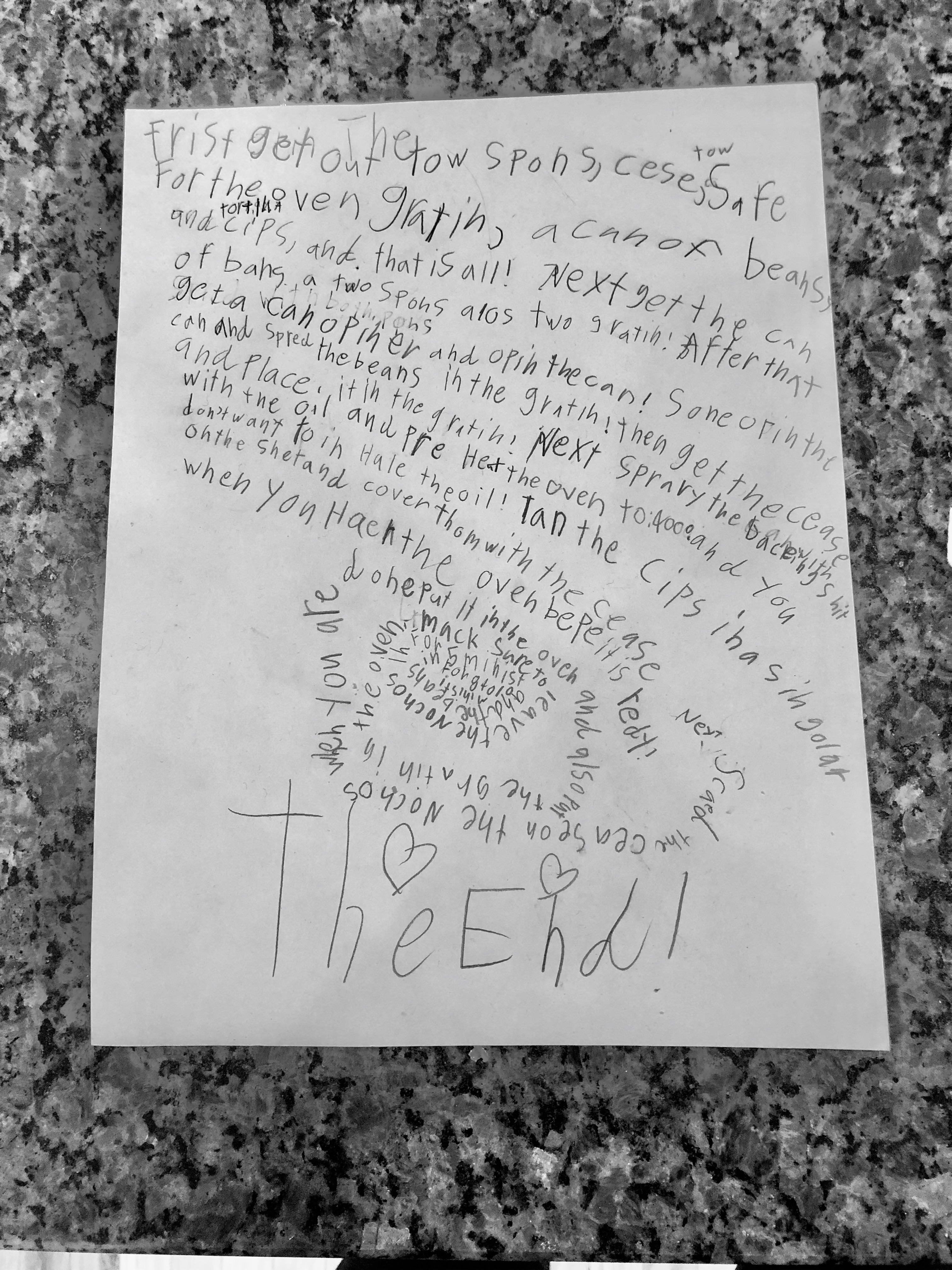
School didn’t prepare us very well when it comes to life skills like filing tax returns, scheduling duct cleanings, managing investments, cleaning refrigerator coils and dryer vents, or how to do things like install an automatic washing machine shut-off valve, but we certainly learned a valuable lesson that day, one that I’m reminded of frequently as we navigate this crash course of life. One child of mine, in particular, requires absolutely explicated, exhaustively specific, pointedly precise instruction when it comes to even things that feel like they should be intuitive, like how to use a knife and fork (at the same time and with separate hands). Recently I taught her how to make nachos, and we thought it would be a good idea to take notes, so here you have it:

The end. Except don’t forget to turn off the oven.

Home improvements

Update: the girls are trying something new. They’ve not only really let their hair down, but they’ve also unloaded some baggage that was weighing on them (those that could, anyway) and are feeling positively footloose. They’re still a little on edge, but it’s always good to come up for air.

The girls feeling elevated by practicing self-care.

Also, some good news for Mr. Lemonhead: he knows he’s not alone, and now that he’s befriended Orange Julius, who finds himself in similar straits, they’re always tied up on weekends.

Misery loves company? No, love and company counteract misery.

Alpha and Omega: the almighty mall

When I was a kid, “going to the mall” was still very much a thing. Usually we’d enter though the women’s department store called Leggett’s, which had the most peculiar feature: a pathway of mirrors in the ceiling following the same course as the walkway through the store. I have no idea if this served to help spot shoplifters (this was the time before surveillance cameras), but we delighted in the novelty and would wander through the store, heads tipped as far back as possible, guiding ourselves by watching our reflections from above. We would say “yes” to every perfume purveyor who asked if we’d like a spritz despite the fact that, by the third or fourth spray, all of the scents would be indistinguishable from each other, and for the rest of the day our wrists would reek of a cloying conglomeration of synthetic scent.

The mall was mostly a very happy place, filled to the gills with fluorescent light and entertaining window displays, each store sampling different music, and smells emanating from everywhere: hot, herby parmesan from the pizzeria, butter and yeast from the soft pretzel counter, the vanilla nuttiness of fresh waffle cones from the ice cream stand, white musk and sandalwood from the cosmetics shop, the heady scent of leather beckoning from Brookstone. There was a system of fountains with statues, including a bathing brass maiden and a fish in full twist. The main drag was dotted with gumball machines and displays of everything from shoes to electronics, books to jewelry, toys to kitchenware, greeting cards to gag gifts, vitamins to candy. It was a place where you could buy basically anything you needed or wanted but couldn’t get at a grocery store, and the people-watching! Oh, the people-watching!

Thirty years later, the place has lost its splendor. Now it’s a kind of shantytown, a monument to abandonment, shuttered storefronts and darkened doors, all the spectacle replaced by vacancy, glitz gone to dust. Its demise was due in large part to the upsurge of online shopping compounded with big box stores and more national chain outposts materializing all over town. Even pre-pandemic, I honestly can’t remember the last time I’d gone there, until last week when I went to what used to be a J. C. Penney but was now just a giant empty space, the ghost of a department store (complete with a whole wall papered to advertise the St. John’s Bay line of clothing), to get my second vaccine.

The whole experience was entirely surreal, partly because it was so very unlike the atmosphere I’d encountered when getting my first dose three weeks earlier. That other day felt like a different season, frigid and dreary. The clinic was held under a tent in a parking lot and was staffed by Army Corp personnel in uniform, one of whom was manning the line outside by barking orders. There was no banter among waiting strangers, no eyes smiling above masks, and I felt like the only young, healthy, person there aside from some very pregnant women and a few young people with special needs, accompanied by their parents. The man in line ahead of me must have been breathing down the neck of his centennial birthday, and when the staff member in fatigues checking him in recognized his Marines jacket and cap, he thanked him for his service. The elderly Marine couldn’t hear him, but when the man pushing his wheelchair (I guessed this was his son), said, “He thanks you too,” I felt completely out of my league. What was I doing amid these people? How had I possibly qualified for the honor of a receiving a vaccine among this kind of company?

Three weeks later at the mall, the operation felt more like being at an airport than a disaster relief center. The line outside wrapped around the building, but a man ahead of me left his spot to join an acquaintance who queued up right behind me. They talked the entire time, one sharing tips on cooking with a George Foreman grill, the other telling the story of how his 97-year-old widower father had died the week before but he hadn’t seen him in over a year because of Covid. Once we got inside, the men parted ways, grillmaster with an orange Moderna card heading left and orphan with a chartreuse Pfizer card following me to the right. There were orange pylons punctuating the room as well as a labyrinth of retractable belt barriers, demarcating the flow of traffic and separating the Moderna crowd from the Pfizers. There were no uniforms in sight; the people staffing this clinic ran the gamut from an elderly man sporting a UVA golfing polo to a youngish woman with a buzz cut and a sleeve tattoo. As we waited, I halfheartedly read my book and looked around and noticed that the patrons were also a motley crew: a mother holding a baby, a statuesque model-type with beautiful bicolor cornrows so thick they made me think of challah, an athletic-looking young woman whose jaunty ponytail bobbed through the back loop of a baseball cap while she typed furiously into her phone with both thumbs and gripped crutches under her armpits, a young man in a business suit, and an old man with a mane of hair and about a dozen silver bangles around each wrist. It was strange to walk that line, every so often catching sight of my own reflection in the mirrored columns of the once-upon-a-time department store, passing the fitting rooms cordoned off with caution tape, scanning the empty display cases and shelving intended for showcasing retail, marveling at the architecture of this space repurposed in such a bizarrely wonderful way. This used to be a place where people shopped for capri pants and graphic tees; now it served as gateway for everyman to pass through from one side of the pandemic into another. Here we were, most of us receiving our second dose, entering those doors hoping to reemerge one step closer to finding our way to a different kind of life.

After I got my shot, I sat for fifteen minutes and listened to a conversation between two girls who knew each other but had never met in person. I gleaned that they took a college class together online, but neither had they ever glimpsed each other wearing a mask nor had they seen each other below the shoulders. One girl said, “I recognized your bun,” and the other responded, “People usually notice me because of my height; I’m basically five feet tall, but you’ve never seen me standing up!” What a weird, wild time to be alive.

It was impossible not to remember going to that mall so many years ago in what truly feels like a different lifetime altogether, and so strange to juxtapose that memory with the reality of the present day. As children, we’d be so excited to go there to get fitted for new shoes. I had my ears pierced at a pagoda in that building when I was six years old. A friend hosted a scavenger hunt birthday party there in middle school involving disposable cameras (I still have the pictures) and a feast of pizza with garlic knots. I remember feeling sheer delight in beholding the kaleidoscopic abundance at Candy Express and trying all the sample lip glosses at The Body Shop (can you believe they did that?). The sentence “I’ll meet you at the mall” was definitely one of the most frequently spoken among me and my friends in the nineties. I even had a favorite parking spot, for crying out loud. If any one location can represent the zeitgeist of that epoch, there it is.

I didn’t spend a penny last week at Fashion Square Mall, but I’m certain that I left with the most valuable commodity I’ve ever been fortunate enough to obtain there, along with an experience that nearly breaks the memory bank. Just don’t tell that to my six-year-old self who just got her ears pierced. Let’s let her have that moment.