It was Sunday night. The kids and I had spent the entire weekend together without interacting with anyone else in person, and that day in particular felt like it had lasted a week. In that one day, we’d weeded and planted the garden, read books, played Plants vs. Zombies: Garden Warfare, watched two episodes of “Gravity Falls”, cleaned rooms and folded laundry and mowed the lawn, practiced violin and recorder, frolicked at the playground, eaten oatmeal and popcorn and bagels and egg salad and twice-baked potatoes, watered the indoor plants, swept and mopped, and tended to the small animals. I’d just given Brian a haircut, assembled the next day’s lunch boxes, and made avocado and tuna maki for dinner, which the kids were currently eating. It seemed like the dialogue of the day had been ongoing, and we adults were feeling it. The relentless “Mommy?” and “Daddy?” felt like catcalls by this point, and finally Brian said it all with, “Do you people even breathe?” He told them we needed five minutes during which no one asked us any questions. Please and thank you.
I was doing Summerly’s hair, preparing her braid for bedtime to avoid the nest of tangles that would otherwise happen overnight, and about four minutes had passed since the last inquest from a child. I felt like I’d taken a deep breath for the first time in way too long, even though the chatter amongst the kids had abated not a whit. There was a pause in conversation for a fractional instant, which gave Summerly the opportunity to chime in with this statement: “I really want to ask you a question.” So I relented, as they’d done a better job withholding inquiries for the past 240 seconds than expected.
Alison: “Okay. Go ahead and ask it.” Summerly: “Has it been five minutes yet?” Alison: “Almost. It’s fine…you can ask me your question now.” Summerly: “That was my question.”
And there you have it, folks. Happy Monday on a Wednesday!
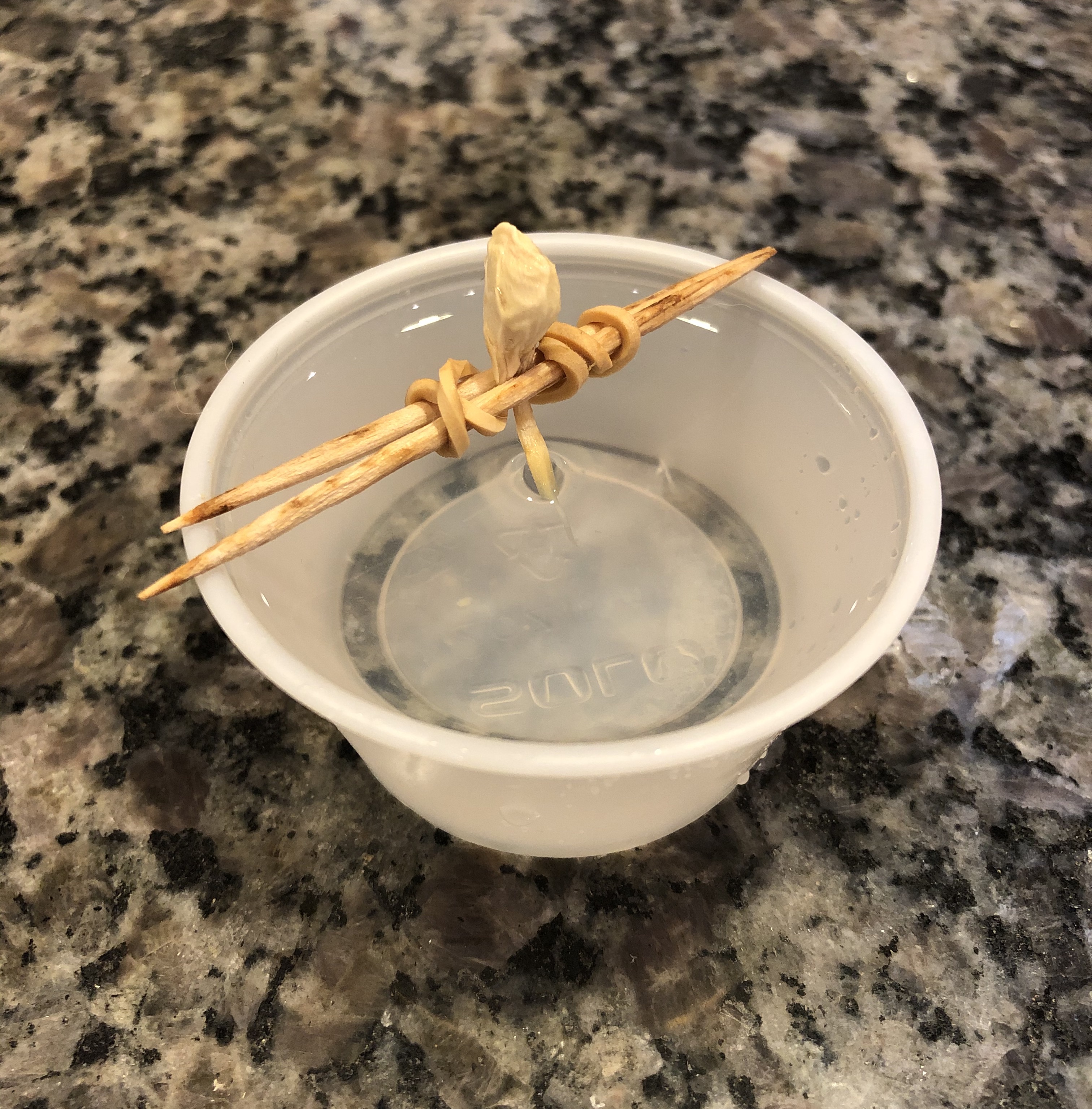
One of my favorite short stories to teach was “The Gift of the Magi” because it represents situational irony so well, and the best way to teach irony, I think, is to provide clear, preferably clever examples. Here’s a real-life instance of situational irony that I find particularly rich: my dad, who had a heart attack a few years ago and takes medication as a result, cannot eat grapefruit because it interferes with the efficacy of said medication. As a rather odd coincidence (I can only assume), his health insurance agent sends him a case of ruby red grapefruit every December as a holiday gift, which my dad divides among his children and delivers to us. One morning a few months ago, I halved one of the grapefruit and, while supreming the segments inside the rind, discovered a seed that had already sprouted.
This felt like a lot of responsibility. It’s possible that I’ve overthought this, but the orphaned little seed with its hopeful protuberance of life potential, that milk-white root reaching for somewhere to nourish it towards growth, plucked at my heartstrings. Here it was, inside its mother mere moments before, fed only by what moisture and nutrients existed within her womb-shaped self, so resourceful as to have synthesized what was preexisting into this posture of promise. And the grapefruit herself, sliced open and bleeding out onto my cutting board, having bequeathed unto her seed what was necessary to mature it to the seedling stage, having given actual part and parcel of her flesh and provided a space conducive to healthy development, having invested more in her tiny proto-plant beyond mere transmission of DNA–it all felt very personal. And now what? Now that the seed had been delivered into air, would it just be tossed into the bin, its possible future as a tree surely rescinded, all of the botanically purposeful energy that had contributed to its growth relegated to a trash compactor? The ground outside was frozen January-solid, so it didn’t stand a chance in the garden, but I was determined that this wouldn’t all be for nought.
It might also help to understand that I once owned a dwarf grapefruit tree in a hefty pot that I bought on a trip to a local garden spot with my sister several years ago. I named the tree “Greyhound” and settled her into a corner of the house that I didn’t know hadn’t been properly insulated during construction (there are three rooms affected by this negligence, one of the many unfortunate aspects of our house that resulted from its being built by people in the employ of what is absolutely the most inept, corrupt, criminalistic construction company in human history, but that’s another story). I didn’t know why Greyhound was unhappy, but her leaves began to brown and curl and fall, one at a time, though she valiantly bloomed and fruited a total of four beautiful chartreuse globes before succumbing to significant leaf loss. I finally realized the problem and relocated her to a warm spot in the dining room, but by then it was too late for her to recover because there just wasn’t enough chlorophyll-imbued surface area left to manage photosynthesis for a plant of her stature. When it was clear that no salvation was possible, I mourned by sawing a footlong portion of her trunk and whittling off the bark to make a smooth, nearly-straight blonde wand that I keep on my desk in the company of other talismans.
Perhaps Greyhound in memoriam, and the knowledge that (though she’d done her best to communicate discontent) I had failed to recognize signs of plight in time to save her, combined with the fact that I’ve had two actual miscarriages, made it feel that nature was holding me accountable for doing what I could to give this little fighter a chance to manifest what it was trying to become, despite all odds. Here was my little ruby red rainbow baby, and I owed it to it and its mother fruit looking up at me from the counter, her halves like two round, weepy eyes, veined with red and rimmed pitifully with pith, to try. It was the least I could do to honor this poor piece of produce, her membrane-encased juice vesicles laid bare in the light of day, who had unexpectedly deposited her foundling on my doorstep without so much as a note. (But who could blame her? She’s citrus x paradisi, hardly homo sapiens.)
Friends, here I introduce my very low-tech but specifically customized hydroponic citrus nursery, currently at single occupancy capacity:
Context: The kids were supposed to be in their own rooms undressing, putting on pajamas, and THEN placing their clothes in the hallway hamper. Instead, they were standing one centimeter inside the thresholds of their bedrooms, as close as possible to each other while still technically being inside their rooms, taking off one article of clothing at a time, and reaching into the hallway to deposit each into the hamper before removing the next item. Summerly: “I heard a good joke! What’s the safest room in a house during a zombie invasion?” Arlo: “What?” Summerly: “The living room!” (a few minutes later) Arlo: “Oh, I have one! What’s the most dangerous room in a house during a zombie invasion?” Summerly: “What?” Arlo: “The dining room!”
***
Context: Rachel Platten’s “Fight Song” came on the radio in the car, and I was explaining that a “fight song” is really an anthem intended to express endurance, perseverance, unflagging efforts in the face of adversity. I said, “It’s not about starting a fight, exactly; it’s about fighting through challenges without giving up or giving in when things are hard or people say or do things to suggest that what you’re trying to accomplish is hopeless or impossible. It’s about having determination, believing in yourself, and pursuing your goals no matter what obstacles stand in your way. It’s about upholding your beliefs and taking action when you encounter wrongdoing or injustice. The song is to help promote those ideas, remind you of your resolve and give you energy to keep going, especially during the hardest times.” Arlo: “Oh! So, like, if a zombie comes, you’d fight it so it doesn’t eat your brains! Right?”
***
Context: Brian was helping the kids suit up in their snow gear, and they were at the stage that causes all parents’ blood pressure to reach unprecedented levels: putting on gloves, or, more specifically, fitting the correct fingers into their corresponding finger-shaped apertures. Brian: “Ok, put your hand in. Now spread your fingers and reach for my brains.” (FYI, I highly recommend this snow-day strategem, as the results were far more successful than my attempts heretofore, which admittedly included the harebrained and probably too stridently-delivered directive of “Oh, come on! JUST THREAD THE NEEDLE!”) Arlo: “But you don’t have any brains!”
***
Context: I was reading to the kids and came to this sentence: “In the middle of the afternoon, the sky suddenly turned dark and ominous.” Alison: “Do you guys know what ‘ominous’ means?” Liam: “Like, scary?” Alison: “Well, sort of! More like ‘threatening’ or ‘making you think or feel that something bad or unwelcome is going to happen’. What do you think is going to happen, in this case?” Arlo: (animatedly) “Maybe zombies are going to fall out of the sky!” Alison: “Yes, except instead of zombies, it’s rain that’s going to fall out of the sky.” Arlo: “Yeah! Rain that eats your brains!”
I suppose it makes sense that the third child should always want to have the last word, especially when zombies are concerned.
At night, especially when he’s had a stimulating day and therefore is tired, Arlo has a kind of frantic energy at bedtime. He’s a little like a whirling dervish, which puts him at risk for running into people or open doors, cracking his jaw on the countertop or shin on the footboard of the bed, or slipping in sockfeet on the hardwood. He can also be extremely uncooperative: lying on the floor while taking off his clothing, running out of the bathroom twelve times when he’s supposed to be brushing his teeth, putting his pants on backwards because he’s not paying attention, bouncing when we’re trying to floss his teeth, needling and ribbing his siblings to try to get a rise out of them. It seems like if an adult walks out of the room in which Arlo is, within two seconds an eruption of some kind occurs.
One evening, the day that my mom had had a thyroidectomy to remove a lymphoma, I was a nervous wreck because we were just hearing news about how the surgery had gone (it went well!) and was trying to take a shower in case I had to go to the hospital in the morning. Brian was tackling toothbrush and floss checks before reading to the kids, and Arlo was having one of his sparkplug nights, trying to talk while his father was brushing his teeth, which annoys us to no end. Brian asked him to wait to speak until after the toothbrush had left his mouth, but he continued talking. After asking him again to wait without receiving cooperation, Brian raised his voice, the result of which was Arlo fleeing the bathroom and running in to cling onto my leg (the shower had been running for at least five minutes at this point). He said it broke his feelings and made him feel sad when Daddy yelled (Brian didn’t really yell, for the record, but his tone was spiked with frustration). I told him I know, I understand, and I heard it too, but he was being really impatient and uncooperative, and I suggested he go tell Daddy how he felt. He said he didn’t want to, and I said, “Well, at least then just go and finish with your teeth in a cooperative way.” He did, thankfully.
About two minutes later, I walked into the kids’ bathroom to do…something…just as Arlo was running out, tossing the hand towel at the hanger on the wall in his flurry, and the towel fell onto the floor. “Arlo,” I called, “You’re not finished in here! Please come back!” He spun on a heel and yelled, “Yes, I AM FINISHED IN HERE!” with clenched fists and classic angry-kid face. Brian and I pointed to the towel, and I said, “I’m talking about that.” He picked it up and hung it properly. I said, “Arlo, I don’t like it when you yell at me. It breaks my feelings and makes me feel sad.” He hugged me with his whole upper body, even his head, and said, “I’m sorry, Mommy,” and dashed into the bedroom for reading.
When I finally made it into the shower, I couldn’t help but wonder whether I’d just gotten lucky with the way the situation had worked out or if Arlo had yelled on purpose to give me the opportunity for that bit of modeling. I’m telling you, it’s entirely possible. The kid’s a sucker for a good setup.
As humans, we’re all enrolled in an unofficial continuing education course wherein we learn all manner of skills, facts, coping mechanisms, shortcuts, and tricks of the trade that help guide us through our days. As parents, we learn an unquantifiable amount about ourselves, our children, and the world around us in from a fascinating variety of sources. For instance, I’ve learned so much from the Kratt Brothers and Ms. Frizzle (did you know her first name is Valerie, by the way?). I could talk for hours about Thomas the Tank Engine and write a novella about Angry Birds or Beanie Boos. I know three different ways to accumulate twenty-two flat marbles (there should be a better name for those…the internet gave me “glass globs” but I’m not having any of it) in Mancala on the first move and can sing several songs from the Disney canon, word for word if not note for note, while being exactly half asleep. We all have a diverse and very specific skill set like this, a toolbox of knowledge and ability that is entirely useful in some situations, completely useless in other situations, and constantly under construction.
In an American Girl “Mini Mysteries” book I was reading to the kids, we stumbled upon the ancient Egyptians’ practice of removing the organs from a deceased person and placing them in a canopic jar to be buried alongside the body as part of the mummification process. Add this to the list of “things I probably never would have known if I didn’t have all these kids”! We went on to learn that these cozy jars of innards did not include the heart, which was left inside the corpse in accordance with the belief that a heart was inextricable from the soul, and it alone was necessary to determine the soul’s suitability for the afterlife. Ancient Egyptians believed that the heart would be weighed by the god Anubis (or, in some traditions, Osiris) to discover the caliber of a person’s goodness, and if the heart weighed the same as or less than the Feather of Maat, or the Feather of Truth, the soul was given a ticket to afterlife. If the heart outweighed the feather, however, the soul was either condemned to the Underworld or consumed by Ammit, a voracious demon of a goddess with the countenance of a crocodile, the torso of a lion, and the trunk of a hippopotamus.
The takeaway here is that ancient Egyptians prized the lighthearted as being more virtuous, more righteous, while associating a heavy heart with wickedness. Do our interpretations of the idiomatic notions of “lightheartedness” and “a heavy heart” have roots in this ideology? My limited research on the topic turned up inconclusive results, but either way it’s an idea I appreciate. Imagine for a minute that love does in fact originate in the human heart and emanate from within it. Now imagine that, with each act a person does that is fueled by love, a tiny shred of heart accompanies it, transmogrified into a kind of philanthropic energy, leaving the body of the giver forever to become part of a love-force (perhaps from which infant hearts are generated in this hypothetical scenario to account for the first law of thermodynamics). This would mean that each time a person acts selflessly, graciously, kindly toward another, as an expression of interpersonal love or for the general love of humanity, that person’s heart would lose an atom or so of mass. The more a person loves and acts as directed by love, the lighter his heart would become. Conversely, a person whose actions are guided by forces less magnanimous than love would have a heart much weightier. Having a “heavy heart” would mean living a life in which one was miserly with his love, or at least parsimonious in acting upon its force.
Perhaps, based on this principle, it would make sense that preparing dinner every night for three children who possess incompatible opinions about food makes me feel just the tiniest bit hollow inside 😉
Remember “the funnies” in the Sunday newspaper? I imagine they still run weekly comic strips, though I can’t remember the last time I saw an actual newspaper. When I was in middle school almost three decades ago, during those years when a girl who’d been a friend decided that it would be a great use of a lot of energy and time to make my life as miserable as possible, I’d look forward to Sunday mornings all week, and after removing the colorful funnies page, would pore over them and cut out my favorites to paste in a notebook. I’m talking about Family Circus, Beetle Bailey, Rhymes with Orange, Sally Forth, Blondie, For Better or for Worse, Doonesbury, Hi and Lois, Non Sequitur, The Wizard of Id. It was a delicious feeling to sit down with that page each Sunday, followed by a nebulous kind of disappointment after finishing it and knowing that I’d have to live through another hellscape of a school week before feeling that excitement again, kind of like coming down after the high of a holiday. The other saving grace that buoyed me through those unfriendly seas of seventh grade was being able to look forward to watching the day’s episode of “All My Children” that my mother faithfully recorded on a VHS tape for me, Monday through Friday at 1:00 EST. Watching that day’s episode was my guilty pleasure and evening ritual after finishing homework, and it’s one of the reasons I survived those days of hiding in a bathroom stall to eat my lunch, feet tucked up under me so no one would see that there was a person in there, with a single shred of sanity intact. I have the fabulous Erica Kane, Adam Chandler, and Hayley Vaughan to thank for allowing me the escape into their on-screen soap opera world for that hour of time out of mind, away from my real-life soap-operatic social scene. Diagramming sentences in English class helped a lot, too, but I digress.
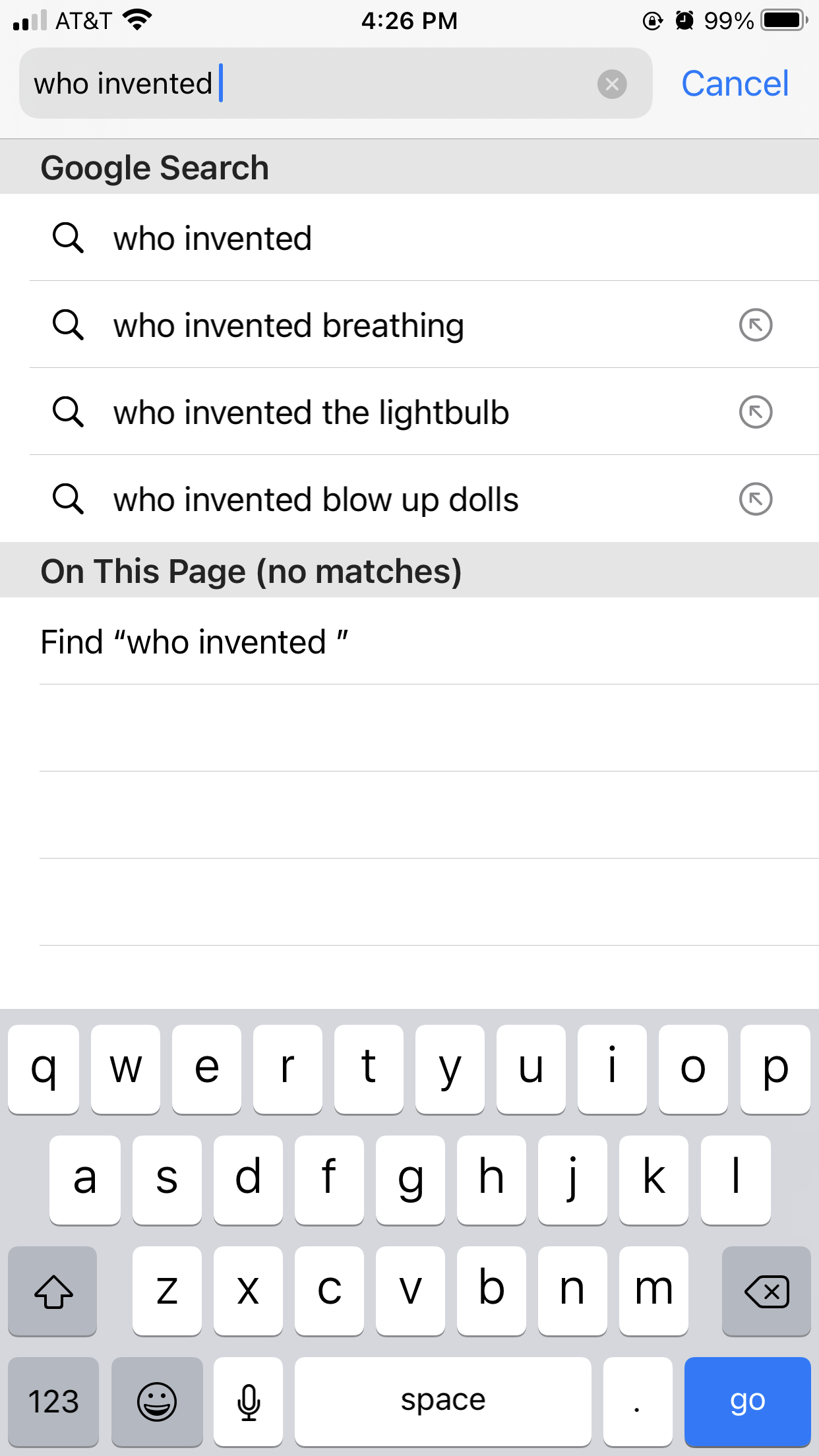
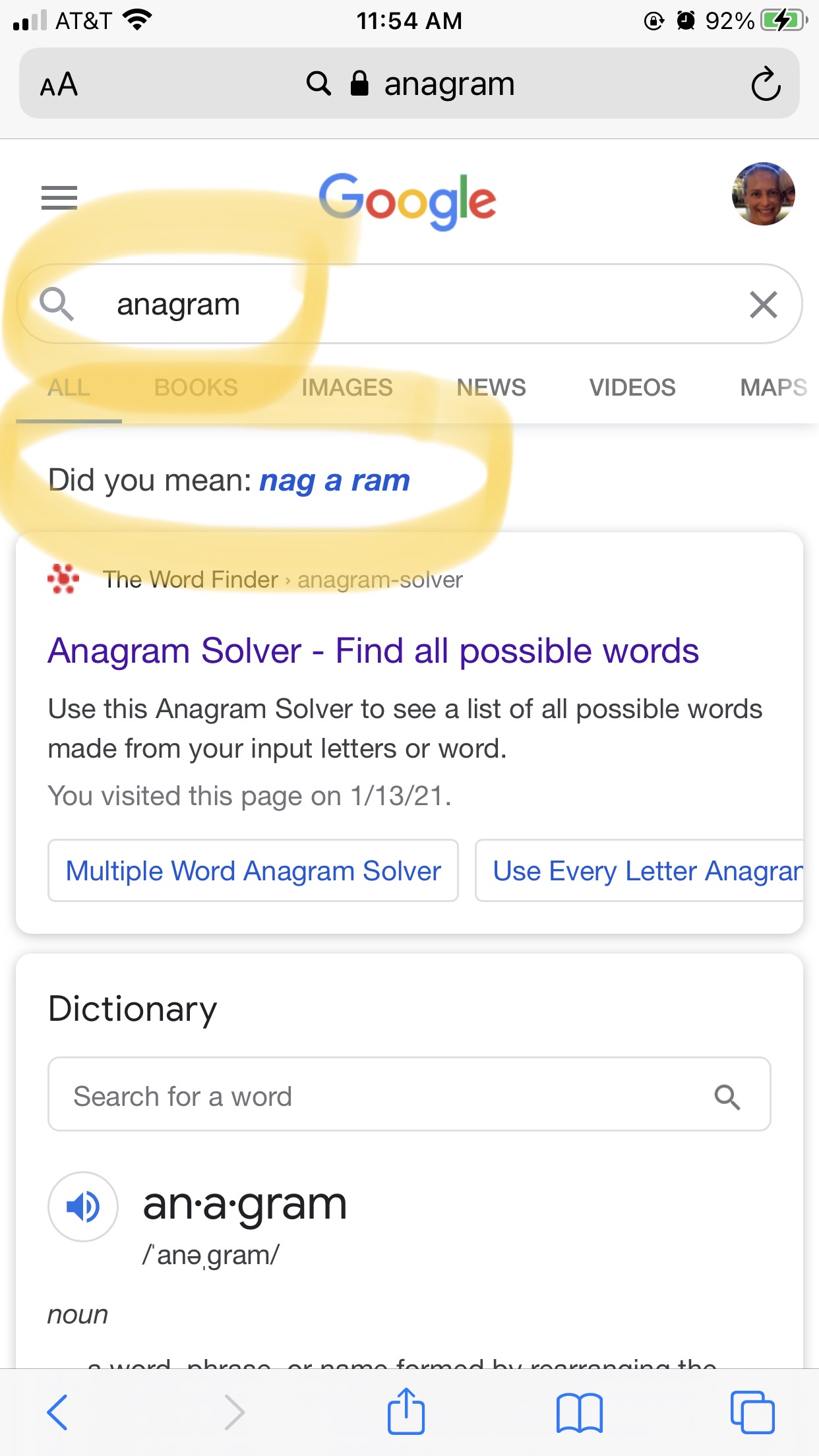
For me, the weekly funnies have been replaced by humorous internet content frequently delivered unto my social media feeds in the form of memes, or in the form of text messages from my many hilarious family members and friends (hi, Dad!). But one of my favorite kinds of comedic content is that which is inserted into the world in subtle ways that are only discovered by chance, and the surprise it provides is value added. So here’s a comedy reel to start off the weekend in the form of two screenshots, amusing discoveries made while conducting Google searches on my phone:
You’ve got to love software developers with a sense of humor.
Having several kids means that a great deal of negotiating and turn-taking is necessary for harmony to prevail over argumentation and disunion, which, as history has proven, are the precursors to dissension and secession. Since secession is out of the question (I hope) and dissension is undesirable, families must develop systems to ensure that everyone’s needs and desires feel heard and represented. It’s a fine balance, to be sure, but if household governance can land on a strategy that functions while still maintaining egalitarianism, a kind of managerial artwork is engendered there.
In our home, we have a few different rotations that occur simultaneously, and though this makes for a lot to remember, it creates an interesting coordination that seems very much like the movement of planets and moons. Here’s how it works: one kid chooses the game we play after dinner and then which audiovisual entertainment they will enjoy on Monday, the second kid selects the game and show on Tuesday, and the third kid makes the choices for Wednesday. They have to choose from a list of parent-approved games to ensure that the duration of play time doesn’t exceed fifteen or so minutes, and the show is always “the next episode” of whichever series they’ve previously chosen and are currently watching (they each have a different program going), and it must be no longer than thirty minutes in length (except on Saturdays). Because there are three children and seven days in a week, this rotation in practice means that when the next Monday rolls around, it’s not the same kid acting as evening cruise director. The Monday following, it’s yet a different kid’s turn to indulge his or her interests. This means that within the span of one week, each kid gets a turn twice–every third day–with Saturday being a special Bonus Day for one of them. On Saturdays, they’re allowed to watch an extra episode of the show slated for that date, depending on which kid’s night it is, bumping the screen time up to almost an hour as a special weekend treat. Each kid gets a Bonus Day on the third Saturday following his or her most recent Bonus Day, meaning that they all have to wait three weeks between times when the double-feature designation falls on their night.
Now add to this rotation a separate rotation: Brian and I take turns reading to the kids before bed, and since there are two of us, this means we have a “one night on, one night off” schedule. These rotations in tandem mean that the parent that reads this Friday won’t read next Friday but will the Friday following. So, because each kid has his or her choice night every third day, and each parent has his or her reading night every second day, every sixth day finds the same kid/parent combo (the common denominator of 1/3 and 1/2 is six, of course). However, since Saturdays have an exceptional rotation all their own, it so happens that the same kid/parent combination doesn’t recur until six weeks later (same common denominator, but this time we’re talking in weeks instead of days).
When I was a teacher and a student would ask, “Why do we have to learn math?” I would half-kiddingly answer, “So you can help your kids with their homework someday.” (This was before Singapore math became common core, obviously.) Now, if faced with the same question, I think my response would be, “So you can carefully calibrate the systems of organization in your future family to ensure a mathematically and logically unassailable method by which each member is judiciously given the power to make choices but also the forbearance to practice patience in proportions that have been deliberately considered and clearly defined in an effort to promote the congruity of togetherness and individuality.”
Calculus, as defined by Brittanica online, is “a branch of mathematics concerned with the calculation of instantaneous rates of change and the summation of infinitely many small factors to determine some whole.” This is basically the same definition of the word “parenting”. So if you want to be a parent when you grow up, kids, keep paying attention in math class. You’ll be doing more calculus than you can ever imagine.
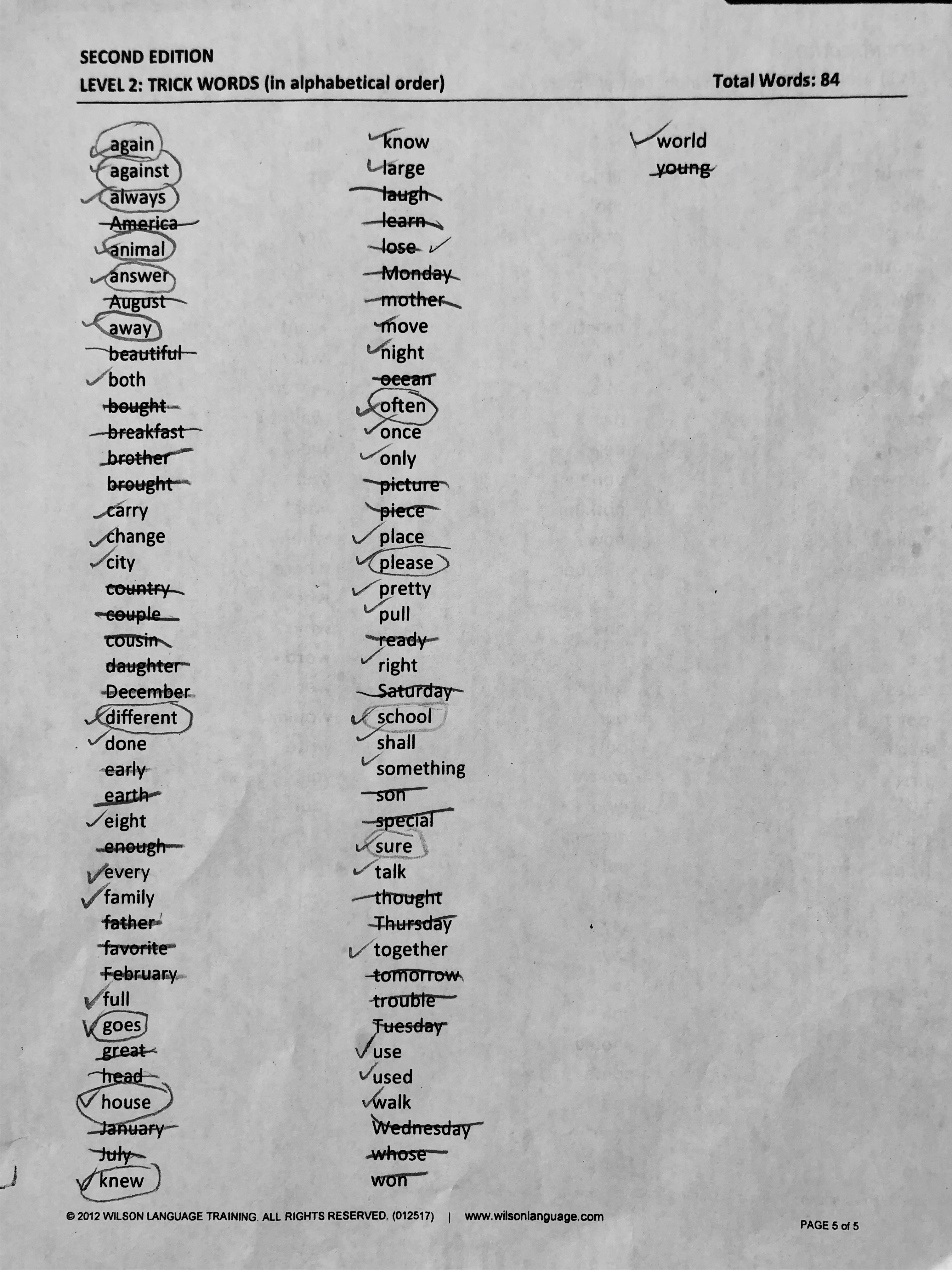
English is a notoriously difficult language to learn, in part due to its rampant irregularity in verb tenses, singular and plural forms, and spelling. As a person who has always been a good speller and passionate about all things linguistic, I find it an interesting challenge to have a child who struggles with even very simple spelling. She is motivated, though, and recently began practicing her list of “trick words” (words difficult to spell because they don’t follow the usual “rules” of phonetics and/or phonemics) in the afternoons while one brother practiced violin and the other “read” a Plants vs. Zombies graphic novel. One night, looking over her practice sheets, I felt inspired to use all 41 words in a writing exercise, and I ended up with a kind of a poem. The only additions I made to the list of words here are two articles (“a”) and one conjunction (“and”), plus some punctuation.
Trick Words
Away, animal night. A place only eight knew: full house both large and used.
Sure.
Something always goes against every right: city, school, family.
Talk (answer). Walk (move). Know (use). Carry (change). Done once…again…often… pretty please a different world shall pull together.
Only the words with a check mark to the left of them were on her list to practice.
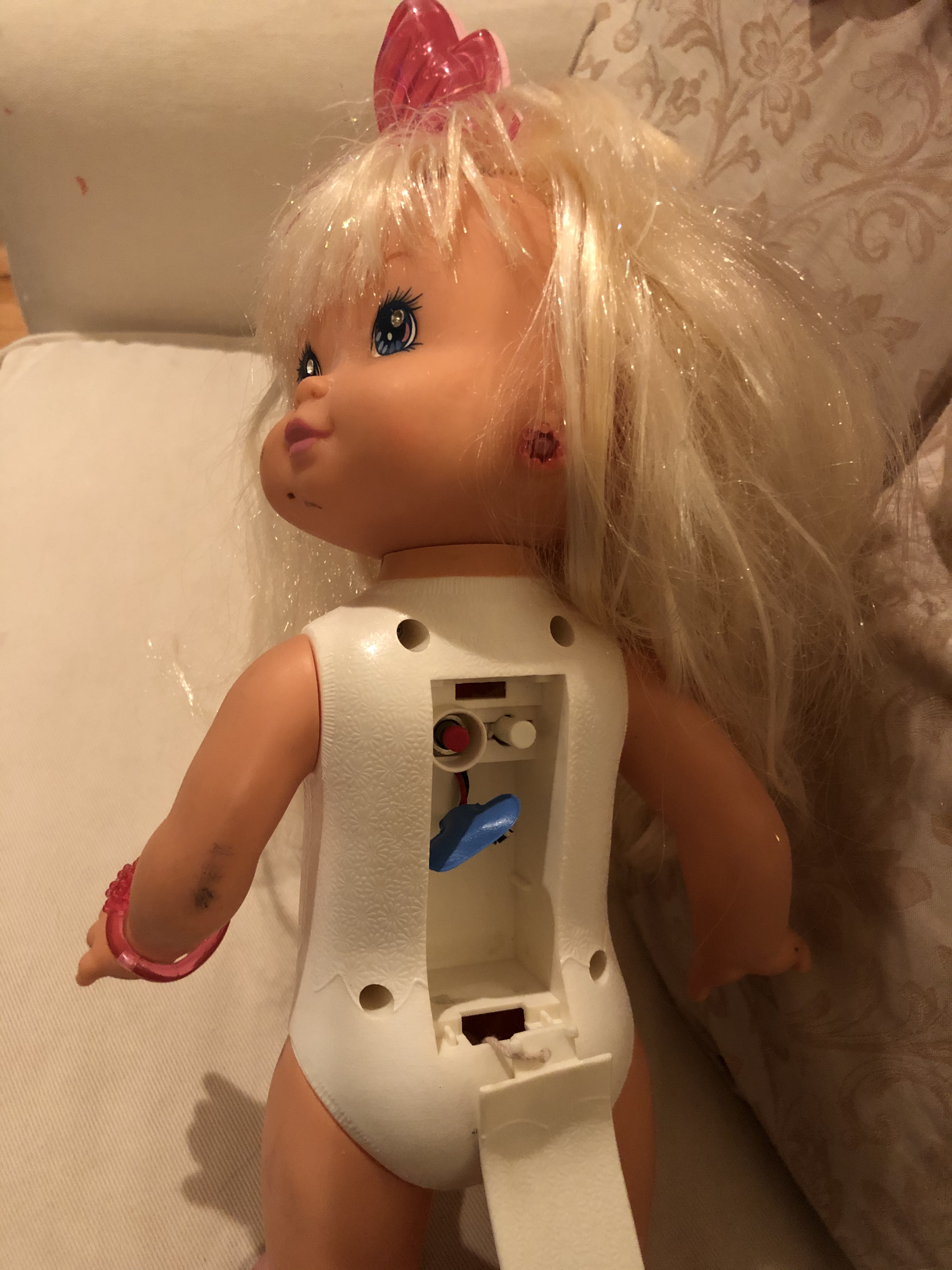
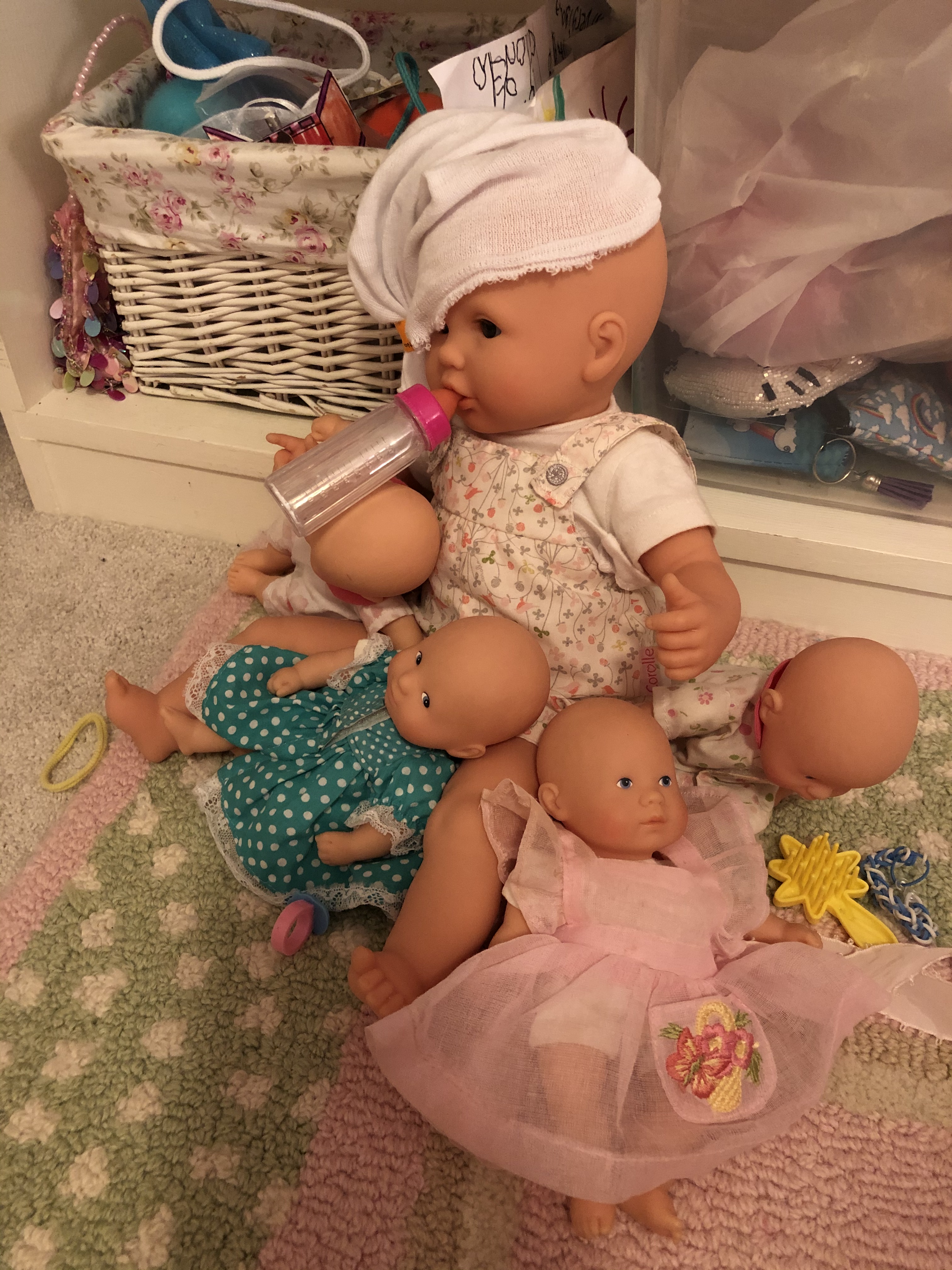
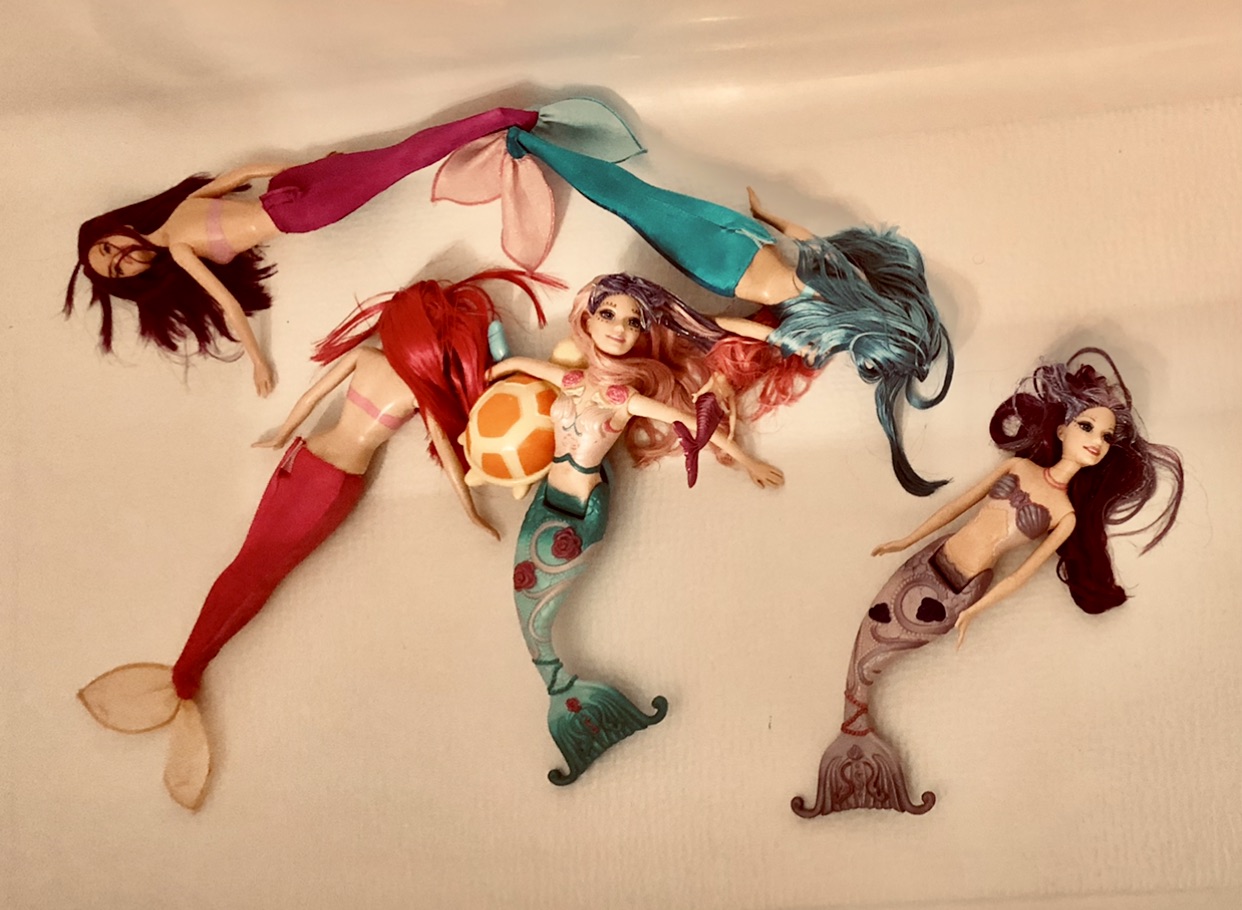
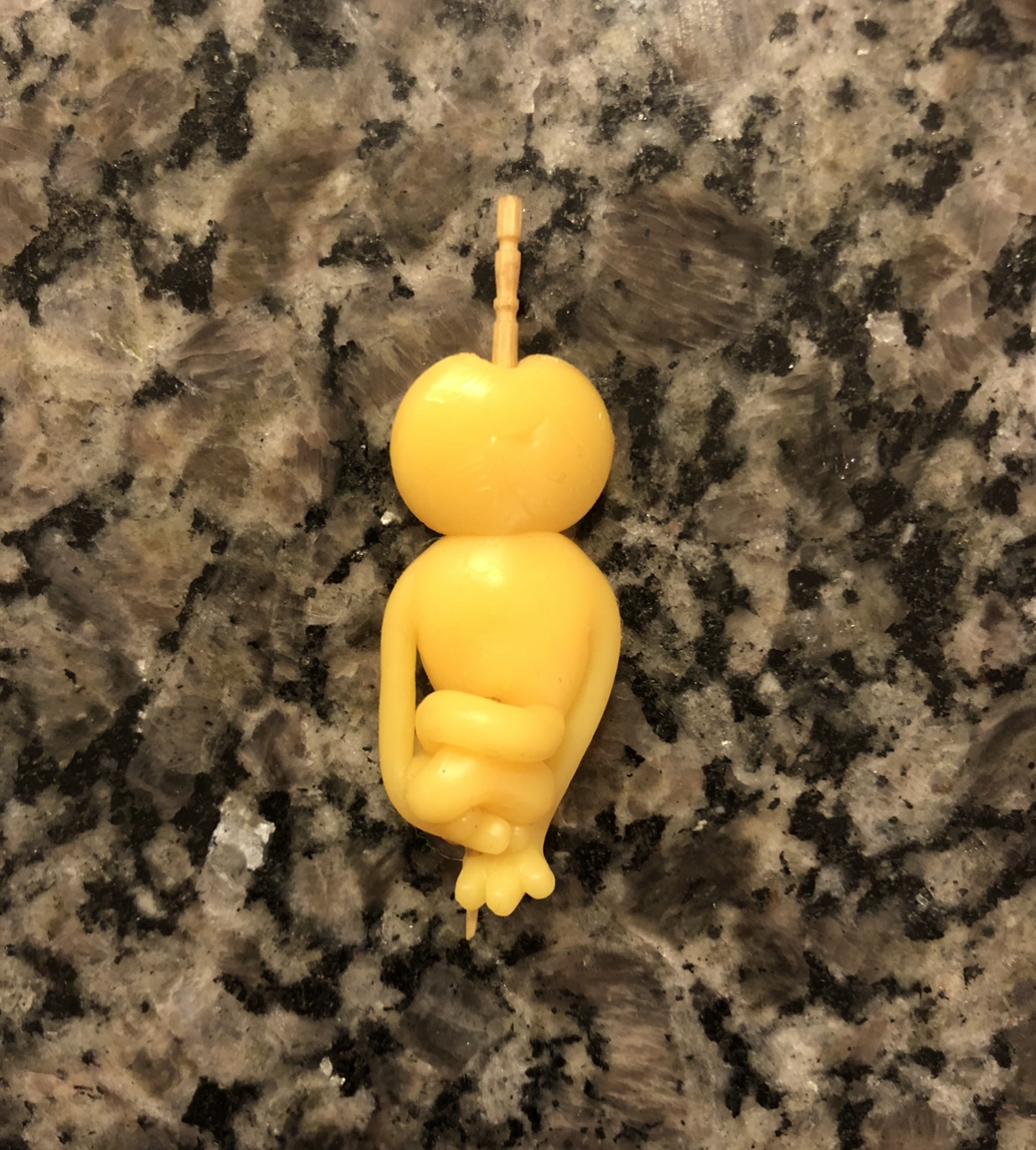
Finally, I have evidence that my kids actually do know how it feels to be an adult sometimes! They’ve created a series of still life artworks to express their understanding, and they leave these compositions around the house for me to discover as a way of saying, “I feel you, Mom.” Isn’t that sweet? I photograph these arrangements to prove how well they identify with the human condition, and I know you can relate to at least one, if not all, of the images in the series. Here are the four most recent installments:
P.J. Sparkles just cannot. She lies on the sofa and stares at the ceiling, only to see the smoke detector flashily flaunting its functional 9-volt battery like a social media feed filled with pictures of people looking well-rested and worry-free.Corolle wasn’t prepared for how hard this would be. Tonight she’s on the bottle and asking not to be judged.These girls remember taking baths back when they were in their twenties. It’s just not like that anymore.Mr. Lemonhead, you are all of us.
Aren’t these kids thoughtful in their reflective creations? I’ve never felt so seen!
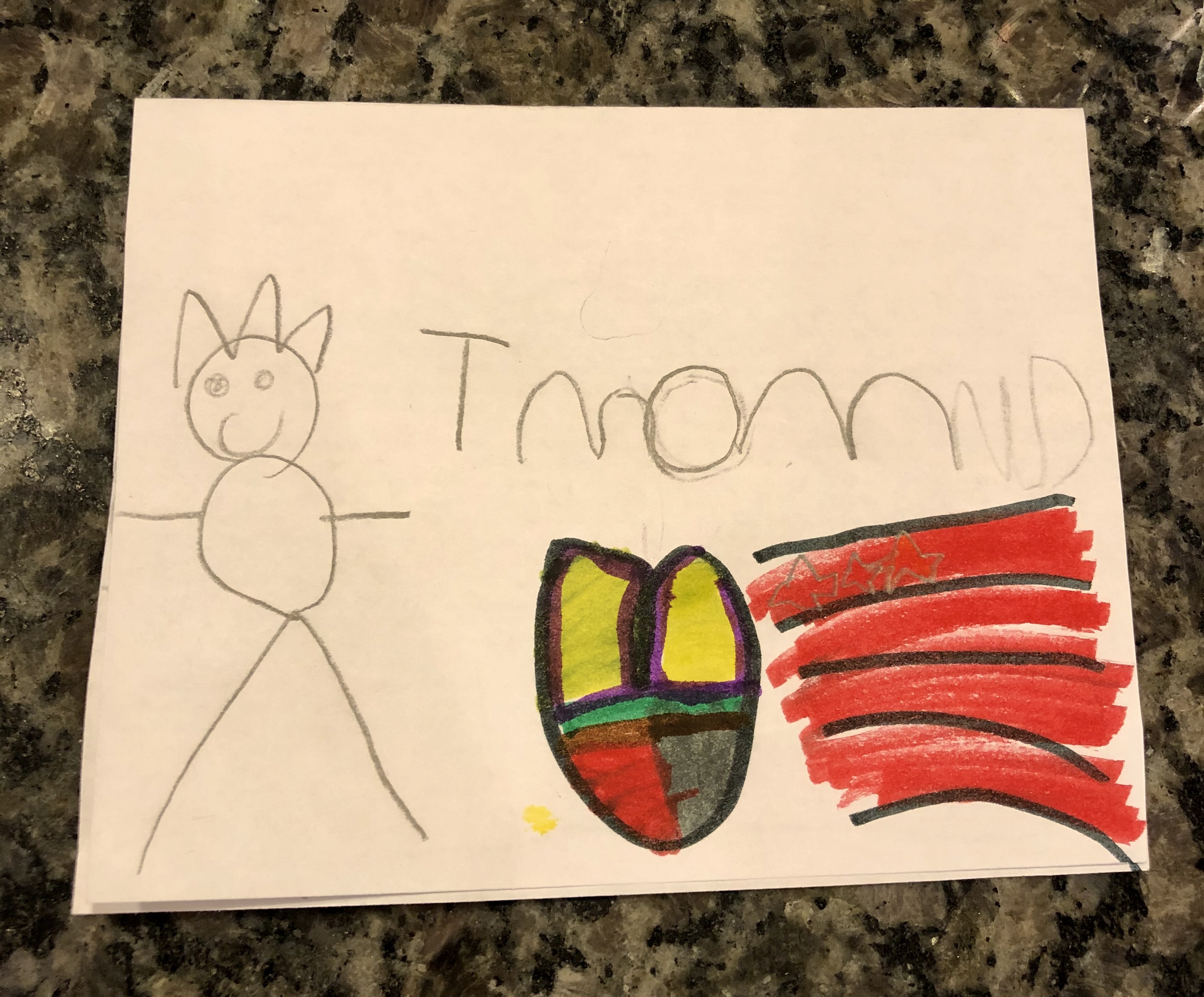
It was time to go upstairs for bed, but Arlo was feeling inspired and asked politely to have a couple of minutes to finish a card he had started that day in Kindergarten. “I made the front of the card in Ms. Ashley’s class. It’s for you,” he said, sealing the deal, and since I had a few more dishes to do I agreed to let him stay downstairs to work. It was the sweetest scene: this boy sat there holding his pencil in his fist the way you’d hold a screwdriver, the way I’ve given up trying to reform, sounding out the words he was trying to write. I cut the water to listen because last time he’d written something that none of us, including him, could decipher, he flew into a fit of pique. I wanted him to feel confident and encouraged in learning to read and write, so I tuned in lest that unsavory situation recur. Here is the front of the card:
“To Mom”
And this is the message inside:
It says, and I’m really glad I paid attention while he was writing, “I am thankful for you because you do so much for us.” Well, my heart just about grew wings and flew me directly to a comfortable spot on cloud nine. Arlo frequently expresses gratitude, but he’d never written me a card like this! And what a likeness! My hair really does resemble that rendering most days! And I don’t know what’s in the pan I’m holding, but his depiction of the gas range is dead on.
“Arlo!” I said. “This makes me so happy! Thank you. I love it and will put it on the refrigerator so I can see it all the time. I wonder what gave you the idea to make a card like this for me!” He grabbed his stuffed animals and began dutifully trudging upstairs. “Ms. Ashley said we should,” he said. Oh. Well, there it is. Turns out his sweet gesture, while still sweet, was the fulfillment of an assignment his teacher had suggested they accomplish. I wanted to laugh for a second but then I had a very serious thought: this child is really good at homework. Cloud nine, I’m back! That note is definitely going on the fridge.


 Momologica