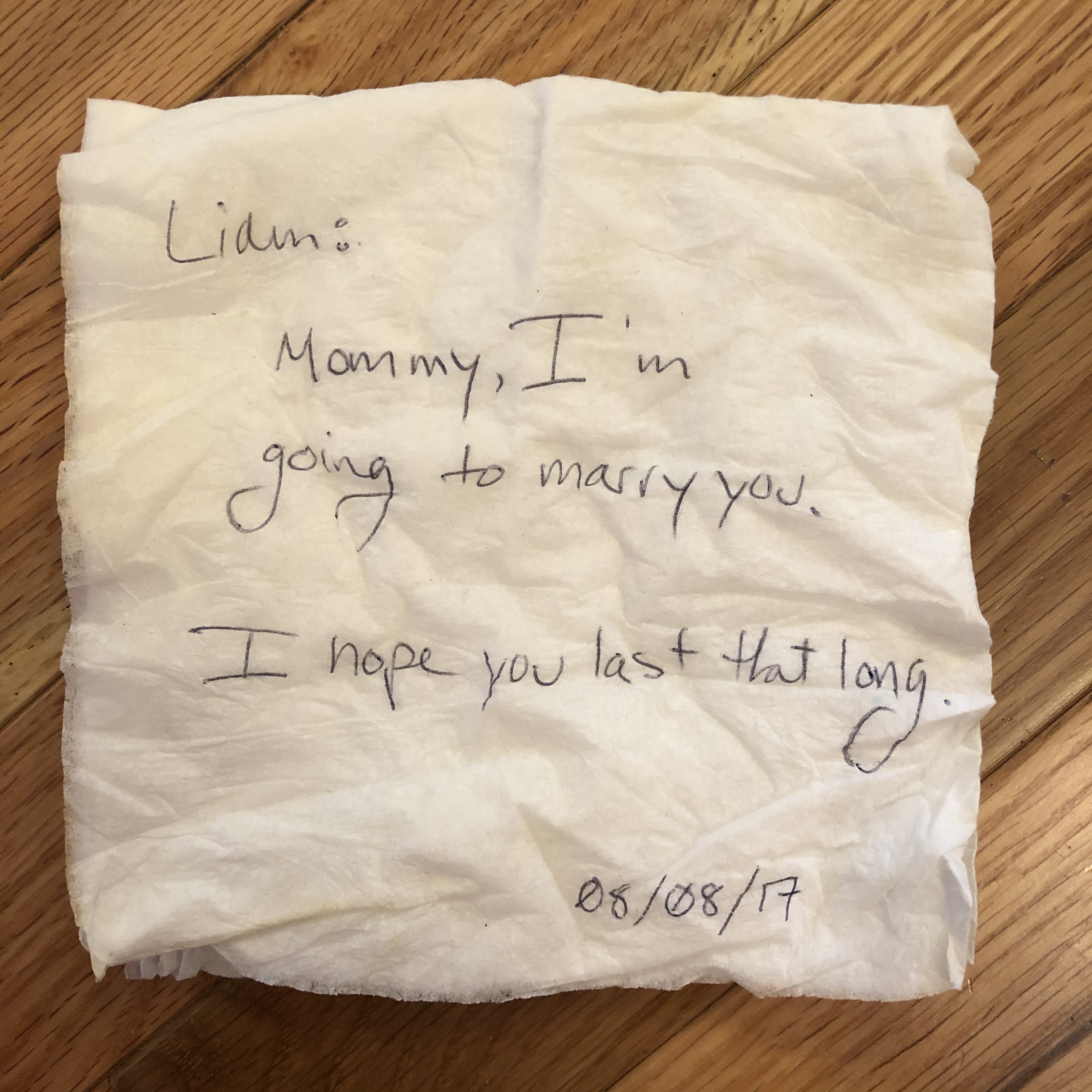
I recently graduated from a 2009 Suburban (“The Dawn Treader”) to a 2017 Chrysler Pacifica (“Harriet the Chariot”)! Yes, I am now delighted to call myself the driver of a minivan. Honestly, I kind of detested the Suburban from the moment I drove it off the lot six years ago, and it continued to rankle for the remainder of its tenure as my mainstay vehicle. In the process of cleaning out the interior, I discovered among the contents of the console and glove box (former home to a mouse nest, but that’s another story) several artifacts, including a bag of M&Ms that had basically powderized, a key to my friend Becca’s house from that time I watered her plants while she was out of town a few years ago, a packet of pacifier wipes (my youngest child is five), mascara (who even WAS I?!), and this:
There’s so much to love about this. First of all, it’s written on a napkin, which is classic, in my husband’s perennial penmanship, including the zeros with the lines through them (a holdover from his time in the Coast Guard). Then there’s the fact that he dated it, which I deeply appreciate, especially considering that it happened to be our ninth wedding anniversary that day, providing context that otherwise would be lost on its future audience. But most of all, I love that this captures so precisely how kids think and emote and express: guilelessly, earnestly, unfettered by societal stigma or so-called norms, unafraid of causing offense or affronting decorum. It’s at once hilarious and profoundly innocent, and I’m keeping it forever. I look forward to showing it to Liam’s future spouse, if he wants and finds one, as an example of just how perfectly pure his mind was at the age of seven and two months and four days. That is, of course, if I last that long.
1. Context: Over a year ago, a family member treated Arlo to an afternoon of lavish enjoyment, including sweet treats and several toys and gifts. It was definitely a superfluity of generosity and money spent that resulted in his coming home with a bag full of things he didn’t need. Summerly was looking through it a few days later when it was just the two of us, and she remarked upon the excess.
Alison: “I know; it’s a lot. And it’s stuff he doesn’t need. But it’s just {family member}’s way of saying, ‘I love you.'” Summerly: “Then why doesn’t she just say that?”
2. Context: Arlo had had a rough week. He’d been the youngest one at full-day camp and the other kids hadn’t been especially deferential to his size and age while playing games like soccer and Ga-Ga Ball, and Arlo was feeling it. The Saturday following, he was a mess. He complained about nearly everything and was basically an exhausted raw nerve ending of emotion. Summerly, meanwhile, was as patient and kind and generous of spirit with him as she’s ever been, and he felt built up enough by bedtime to fall sweetly asleep. I’m convinced that wouldn’t have been the case if he’d had another day feeling generally “less” during activities, and all day I’d been expecting an epic evening meltdown. I credited Summerly for playing a vital role in preventing that eventuality, particularly because Arlo seeks interaction, validation, and recognition from his peers even more fiercely than he does from adults.
Alison: “Summerly, thank you for giving Arlo such a good day.” Summerly: (nodding) “He needed it. And he was tired.”
3. Context: A few weeks later, Arlo had another tough weekend. He’d slept poorly on Saturday night and gave us all a run for our money from the moment he awoke on Sunday until he finally fell asleep. I was getting over a kidney infection and feeling worn out by it, Brian had worked from home all day, and I thought the high emotions in the house had stressed everyone out.
Alison: “Summerly, thank you for being so patient with Arlo. I mean, today was pretty–” (nanosecond pause) Summerly: (filling the nanosecond pause) “Joyful.” Alison: (Stunned into silence. I’d been about to say “intense”.)
4. Context: Brian had just bought the kids a new book, and they were excitedly flipping through it. The back cover featured images of a few other books, probably by the same publisher, and Arlo pointed them out, professing his desire to get them also. We told him that right now we’re going to enjoy the new book because everyone seems excited about the gift, which means they’re probably feeling grateful, and that’s a great feeling, and left it at that.
Summerly: “You know how Arlo said earlier that he wants those other books? I mean, we just got that new one.” Alison: (suspecting that she wants those books, too, but knows it might sound greedy to say so) “Yeah. The thing is, it’s not coming from a place of ingratitude. He was definitely grateful; we could tell by his reaction to getting the book. It’s just that Arlo loves almost everything (well, except whatever I make for dinner). That’s just the way he is. He’s a gift kid–he loves receiving gifts but he also really loves giving them. Just like in the car today when you and he were eating the rest of the melts and Liam asked for one. Arlo only had a few left, but he was the one who shared first, AND he offered Liam one of the big ones. When he says he wants those books, he’s not asking us to buy them, exactly. At least, certainly, not right away. He’s just saying he wants them, and that’s ok. We don’t want him to constantly be asking us to get him thing after thing after thing, but we don’t want him to think it’s not ok to want something. Wanting is natural. And Arlo loves sharing his thoughts and ideas and feelings with us. Wanting is kind of a ‘thought-idea-feeling’ all in one, so it’s nice that he feels comfortable sharing it. When he’s older, he’ll probably learn to express his wanting in ways that might feel more considerate, or he’ll understand that timing is really important with stuff like this. Like, if he’s just gotten a gift and says he wants other things right away, the person who gave it to him might interpret that in a way Arlo didn’t intend, so we can help him understand this and be able to communicate clear gratitude before expressing wanting, or he can phrase it in a way as to avoid misunderstanding. Right now, he just loves so MUCH, and he’s still figuring out how to convey his wanting in sensitive ways.” Summerly: “I know, I know. It’s sweet. But it’s hard.”
I’m telling you, I am SO excited to someday watch this girl mother her own children (if she wants them and is fortunate enough to then have them). I just know she’ll do a better job than I. What more can we hope for the future than that?
Ever wonder how the word “boob” as slang for “breast” insinuated itself into the English language? I don’t know the real answer, but consider this:
Despite what people like Hugh Hefner would have us believe, I think the the main purpose of women’s breasts is to facilitate the feeding of newborns. Not all mothers breastfeed, of course, for a variety of reasons, but even those who choose formula or a hybrid model of “fed is best” would probably agree that the biological reason that women possess these anatomical features is to enshrine mammary glands, the purpose of which is to enable lactation.
Alongside this idea, consider the common initialism found on invitations to gatherings (remember those?) for “bring your own beverage”. We’re all familiar with it: BYOB. Now, I wonder: is it a coincidence that breastfeeding mothers can say, “We’ll bring our own beverages,”? In short, their response to the invitation to motherhood (if they both want one of these and also are fortunate enough to receive one at a time when it’s welcome) can be shortened to contain the tidy, singular, palindromic syllable of (I know, you already figured this out) BOOB.
If this were the case, the acronym “boob” would actually be a verbal phrase, and it would only be applicable to a first person plural subject. Its place in our language would no longer be as a noun; rather, it could become a slogan of unity for all women who get the side-eye from imbeciles when they’re nursing their babies in public. Like in Target that time, when I was tucked away at the most remote table in the cafe to feed Summerly, myself nursing a Chai Latte to give me the strength to finish shopping, and that guy whose body wasn’t fully tucked into his clothing either wrinkled his upper lip and rolled his eyes in my direction, I should have stood up, fist upraised, and incanted, “WE BOOB!”
“WE BOOB” could be the name of the next women’s movement to affirm our rights to nourish our children whenever and wherever is healthiest for them, in whatever way works best for us as parents. The power to choose breast over bottle or bottle over breast, or whichever other way we decide to nourish our babies without anyone batting an eye! The freedom to use those inestimably valuable methods at our disposal to ensure that our children’s growth is favored, regardless of what anyone else thinks or expresses to us! “WE BOOB” could serve as the rallying cry of solidarity for the next generation of mothers, an anthem so succinct it could fit on coffee mugs, bumper stickers, T-shirts…maybe even the La Leche League would get on board and fund a Kickstarter campaign!
Anyway, that’s what I was thinking about at 2:00 am.
In the process of designing our house before it was built, we amended the walk-in closet that runs along one side of the master bedroom to afford 40% to his space and 60% to my space, with a wall in between and separate doors on either end. I used to love my generously-portioned closet: the only space in the house that was ALL MINE. It was a place where I didn’t just keep my clothing but also hid gifts and stored special things that just didn’t have a sensible home, like the Ray-Ban sunglasses I don’t wear because I’m afraid of losing or damaging them and that decorative box with a magnetic lid that will surely be perfect for keeping something someday.
These past months, however, that little room has become an overwhelming place. I know I’m not alone in feeling a wave of emotions every time I walk inside my closet: uncertainty, sadness, frustration, and anxiety all bound and gagged and chained to the walls. I think about things I used to do in there, like take four dresses, still dangling from their hangers, and lay them on the bed while I tried on one after the other to see which I liked best for a certain occasion, and I’m stupefied. I used to open that wicker hamper and look through it to choose a shirt that would be just right for the kind of day I was going to have. Once upon a time I pulled a pair of jeans from the bottom of the stack to ensure that I didn’t rewear the same one I’d worn the last time I saw the people I was preparing to see. I actually used to touch the rows of skirts and dressy shirts hanging on the right wall and the fancier-than-everyday shoes in the organizer hanging over the door. The idea of doing these things again is bewildering.
Now, when I walk in the closet, I see the dresses and think: when will I? Will I even? What will that feel like? I see the pile of jeans and wonder at the number. There: the neatly-folded bathing suit cover-ups for the beach that I won’t need again this summer. There: the cornflower blue maid-of-honor dress I spent as much to have altered as I did on its purchase, a beautiful gossamer-to-the-ankle number with the strappy Jacob’s ladder crossback I was supposed to wear to watch my sister get married on May 2, 2020. There: Summerly’s flower girl dress that might not fit her when (if?) her aunt ever has the big wedding, and her never-worn jelly shoes I bought to complete the bridal-aisle ensemble, clear plastic with silver glitter and a kitten heel that can be set to light up upon footfall (fun for the after-dark dance floor!) that she’s probably already outgrown. There: a shapely glass bottle of perfume (Shalimar, a gift from my mother) that I’m afraid to even smell lest it cause me to weep with nostalgia; there: a vial of mascara so long unused it might as well be the slim femur of a very small dinosaur. The space is filled with ghosts, past ghosts and present ghosts and future ghosts, ghosts of a life that used to be and a life that isn’t now and a life to come that we can’t even conceptualize. It’s a museum full of exhibits, period pieces, items that remind us of how things were, of canceled plans, annulled events, missed opportunities. It’s a time capsule stamped with a boldfaced question mark begging, “Will these things belong in the afterworld? Will they stand this incredibly trying test of time? Will they once again be useful, phoenixes shaking the ashes of dust off their wingtips? Will they fit a way of life we can’t even imagine and yet know we’ll live to see? Or is this just a holding area, a lily-filled mortuary, embalmment before the tomb?”
Maybe I don’t like being in my closet anymore because it feels a little like a hospice, a little like a hostage situation, and a little like limbo in stark relief. Whoever coined the phrase “skeletons in the closet”, despite the idiom’s original meaning, couldn’t have known how accurately it represents this feeling. Perhaps these skeletons will become reanimated some day; perhaps they’ll regain sinew and skin, hearts once again tasting oxygen, faces exposed to sun and wind, light and sound, no longer inhabited by hollow hangers or inhabiting the claustrophobia of closeted neglect. Perhaps they’ll be liberated from a long hibernation, happily reunited with a life they recognize and are glad to see again. Time, that old friend tucked into every corner of the tiny room, will tell.
A note on the text: I wrote this two months ago. My first dose of the Pfizer vaccine is scheduled for tomorrow. So MANY THOUGHTS.
Despite our cognitive understanding that multitasking is often the antagonist to productivity, we all find our attention fractured and divided more frequently than we’d like. The obvious effect of this is that we’re not fully focused on the simultaneity of tasks we undertake on a daily, if not hourly, basis, compromising singular functionality in favor of spreading our energies thinly over a multiplicity of tasks. This habitual practice has led countless people to misplace countless cups of coffee, and in our house we call these lost mugs “Daddy coffees” because Brian suffers more from the conundrum than I do (maybe because he drinks more coffee, or maybe because he’s not as natural a multitasker as I am, or maybe because, being more chipper than I am in the morning, he doesn’t clutch the handle of his mug with white-knuckled tenacity, as if for dear life).
I’ve lost mugs in the house many times, too, the most memorable of which ended up being found by Liam on top of the dryer after I’d levied a cash reward for its safe return several days after the search began. Daddy coffees routinely turn up in the microwave, in a kid’s bedroom, on a windowsill, or sometimes on the floor after our post-dinner game time. Maybe when we’re older and more in control of our faculties, we’ll possess a less fragmented frame of mind while enjoying a steaming mug of fresh coffee, all in one sitting, interrupted by no one, least of all ourselves. Maybe then we’ll remember fondly the process of scrubbing that familiar brown circle off the ceramic inside of a mug before putting it in the dishwasher, that telltale ring demarcating the upward edge of eight ounces of pristine caffeine abandoned amidst the uproar of life, grown cold in the wasteland of forgotten things, orphaned by our inability to be fully present with it still heating our hands.
One night, Brian poured himself a petite glass of Port after dinner (ah, the romance of a digestif! Sipping on a heady glass of fortified wine, perhaps while gazing at a sunset while comfortably reclined and engaged in an act as sinfully indulgent as, say, reading a book or doing a crossword puzzle or even taking in a film! Quelle fantaisies!). He put the dainty little port glass on the counter near’s Arlo’s spot at the kitchen island and then got distracted by who knows what sequence of events until Arlo sat down and noticed it. “Is this for me?” he asked, to which I said, “No, that’s a Daddy drink. Not for kids.” Brian overheard this conversation from the other room and added, “Yeah, that really IS a Daddy drink! It’s an adult beverage, but it’s also a drink I knew I’d put down somewhere and then couldn’t find it. A Daddy drink is like a Daddy coffee: I haven’t drunk it yet, but I port it!”
Well, at least it seems that he’d kept track of his coffee that day.
Remember that 48-pack of string cheese I bought at Costco back when Arlo liked it, only to have him declare it unpalatable about a day later? Well, I successfully used it on pizza, as I’ve mentioned, and continued to do so (pin this idea for Halloween: it makes great spiderweb pizzas! String it to make the web, then cut it into circles for spiders, add shorter strings for legs and black sesame seeds for eyes!). I thought we were down to fewer than a dozen of those cylindrical mozzarellas when Arlo said he’d try one again and, lo and behold, he liked it once more! So the next time I went to Costco, I bought another 48-pack, inwardly rejoicing that my campaign for getting Arlo to eat protein had just made a huge stride. When I went home, I put it away only to discover that there were still 24 left in the other bag. How had I missed that? I decided I’d just have to feed him string cheese at every possible opportunity. Now, you probably saw this coming, but guess what Arlo said he no longer liked later that afternoon?
Well, the challenge was obvious. I steeled my apron strings for the weeks ahead, a crusader on a mission to incorporate string cheese into every dinner until it was gone. Even though zero of my children would eat it cold out of the fridge (WHY NOT?! String cheese is so fun! It’s like cat’s cradle but with dairy), I thought they wouldn’t protest if it were heated, melted, and incorporated with other ingredients, as evidenced by the pizza experiments. So I strung it and mixed it with cheddar for quesadilla night, lined the inside of taco shells with it before baking and filling them, layered it on the refried beans spread on dough for Mexican pizza before topping with shredded chicken. I tucked it inside grilled cheese sandwiches and burritos, crisscrossed it into lasagna, stirred it into filling for twice-baked potatoes, folded it into omelets, and decorated the pastry bottom of a quiche with the now very familiar cream-colored strands. It slowly began to disappear from the refrigerator.
My favorite repurposed string cheese-centric meal is a take on mozzarella sticks (this preparation was better-received than when I tried making actual breadcrumb-coated mozzarella sticks in the air fryer). Here’s the recipe (if you can even call it that):
Ipzza Sticks (a.k.a. Inside-Out Pizza)
Ingredients:
String cheese (duh), frozen Pizza dough (however you like it: store-bought, homemade, from a mix, etc.) Marinara or pizza sauce (again, however you like it: open a jar or start from scratch) Pepperoni, fresh basil, garlic powder or other toppings/seasonings (optional)
Preheat the oven to 425 degrees with rack in center. Roll out the pizza dough and cut it into rectangles big enough to wrap around a piece of string cheese with an extra half an inch or so to allow for sealing. Remove cheese from freezer and, working quickly, wrap each in a piece of dough, sealing the edges of the dough very tightly to minimize the ooze factor and place on a greased cookie sheet. Bake for about 10 minutes, until dough begins to brown, but watch carefully and remove from oven as soon as any cheese begins to bubble out of a seam. Serve with marinara or pizza dipping sauce. Note: you can add pepperoni or basil leaves and any seasonings you like before rolling and sealing up these little logs.
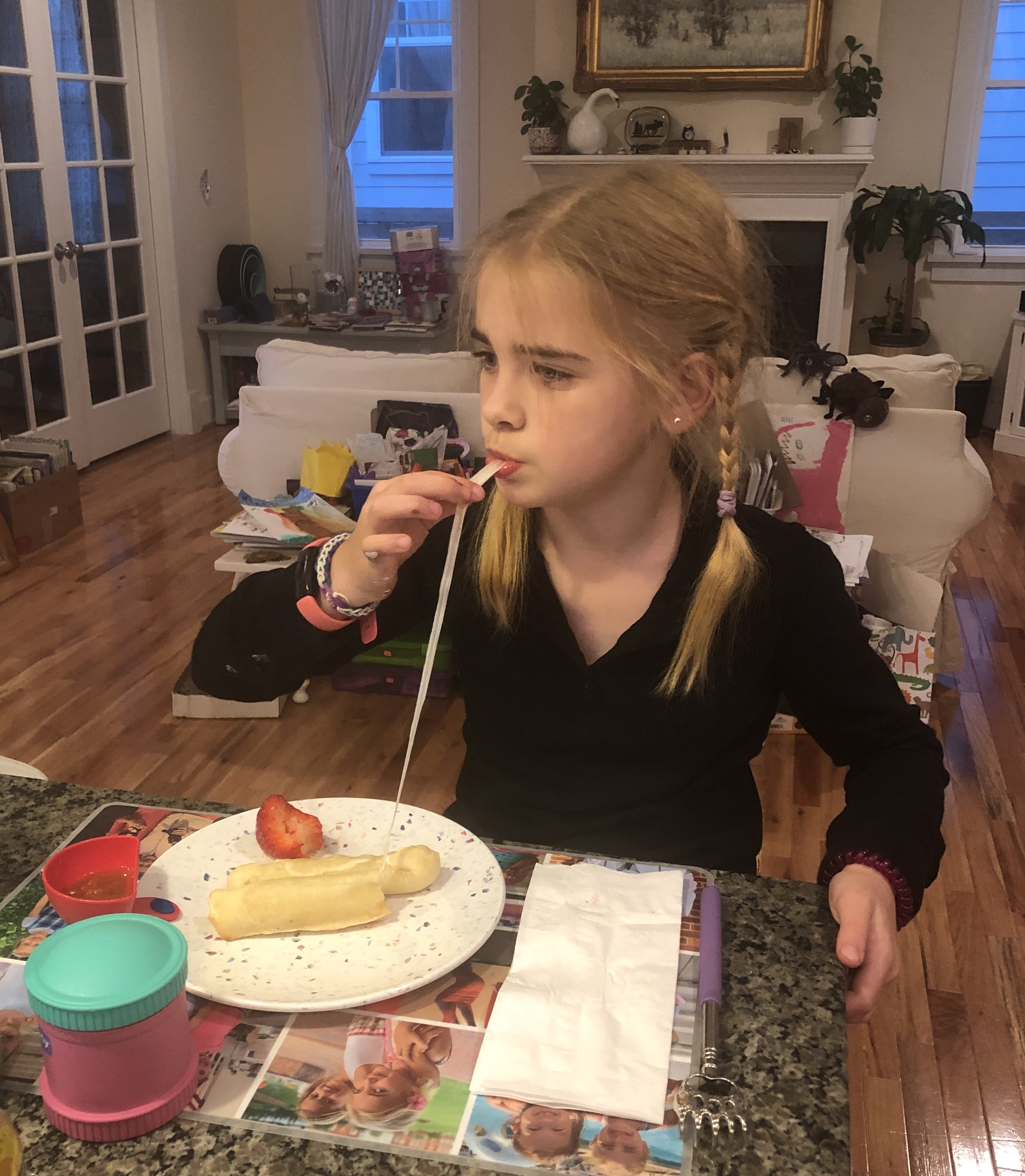
Even the child who likes string cheese least of all, who normally wouldn’t so much as touch a shrink-wrapped tube of mozzarella if she could help it, made quick work of three Ipzza Sticks while rewatching a recording of the 2021 presidential inauguration speech. As Joe Biden said to the nation that day, “Don’t tell me things can’t change.” Right on, Mr. President.
Yes, that’s a backscratcher next to her napkin. No, she doesn’t use it as a fork.
Add to the list of “things they don’t tell you before having children” this conversation:
Arlo: (bopping a red balloon around, just outside of the boundary I set circumscribing the kitchen while I’m making three lunchboxes) “I hope you guys live longer than I do.”
Summerly: “Why?”
Arlo: “Because I like you guys.”
This child LOVES LIFE. I’ve never known anyone to find such pure joy simply from being alive. He lives vibrantly, energetically, so vividly that his life force is practically palpable. Thermodynamics tells us that energy can neither be created nor destroyed, but the way Arlo lives threatens that theorem. The vibrational resonance of his engagement in and appreciation of life is electromagnetic, and the power of his love feels both spiritual and gravitational. I’m convinced that, had he been born in a different place and time, he might have been snatched from my arms to be raised as a shaman or a lama or a mage or an imam. He’s an empath with a sense of compassion so intense that he does things like burst into tears and literally fall to his knees when his sister spilled water on the homemade book she’d finally finished illustrating with markers because he knew how hard she’d worked, how much she cared, how proud she was. His feelings weren’t only for her; they were with her; they were his too. He’s the kid who shares things he loves purely because he derives delight from the experience. People have told me, “He’s so good at sharing,” but that’s not it; he’s just really good at loving.
Upon further discussion, Arlo explicated his wish to be outlived to clarify that, because he loves us and because he loves life, he wants us to live as long as possible. He knows that some of us will outlive others, and he loves so fiercely that he wants to give us the gift of longest life. Mortality is on his mind more frequently than most kids’, I think, because he appreciates being alive so profoundly and with such cognizance that he doesn’t take it for granted, and he’s often talking to me about death, saying that he doesn’t want any of us to die. He told me that if he had one wish, it would be to let everyone on Earth live as long as they want to. That’s some next-level benevolence. And this kid is FIVE.
Can you imagine what it would be like if the world and its infrastructure were designed by adults similarly driven by forces of magnanimity, generosity of spirit, avid goodwill? By a horde of humanitarians hungry for a higher harmonic of existence? Our history books are rife with horror stories and peopled with leaders who suffer from moral bankruptcy, insatiably chasing power and amassing fortune and capitalizing on every opportunity for personal advancement, fueled by fear or narcissism or inferiority complexes, their priorities hijacked by greed or senseless convention. They were born into a world so unfriendly that their recourse was to fight back, and no one ever taught them that a more effective avenue to success, which is to say happiness, is to love back instead.
I hope the future is disturbed and restructured by people like Arlo, people whose sense of selflessness is the opposite of martyrdom, whose munificence is guided by the desire not just to live illuminated by the pilot light of love but to share that kind of life with others. What greater gift can there be than the kind of sustenance that comes from sharing such a clarified, such a rarefied, existence?
In “The Love Song of J. Alfred Prufrock”, Eliot asks, “Do I dare / Disturb the universe?” Arlo dares. Let’s all dare.
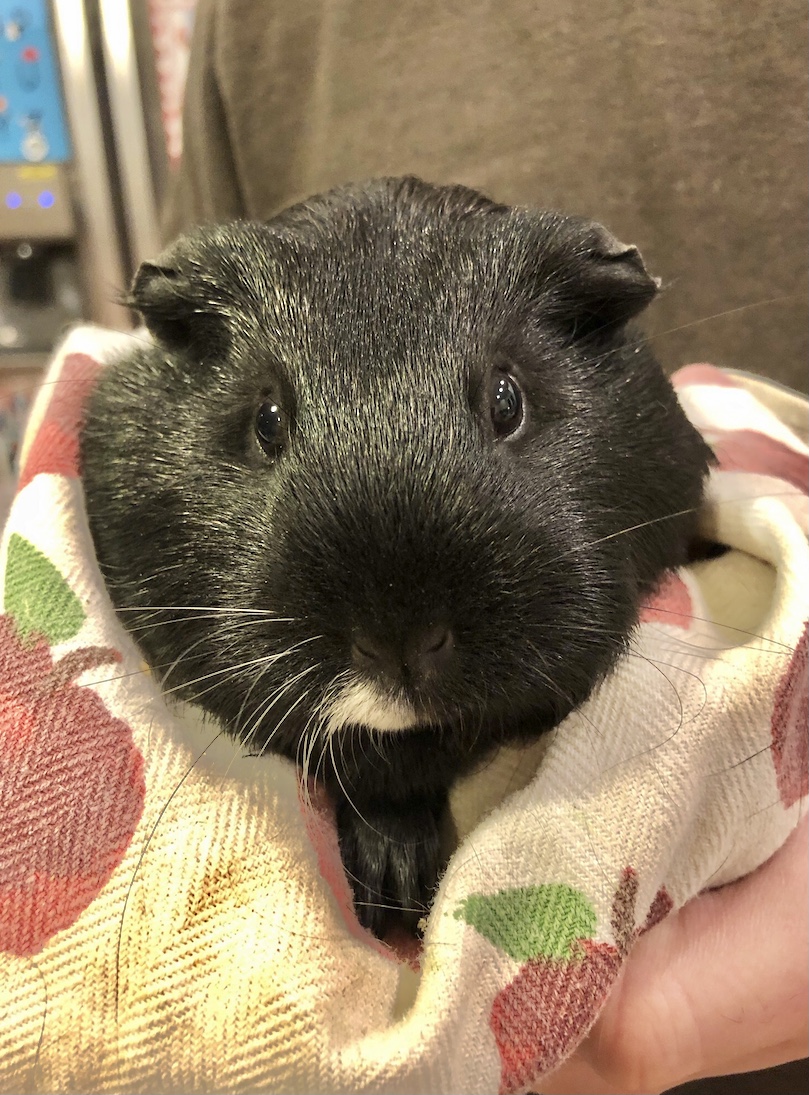
Hi! My name is Paddy Paws. I’m twenty months old and weigh one pound, fourteen ounces. My favorite pastimes are eating hay, eating clover, eating bok choy, eating baby lettuces, eating carrot tops, eating parsley, easting pea shoots, eating carrot peels, and watching tadpoles. I’ll nibble your kitchen mats if you let me too close, but I’m very tame and friendly and communicate well. I used to live in a preschool classroom, but I’ve been on spring break for exactly one year today! It’s pretty great here. I get to sit on the sofa to snack on Romaine and watch Netflix with the kids, and I like to hang out in the backyard, which the humans are trying to convert to a clover lawn. The only thing I’m not wild about is the family’s pet rabbit, who tries to take my food, but if it weren’t for him we wouldn’t have so many fun treats in the house, like timothy biscuits and alfalfa nibblers. In fact, spring break is so much fun I might NEVER LEAVE!
Just as 2020 was circling the drain, a day before the new year dawned, one final aggravation just had to have its way: the washing machine gave up the ghost. It had served us faithfully for a decade, alerting us to its cycle completion with a chirpy little ditty countless times, so the squealing and thumping it emitted that night of December 30th, accompanied by a telltale burning aroma, bore the unmistakeable strains of requiem. We thanked it and, after a moment of silence, transferred the final drum full of clothing to its sturdy sidekick, the dryer.
Our pod family friends immediately offered the use of their unit, which would have been extremely convenient considering that their home is almost a stone’s throw from ours, and my dear friend, Kate, proposed that I mask up and run loads at her beautiful house in Ivy. My mom even volunteered to pick up and do our laundry for us, but I was bound and determined to see this out. Here was my second social experiment: what would it look like and feel like to go without a washing machine for seventeen days? I mean, it’s not like everyone has one. It would be a good exercise to live for a while without. We’ve learned that we can live without so many other things this year, and considering that the ability to launder using an appliance in our own dwelling is a creature comfort afforded only to those considered affluent by worldwide standards, I thought it would be worthwhile as a way to emphasize the appreciation we should recognize for the luxuries we sometimes might forget are luxuries.
I could wash things in the sink if necessary, but I knew we all had enough clothing to go that long without NEEDING to launder. I wanted to showcase this fact, the explicit fact of our privilege, for my kids as a way to show them the excess implicit in a lifestyle as comfortable as ours is. I wanted to test myself, too, and shine some perspective on how fortunate I am to own things like a washing machine and a dishwasher; as much annoyance as chores like laundry and dishes are, they could be a whole lot more arduous to accomplish without the automaticity of Samsung and Whirlpool and Maytag literally at our fingertips. In an admittedly minuscule way, perhaps this process would amplify the wattage of the bulbs in our gratitude lanterns.
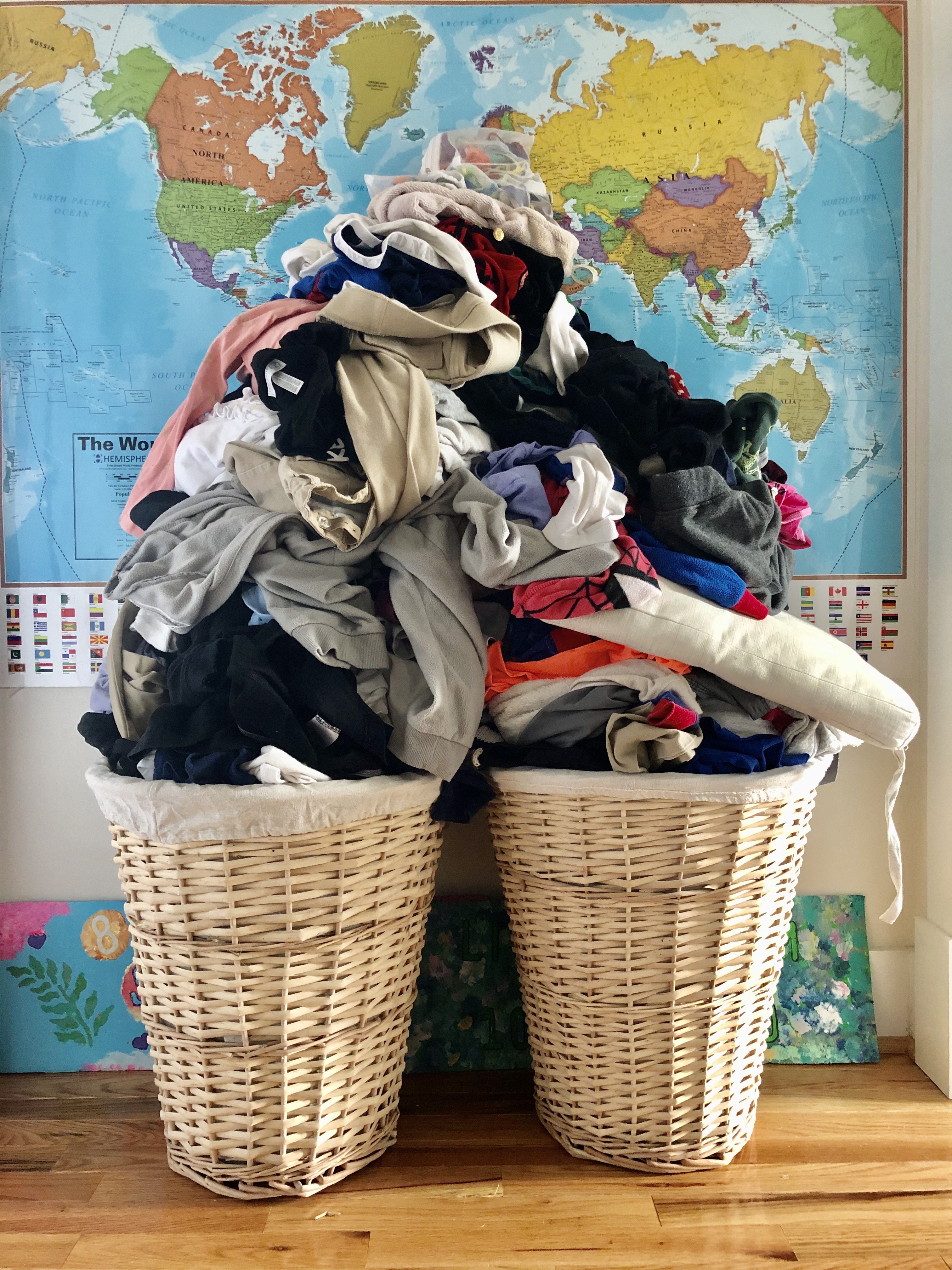
Well, I can show you how a couple of weeks’ worth of laundry stacks up over here:
Not pictured: Brian’s personal basket in his closet
We watched the pile creep up the map, all the way to Scandinavia, topping out with the mesh bags of school masks right there at Rovaniemi, which happens to be the capital of Lapland as well as the “official” home to Santa Claus and a prime location for viewing the aurora borealis, so says Google. This process was most difficult for Liam, who is particular to the point of pedantry when it comes to his clothing, especially as it pertains to which underwear he pairs with which outfit and which day of the week. He likes to have the whole week ahead laid out for himself, frequently fretting over the whereabouts of his Friday underwear when it’s only Monday. He also likes to wear the same things over and over again until I finally draw the line and say, for example, that he must retire any clothing that is size seven or smaller (he’ll be eleven in three months). I wanted to push him out of the conscription of his self-imposed sartorial safety zone, compel him to struggle against his reluctance to try the new clothing hibernating in his drawer, to practice feeling uncomfortable in this short-term, relatively unthreatening way.
And, by jingo, he did it. Because this all began over the winter holiday weeks, he couldn’t even seek solace in the monotony of the school uniform at first. No, this was full-bore NEW SHIRT NEW PANTS, lo, NEW UNDERWEAR territory. He hardly complained that he hadn’t seen his “Monday undies” in a month of Sundays or that he was missing that familiar pinch under the arms that only his outgrown Old Navy crew shirts could provide. He bravely donned that hand-me-down hoodie and even the tie-dyed number he’d previously proclaimed aesthetically objectionable and, dare I say, he rather liked it.
I do declare that I felt a sense of relief when the new washing machine, a ravishing black top-loader with just enough but not too many features, was delivered and installed. But the look on Liam’s face when he put that first load of laundry into the shiny silver basin? Sheer glee.
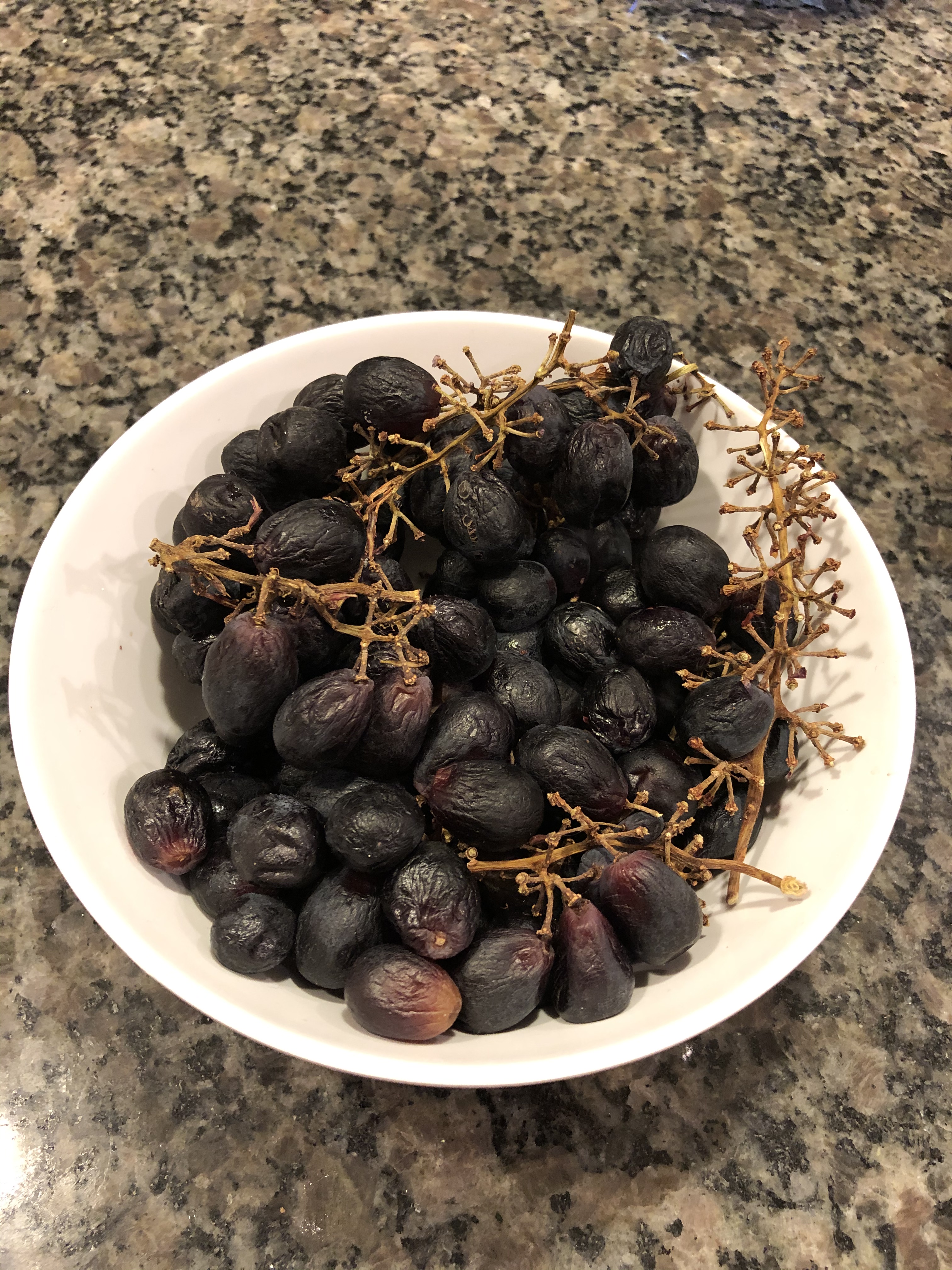
I’m currently running a series of social experiments. The first is called “Bowl of Grapes on the Counter (BoGoC)”.
Fig. 1
They’re sitting in the center of the kitchen island directly in line of sight of all five of us during mealtimes. At the point when Fig. 1 (above) was recorded, the bowl had been in position and untouched for three days. Basically I’m just going to leave them there and see what happens.
Hypothesis: In about two weeks, I’ll be raisin hell.


 Momologica